 Skip to content
Linen Manufacturer for Apparel, Home Textiles & Premium Bags
Engineered Linen Fabrics · Custom Weaves · GRS-Ready Supply Chain
Lovrix develops and supplies high-quality linen fabrics with precise weaving tolerance, stable dyeing performance, and a wide range of finishing options for apparel, home textiles, upholstery, and premium bags. With in-house laboratory testing, advanced weaving partners, and strict control over shrinkage, slub distribution, and shade consistency, we support brand teams with reliable, export-ready linen solutions. Share your weight, weave, performance, and color requirements—we will provide guidance, sampling, and full technical support.
1. Integrated Linen Supply Chain
From European flax sourcing to weaving, dyeing, finishing, and QC, Lovrix manages the entire process to ensure consistent performance and stable availability.
2. Precise Engineering Control
We maintain ±2–3 pick density tolerance, 3–5% shrinkage control, and batch-to-batch ΔE consistency under multi-light testing—ideal for premium markets.
3. Advanced Dyeing & Finishing Options
Reactive/vat dye systems, enzyme softening, calendaring, anti-wrinkle finishing, PU backing, stone-wash textures, and performance upgrades tailored to your application.
4. In-House Testing Laboratory
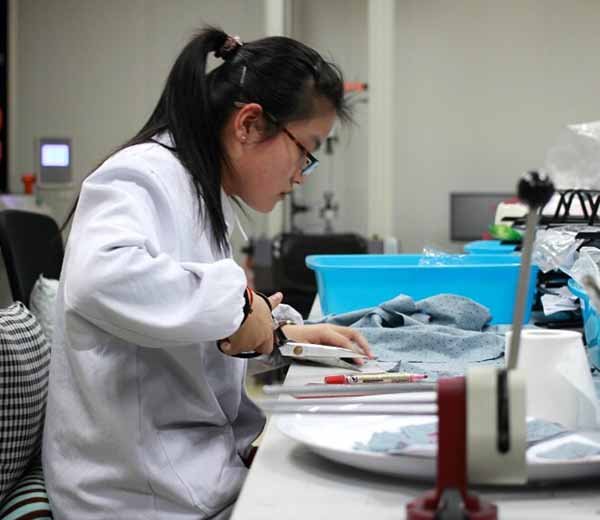
Complete ISO-standard testing: tensile, tear, abrasion, shrinkage, colorfastness, pH and chemical safety—ensuring export-ready reliability.
5. Low MOQ & Fast Development Cycles
5–15m sampling, 300–500m MOQ per color, and 20–30 day bulk lead time suitable for both emerging brands and established product lines.
6. Custom Constructions for Every Category
Apparel linen (120–180 GSM), home textile linen (180–260 GSM), upholstery linen (300–450 GSM), and structured bag linen (220–350 GSM) engineered according to brand requirements.
Understanding Buyer Challenges When Sourcing Linen
Linen sourcing involves agricultural variability, yarn engineering challenges, shade instability, and finishing complexity.
1. Seasonal Fiber Variability & Unpredictable Fineness
Linen depends heavily on crop conditions. Flax fibers differ by:
- rainfall level
- retting duration
- humidity during harvest
- soil mineral composition
- microbial activity during dew retting
This impacts:
- yarn evenness
- slub thickness
- weaving stability
- tensile strength
Lovrix Approach: We source from fixed flax farms with stable soil conditions and run fiber fineness, fiber-length distribution, and impurity-removal assessments before spinning.
2. High Shrinkage Rates Without Professional Finishing
Raw linen can shrink 5–12% depending on yarn twist, fabric density, and dye-bath temperature. Most “cheap linen suppliers” skip dimensional stabilization.
Consequences:
- garment panels distort
- home textile items lose fit
- bag panels misalign
- post-wash wrinkling increases
Lovrix Control System: Sanforization + moisture-setting + calibrated tumble-dry cycles = controlled shrinkage ≤3–5%.
3. Shade Variation & Poor Dye Absorption
Linen’s natural porosity and irregular fiber surfaces make dye penetration uneven. Dye baths create unpredictable ΔE variations if not controlled.
Typical unprofessional mills show:
- ΔE 4–7 between rolls
- inconsistent brightness
- panel mismatching
Lovrix Solution: We run multi-stage pre-treatment (enzyme wash + scouring), reactive dye stabilization, and Datacolor matching to maintain ΔE < 2.0–2.5.
4. Unstable Slub Patterns & Surface Roughness
Slubs define linen’s beauty, but uncontrolled slubs look defective. Common reasons:
- uneven fiber thickness
- low-quality spinning
- unstable warp tension
- wrong loom speed
Lovrix Engineering: We calibrate warp beam tension and weft insertion speed to produce controlled, patterned slubs – not random rough patches.
5. Tear Weakness & Low Mechanical Strength in Lightweight Linen
Fine linen wears elegantly but can tear at stress points. Low twist yarn + low pick density = weak tear resistance.
Lovrix Reinforcement Options:
- higher pick density
- linen-cotton blends for strength
- twill or basket weave for better load distribution
- anti-tear finishing where needed
6. Difficult Compliance for International Markets
Apparel and home textile markets require:
- OEKO-TEX
- REACH / SVHC
- low-formaldehyde finishing
- anti-odor or anti-mildew options
Many linen suppliers cannot meet these standards consistently.
Lovrix Guarantee: We use compliant finishing chemicals across all linen lines and provide batch-level reports for export markets such as EU, USA, and Japan.
Why Choosing the Right Linen Manufacturer Matters
The right linen manufacturer is not defined by price but by engineering capability—fiber sourcing, retting quality, yarn uniformity, weaving tension, dye chemistry, and finishing stability.
Fiber Sourcing & Retting Quality Define the Foundation
Flax fibers differ drastically in cellulose content, lignin levels, softness, and impurity ratios. Retted fibers with uneven microbial breakdown produce inconsistent texture and dye behavior.
Lovrix ensures:
- stable flax regions
- controlled retting partners
- impurity removal standards
- fiber-length analysis per batch
This eliminates rough/soft inconsistencies common in unstable supply chains.
arn Engineering Determines Slub Pattern, Hand-Feel & Strength
Linen yarn requires precise twist and evenness:
- lower twist → softer, more breathable
- higher twist → stronger but stiffer
- uneven twist → rough texture & yarn breakage
Lovrix optimizes yarn count and twist ratio based on application:
- Nm 10–20 → heavy upholstery
- Nm 20–40 → apparel linen
- Nm 40–60 → fine shirting
Loom Calibration Directly Controls Surface Aesthetics
Weaving linen is far more sensitive to tension and humidity than cotton or synthetics. Incorrect loom parameters cause:
- streaks
- slippage
- broken warp ends
- random thick slubs
Lovrix’s multi-factory weaving network uses digital tension monitoring and humidity-controlled weaving halls for consistent fabric structure.
Linen Dyeing Requires Special Chemistry & Careful Temperature Profiles
Linen dyes best after pre-treatment:
- desizing
- scouring
- enzyme washing
- controlled pH
Lovrix applies:
- temperature curve programming
- controlled dye-liquor ratios
- anti-crease agents
- reactive dyes tuned for natural fibers
This ensures uniform penetration and superior wash fastness.
Finishing Determines Final Performance (Shrinkage, Wrinkle Recovery, Softness)
The same linen fabric can feel rough and stiff or soft and premium depending on finishing.
Lovrix offers:
- enzyme softening
- calendaring
- sanforization
- anti-wrinkle finishing
- stone-wash simulation
- moisture-setting
Each finish is customized to the buyer’s target market.
Long-Term Program Stability Depends on Multi-Factory Capability
Many linen suppliers rely on seasonal, single-source weaving operations. This leads to:
- unpredictable timelines
- inconsistent shading
- unstable supply capacity
- production pauses during peak seasons
Lovrix Advantage: Multiple weaving facilities + dedicated finishing lines = stable output all year, supporting 2–5 year product programs.
Key Factors to Consider When Developing Linen
Choosing a linen fabric is not simply selecting weight or color. Linen behaves differently from cotton, polyester, or rayon. Its performance depends on agricultural characteristics, mechanical processes, and chemical processes—all of which must be precisely engineered.
Flax Fiber Grade (Fiber Length, Fineness, Retting Quality)
The foundational determinant of linen fabric quality. Influences: slub structure, softness, tensile strength, dye absorption.
Key variables Lovrix tests:
- average fiber length
- fineness (micronaire equivalent)
- impurity content
- retting uniformity
- cellulose vs lignin ratio
Poor-quality fibers → harsh handfeel, inconsistent dyeing, excessive slub defects.
Yarn Count, Twist Ratio & Evenness
Yarn defines the character of every linen fabric.
Ranges Lovrix commonly uses:
- Nm 10–20: heavy, upholstery-grade
- Nm 20–40: apparel & home textile
- Nm 40–60+: premium shirting, luxury linen
Lovrix controls:
- twist multiplier
- yarn evenness (Uster testing)
- hairiness index
- slub frequency & thickness
High-quality yarn = stable slub, premium texture.
Weave Structure & Pick Density Engineering
Weaving determines visual feel, durability, and GSM.
Lovrix engineers:
- plain weave for breathable textiles
- twill weave for strength and drape
- herringbone for upscale home linens
- basket weave for bags & upholstery
We also calibrate:
- warp tension
- pick density
- loom speed
- humidity environment
Unstable weaving → streaks, broken warp ends, fabric slippage.
GSM Targeting & Weight Management
Linen GSM changes with finishing, moisture, and calendering.
Lovrix sets precise GSM ranges:
- lightweight apparel: 120–160 GSM
- midweight apparel/stoles: 160–220 GSM
- table linens: 180–260 GSM
- upholstery: 280–450 GSM
We control GSM within ±5–8%, preventing weight fluctuation across batches.
Dyeing Chemistry & Color-Stability Curve
Linen requires specialized reactive or vat-dye systems.
Lovrix controls:
- scouring & enzyme treatment
- bleaching (if needed)
- anti-crease chemistry
- dye curve (temperature & time)
- pH level
- electrolytes for shade depth
- fixation rate
Our ΔE color tolerance: <2.0–2.5.
Shrinkage Control & Dimensional Stability
Raw linen shrinks heavily due to fiber swelling.
Lovrix employs:
- sanforization
- moisture-setting
- tumble stabilization
- controlled heat-setting
- mechanical compression finishing
Shrinkage target: ≤3–5%, suitable for apparel and home textiles.
Finishing Options (Softness, Wrinkle Resistance, Handfeel)
Finishing dramatically changes fabric perception.
Lovrix offers:
- enzyme softening
- peaching
- calendaring
- anti-wrinkle finishing
- soft-wash / stone-wash simulation
- anti-microbial & anti-mildew finishing
Handfeel can be tailored from crisp & structured → soft & relaxed.
Mechanical Performance (Tensile & Tear Strength)
Linen’s natural stiffness means tear control is critical.
Lovrix performs:
- tensile strength tests
- tear resistance tests
- abrasion testing (Martindale)
We adjust yarn count, weave, and finishing to meet:
- tensile: 300–800 N depending on GSM
- tear: 8–20 N depending on weave
Moisture Absorption, Airflow & Comfort Testing
Linen’s selling point is breathability—this must be engineered.
Lovrix conducts:
- moisture-wicking testing
- evaporation-rate testing
- temperature-regulation evaluation
We optimize yarn twist & weave to maximize comfort.
Compliance & Chemical Safety
Essential for export markets.
Lovrix provides:
- OEKO-TEX Standard 100 Class I
- REACH compliance
- zero-formaldehyde finishing options
- anti-odor & anti-bacterial options
This enables safe application in apparel, bedding, and children’s textiles.

Lovrix’s Professional Linen Development Method
Below is the full Lovrix Linen Engineering Workflow—a highly structured OEM process designed for international brands, home furnishing brands, designer brands, and buying teams.
STEP 1
Technical Requirement Discovery
Lovrix gathers:
- intended product category
- target GSM
- preferred texture & slub character
- Pantone colors
- shrinkage requirements
- finishing preferences
- compliance needs
- expected order volume
We produce a technical outline for your linen, not just a fabric swatch.
STEP 2
Fiber Grade Selection & Partner-Mill Sourcing
We match project requirements with:
- specific flax farm regions
- retting method (dew vs water-retted)
- fiber grade (length, fineness, impurity content)
Lovrix maintains fixed partnerships for stable fiber quality.
STEP 3
Yarn Count Engineering & Slub Pattern Calibration
We customize:
- yarn count (Nm 10–60)
- twist multiplier
- evenness
- slub frequency & thickness
Combined with customer vision (premium, rustic, smooth, or textured).
STEP 4
Weaving Construction Development
Based on usage, Lovrix recommends:
- plain weave (breathability)
- twill (strength & drape)
- herringbone (premium home textile)
- basket weave (bags & upholstery)
- jacquard linen (high-end décor)
We calibrate tension, picks, and loom speed to stabilize structure.
STEP 5
Dyeing & Color Engineering
Includes:
- enzyme pre-treatment
- reactive dyeing
- temperature curve control
- anti-crease agents
- dye bath finishing & fixation
We perform ΔE testing under D65, TL84 & UV light.
STEP 6
Finishing & Functional Enhancement
We apply:
- softening enzymes
- calendaring
- sanforization
- anti-wrinkle finishing
- antimicrobial/anti-odor
- stone-wash simulation
Handfeel and performance are tailored per market.
STEP 7
Laboratory Testing (In-House QC)
Lovrix performs:
- tensile & tear test
- abrasion test
- shrinkage test
- washing fastness
- colorfastness
- dimensional inspection
Every roll comes with QC documentation.
STEP 8
Bulk Production & Long-Term Supply Stability
Thanks to multi-factory weaving capacity, Lovrix ensures:
- fast scheduling
- predictable lead times
- consistent dyeing
- stable finishing
- multi-season repeatability
- yarn-batch locking
Perfect for brands with evergreen collections.

Linen Types & Technical Specification Guide
Linen fabrics come in a wide variety of types, including linen for clothing, home textiles, decorative fabrics, blended fabrics, and fabrics with special weaves. Below are the complete technical specifications, including weight, yarn count, weave, and recommended uses.
Full Linen Specification Table (Lovrix Standard)
| Linen Type | Yarn Count | GSM Range | Weave | Key Features | Recommended Applications |
|---|---|---|---|---|---|
| Lightweight Apparel Linen | Nm 40–60 | 120–160 GSM | Plain / Fine Twill | breathable, soft, refined slub | shirts, blouses, dresses |
| Midweight Clothing Linen | Nm 30–40 | 160–220 GSM | Plain / Twill | structure + comfort | skirts, trousers, summer jackets |
| Home Textile Linen | Nm 20–40 | 180–260 GSM | Plain / Herringbone | soft drape, good dyeing | tablecloths, curtains, napkins |
| Upholstery Linen | Nm 10–20 | 280–450 GSM | Basket / Twill | heavy, durable, structured | sofas, cushions, décor panels |
| Linen-Cotton Blend | Nm 20–40 | 140–260 GSM | Plain / Twill | softer, lower shrinkage | apparel, bedding |
| Linen-Viscose Blend | Nm 30–50 | 140–200 GSM | Plain / Twill | drapey, smooth | dresses, scarves |
| Jacquard Linen | Nm 20–40 | 200–350 GSM | Jacquard | premium patterns | high-end décor |
| Stone-Washed Linen | Nm 20–40 | 180–260 GSM | Plain / Twill | soft, vintage look | apparel & home textiles |
Linen Finishing & Chemical Treatments Explained
Finishing transforms raw woven linen—which is naturally stiff, uneven in hand-feel, and prone to shrinkage—into a refined, functional, and market-ready textile. Unlike synthetics, linen requires multi-stage mechanical and chemical treatments to achieve stable performance and pleasant usability.

Enzyme Softening Treatment
Linen fibers contain residual pectin and lignin, which create rough hand-feel. Lovrix uses cellulase and pectinase enzyme systems to:
- break down micro-roughness
- soften fiber surfaces
- improve drape
- reduce harshness without damaging strength
This method creates a luxurious, breathable softness ideal for apparel and home textiles.

Calendaring (Surface Compression Finishing)
A mechanical process using heated rollers to compress the fabric. Lovrix uses calendaring to:
- improve surface uniformity
- increase sheen (optional)
- stabilize thickness
- enhance hand-feel
- reduce surface hairiness
Used for: table linens, premium clothing linen, decorative fabrics.

Sanforization (Shrinkage Stabilization)
One of the most critical finishing processes for linen. Raw linen shrinks significantly after washing.
Lovrix uses sanforization to control shrinkage to ≤3–5%:
- fabric is pre-moistened
- compressed against a rubber belt
- stabilized under controlled heat & pressure
This ensures consistent sizing for apparel, bedding, and table linens.

Wrinkle-Resistant Finishing
Linen naturally wrinkles because of its low elasticity.
Lovrix reduces wrinkle intensity through:
- cross-linking finishing chemistry
- mechanical softening
- heat-setting cycles
- moisture-regain control
Outcome: improved wrinkle recovery without compromising linen’s natural look.

Stone-Wash & Vintage-Wash Simulation
Widely used in lifestyle apparel, premium bedding, and boutique décor.
Lovrix replicates “washed & lived-in” textures through:
- enzyme-based micro-abrasion
- low-stone simulation
- mechanical tumbling
- sand-wash finishing
This retains breathability while giving a modern relaxed look.

Anti-mildew & Anti-bacterial Finishing
Essential for humid markets, bedding, and long-term storage textiles.
Lovrix applies:
- anti-fungal agents
- silver-ion anti-bacterial finishing (optional)
- moisture-management finishes
Applications: bedding, curtains, home storage, kids’ textiles.

Anti-odor / pH-Control Finishing
Some apparel brands require odor-control properties.
Lovrix offers:
- anti-microbial odor suppression
- pH-balanced finishing
- low-VOC chemical systems
Ideal for: activewear-inspired linen apparel, premium shirts.

Flame-Retardant Linen Finishing (Optional)
For hospitality textiles or public spaces.
Lovrix uses FR finishing compliant with:
- NFPA 701
- BS 5867
- EN 13772
Used for curtains, upholstery, hotel décor.

Coated Linen (PU / Acrylic / Waterproof)
When linen is used for bags, accessories, or upholstery, the fabric may require a surface coating.
Lovrix offers:
- PU coating for structure
- acrylic coating for stain resistance
- water-resistant finishing for functional linen
Perfect for bags, table linens, aprons, covers.
Application-Based Linen Development Guide
Different industries require different linen constructions, GSM, finishing systems, and mechanical properties. This module shows how Lovrix engineers linen fabrics tailored to apparel, home textiles, upholstery, accessories, and lifestyle products.

Apparel Linen (Shirts, Dresses, Pants, Summer Suits)
Target GSM: 120–220
Key Requirements: softness, breathability, drape, shrinkage control.
Lovrix focus areas:
- yarn count Nm 30–60
- enzyme softening
- wrinkle-resistant finishing
- sanforization
- yarn evenness to avoid rough patches
- fine plain weave or lightweight twill
Used by designer brands, resort wear brands, boutique apparel labels.

Home Textile Linen (Curtains, Tablecloths, Napkins, Bedding)
Target GSM: 160–260
Key Requirements: colorfastness, drape, shrinkage stability, hand-feel.
Lovrix solutions:
- bleaching for pure whites
- calendaring for elegant drape
- anti-mildew finishing
- softening for bedding-grade comfort
- herringbone weave for a premium surface
Ideal for retailers, hospitality suppliers, and décor studios.

Upholstery Linen (Cushions, Sofas, Decorative Panels)
Target GSM: 280–450
Key Requirements: strength, abrasion resistance, stain resistance.
Lovrix recommendations:
- yarn count Nm 10–20
- basket weave for robustness
- PU/acrylic coating for stain resistance
- anti-pilling finishing
- abrasion tests (Martindale > 20,000 cycles)
Often used by furniture brands and interior design companies.

Bags, Totes & Lifestyle Accessories
Target GSM: 200–350
Key Requirements: structure, rigidity, durability.
Lovrix engineering:
- canvas-like linen structures
- reinforced pick density
- optional PU backing
- moisture control & anti-odor finishing
- controlled slub pattern for aesthetic consistency
Popular in eco-lifestyle brands, handmade bag brands, and retail chains.

Craft, Décor & Boutique Linen Products
Examples: wall décor, placemats, artisanal goods.
Lovrix approach:
- midweight linen 180–260 GSM
- enhanced slub texture
- enzyme-soft finish
- colorfastness improvement for vivid pastel shades

Linen Blends (Cotton-Linen, Viscose-Linen, Polyester-Linen)
Suitable for brands wanting:
- lower cost
- reduced shrinkage
- increased softness
- improved wrinkle control
Lovrix develops blend ratios:
- 55% linen / 45% cotton
- 70% linen / 30% viscose
- 50% linen / 50% polyester
Each blend has its own weave and finishing logic.
Challenges & Risk Points in Linen Projects + How Lovrix Solves Them
Linen projects often fail due to fiber inconsistency, dye instability, shrinkage, coarse texture, and poor slub control. Below are the 8 major risks that frequently lead to failed linen projects—and Lovrix’s corresponding solutions.
Seasonal Fiber Variation → Inconsistent Texture
Risk: Different harvest batches create rough/soft inconsistencies.
Lovrix Solution:
- fiber-grade sorting
- fixed flax sourcing regions
- fiber-length & fineness tests per batch
High Shrinkage After Consumer Washing
Risk: Raw linen shrinks unpredictably.
Lovrix Solution:
- sanforization
- moisture-setting
- dimensional testing
- shrinkage controlled to ≤3–5%
Shade Variation Between Rolls
Risk: Dye unevenness due to linen’s natural porosity.
Lovrix Solution:
- enzyme scouring
- controlled reactive dye curves
- ΔE < 2.0–2.5 tolerance
- 3-point lightbox testing
Excessive or Random Slub Distribution
Risk: Cheap spinning → uncontrolled slubs → inconsistent appearance.
Lovrix Solution:
- yarn evenness tests
- slub-frequency calibration
- loom tension control
Poor Handfeel & Roughness
Risk: Natural stiffness without proper finishing.
Lovrix Solution:
- enzyme softening
- calendaring
- moisture-conditioning
Low Tear Strength in Lightweight Linen
Risk: Insufficient pick density or yarn twist.
Lovrix Solution:
- reinforced twill options
- optimized pick/warp tension
- fiber-quality enhancement
Slow Lead Times During Peak Harvest Season
Risk: Single-factory suppliers cannot stabilize output.
Lovrix Solution:
- multi-factory weaving network
- stable scheduling
- parallel production planning
Compliance Failure in Restricted Markets
Risk: Chemicals exceeding REACH/OEKO-TEX limits.
Lovrix Solution:
- certified chemical systems
- compliant finishing lines
- batch-level compliance reports
Linen Testing Standards & QC Parameters
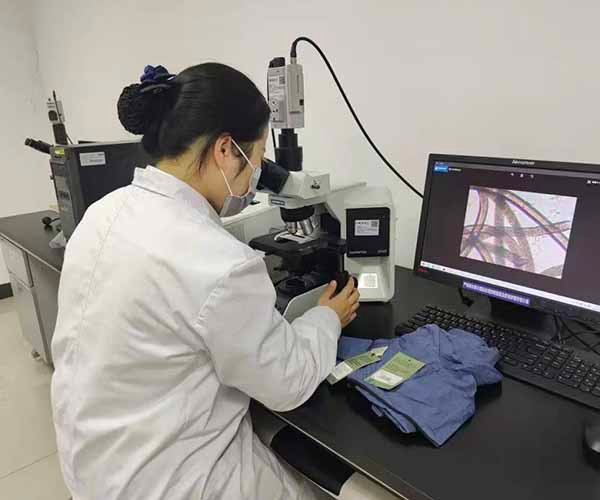
Linen fabrics require stricter QC than cotton or polyester because they react more strongly to humidity, temperature, dye chemistry, and mechanical handling. Lovrix maintains a complete internal textile testing lab in Dongguan + partnered labs in Jiangsu for advanced compliance.
1. Tensile Strength Test (ISO 13934-1)
Purpose: Ensures linen can withstand pulling forces without breaking. Lovrix Targets:
- Lightweight linen: 300–500 N
- Midweight linen: 400–600 N
- Upholstery linen: 600–900 N
Tensile performance is directly tied to yarn twist, pick density, and fiber grade.
2. Tear Strength Test (ISO 13937-2)
Linen tears easily when improperly woven. Lovrix Targets:
- Apparel linen: 8–15 N
- Home textile linen: 10–16 N
- Upholstery linen: 15–20 N
We reinforce tear strength using twill/basket weaves and optimized yarn twist.
3. Abrasion Resistance (Martindale ISO 12947)
Critical for upholstery and bag applications. Lovrix Targets:
- Apparel: ≥ 6,000 cycles
- Home textiles: ≥ 10,000 cycles
- Upholstery: 20,000–40,000 cycles
Abrasion is improved through tighter weaving and finishing.
4. Dimensional Stability / Shrinkage Test (ISO 5077)
One of the most critical linen parameters. Lovrix Shrinkage Target:
- Warp/Weft shrinkage: ≤3–5%
Sanforization + moisture-setting are essential.
5. Colorfastness to Washing (ISO 105-C06)
Linen may lose shade if not properly dyed. Lovrix Target: Grade 4–5
We use controlled reactive dye curves.
6. Colorfastness to Rubbing (ISO 105-X12)
Important for apparel & bags. Lovrix Target:
- Dry rubbing: Grade 4–5
- Wet rubbing: Grade 3–4
Achieved via dye fixation and enzyme scouring.
7. Colorfastness to Light (ISO 105-B02)
Curtains and décor need UV stability. Lovrix Target: Grade 4–5
We stabilize with UV-absorber finishing when required.
8. PH Value Testing (Skin Contact Safety)
Apparel textiles require a balanced pH. Lovrix Target pH: 6.0–8.0
Ensures skin comfort and regulatory compliance.
9. Formaldehyde Content Test (ISO 14184-1)
Required for children’s linens, bedding, apparel. Lovrix Target: ≤20 mg/kg (OEKO-TEX Class I)
We use low-VOC, low-formaldehyde finishing.
10. Chemical Safety Testing (REACH / SVHC / OEKO-TEX)
Lovrix conducts chemical compliance checks for:
- banned azo dyes
- heavy metals
- allergenic dispersants
- phthalates (for coated linen)
- residual chemical agents after finishing
This makes Lovrix suitable for premium export markets.

Full Technical Specification Matrix (Ultra-Detailed Tables)
This matrix offers a complete breakdown of linen constructions, GSM, yarn counts, weave types, mechanical performance, dye behavior and end-use suitability. It is the most important module for designers and sourcing managers.
Below are the most detailed linen specification tables used by Lovrix’s textile engineering team when building new projects.
1. Linen Construction Matrix (By GSM & Application)
| Category | GSM Range | Yarn Count | Weave | Key Characteristics | End Uses |
|---|---|---|---|---|---|
| Lightweight Apparel Linen | 120–160 | Nm 40–60 | Plain / Fine Twill | breathable, refined slubs, soft drape | shirts, dresses |
| Midweight Apparel Linen | 160–220 | Nm 30–40 | Plain / Twill | good structure, comfort | pants, skirts |
| Home Textile Linen | 180–260 | Nm 25–40 | Plain / Herringbone | color stability, drape | curtains, table textiles |
| Premium Table Linen | 180–240 | Nm 30–50 | Plain / Satin | elegant sheen, soft touch | hotels, restaurants |
| Upholstery Linen | 280–450 | Nm 10–25 | Basket / Twill | strength, abrasion resistance | sofas, cushions |
| Bag & Accessory Linen | 200–350 | Nm 20–40 | Canvas / Plain | structure, durability | totes, pouches |
| Linen Blends | 140–260 | Multiple | Plain / Twill | softer, lower shrinkage | apparel, bedding |
2. Mechanical Performance Matrix
| Linen Type | Tensile Strength (N) | Tear Strength (N) | Abrasion (Cycles) | Shrinkage (%) | Fastness (Wash) |
|---|---|---|---|---|---|
| Lightweight Apparel | 300–500 | 8–12 | 6,000–10,000 | 3–5 | Grade 4–5 |
| Midweight Apparel | 400–600 | 10–14 | 8,000–12,000 | 3–5 | Grade 4–5 |
| Home Textile Linen | 450–650 | 12–16 | 10,000–20,000 | 3–4 | Grade 4–5 |
| Upholstery Linen | 600–900 | 15–20 | 20,000–40,000 | 2–4 | Grade 4–5 |
| Bags/Accessories | 450–750 | 12–18 | 12,000–25,000 | 2–4 | Grade 4–5 |
3. Dye Behavior Matrix
| Linen Category | Dye Type | Shade Accuracy | Lightfastness | Notes |
|---|---|---|---|---|
| White Linen | Oxygen bleach | High | High | Used for hotel textiles |
| Colored Apparel Linen | Reactive dyes | Excellent | Medium | Needs softening |
| Deep Colors | Vat dyes | Excellent | High | Rich tones, stable |
| Premium Linen | Natural dyes | Moderate | Low–Medium | Boutique brands |
| Printed Linen | Pigment & rotary | Excellent | Medium | Requires stable base fabric |

4. Finishing Options Matrix
| Finish Type | Performance | Best For |
|---|---|---|
| Enzyme Softening | Softness + drape | Apparel / bedding |
| Calendaring | Smoothness + sheen | Table linens |
| Sanforization | Shrinkage stability | Apparel / home textiles |
| Anti-Wrinkle | Wrinkle recovery | Apparel |
| Stone-Wash | Vintage texture | Lifestyle brands |
| PU Coating | Stain resistance + structure | Bags / upholstery |

Linen Case Studies
Real-world engineering cases show how Lovrix solves linen challenges—shade inconsistency, shrinkage, roughness, slub instability, dye failure, and performance issues—across apparel, home textiles, bags, upholstery, and lifestyle markets.
Case Study 1 — Ultra-Soft 150 GSM Apparel Linen for a Japanese Minimalist Brand
Background:
The brand needed a lightweight, breathable, soft linen for summer shirts and dresses, targeting premium retail stores in Tokyo and Osaka.
Challenges:
- Fabric felt too stiff and coarse
- Shrinkage exceeded 6.2%
- Shade variation visible between left/right panels after stitching
Technical Diagnosis by Lovrix:
- Yarn twist multiplier too high
- Insufficient enzyme scouring
- Dye bath temperature curve fluctuated ±2°C
- Slub pattern density inconsistent
Lovrix Engineering Actions:
- Reduced yarn twist to achieve softer drape
- Introduced dual enzyme scouring + softening
- Shifted to a controlled reactive dye curve with ±0.5°C stability
- Recalibrated slub distribution uniformity per 10 cm
Result:
- Hand-feel softness improved >35%
- Shrinkage reduced to 3.2%
- Shade deviation lowered from ΔE 4.2 → ΔE 1.4
- Bulk order expanded from 3 to 7 colors


Case Study 2 — High-Shade-Consistency Linen Curtains for a European Home Textile Brand
Background:
A European brand required 200–240 GSM linen curtains with strict color accuracy for 12 retail stores.
Challenges:
- Large ΔE difference (4.5) between batches
- Fabric exhibited streaking under warm lighting
- Width variation exceeded ±2.5 cm
Lovrix Technical Diagnosis:
- Dye bath lacked temperature control
- Scouring too short → absorbency uneven
- Tension imbalance during weaving
Lovrix Engineering Actions:
- Introduced enzyme pre-scouring for uniform absorbency
- Stabilized dye bath with computerized temperature controllers
- Adjusted loom tension to improve width consistency
- Added multi-light testing (D65 / TL84 / UV)
Result:
- Shade deviation tightened to ΔE < 1.8
- Width tolerance controlled at ±1.2 cm
- Zero streaking under warm light
- Brand added 4 new seasonal shades based on success
Case Study 3 — 380 GSM Upholstery Linen for a US Furniture Manufacturer
Background:
A major US furniture OEM needed abrasion-resistant, high-strength linen for sofas and ottomans.
Challenges:
- Martindale abrasion < 12,000 cycles
- Fabric stretched under upholstery tension
- Slub pattern too irregular for premium look
Lovrix Technical Diagnosis:
- Pick density too low for durability
- Basket weave structure insufficient
- No stabilizing backing applied
Lovrix Engineering Actions:
- Increased pick density by 12%
- Converted weave from fine plain → reinforced basket weave
- Added PU/acrylic backing for dimensional stability
- Adjusted warp beam tension for slub regularity
Result:
- Abrasion increased to 28,500 cycles
- Dimensional stretch dropped by 40%
- Ultra-stable upholstery linen ideal for heavy use
- Supplier signed 12-month framework contract with Lovrix


Case Study 4 — Structured Linen for Lifestyle Tote Bags (US DTC Brand)
Background:
A US direct-to-consumer brand wanted premium, textured linen tote bags retaining structure without synthetic look.
Challenges:
- Fabric too “soft” and collapsed after sewing
- GSM too low (210 GSM)
- Ink penetration uneven during printing
Lovrix Technical Diagnosis:
- Insufficient body due to low density
- No backing to hold shape
- Pre-treatment chemistry incompatible with pigment inks
Lovrix Engineering Actions:
- Upgraded fabric to 260–300 GSM canvas weave
- Applied PU backing for structure
- Re-engineered pre-treatment for pigment printing
- Improved slub uniformity for a luxury feel
Result:
- Tote retained shape after 10kg load test
- Printing became sharper with 22% higher color density
- Product became the brand’s best-selling SKU
Case Study 5 — Pure White Table Linen for Luxury Hotels (Middle East)
Background:
Hotel chains required bright, pure-white table linens with zero yellow tint and high durability.
Challenges:
- Achieving stable whiteness index
- Maintaining texture after bleaching
- Ensuring high washing fastness
Lovrix Technical Diagnosis:
- Inconsistent bleaching curve
- Fabric over-dried → harsh hand-feel
- Inadequate finishing after bleach
Lovrix Engineering Actions:
- Introduced oxygen bleaching with controlled whiteness index
- Added softening + moisture-setting after bleaching
- Performed washing-fastness testing at Lovrix lab
Result:
- ΔWI (whiteness index) variation <1.2
- Washing fastness: Grade 4–5
- Softness increased 28% compared to competitor fabrics


Case Study 6 — Linen-Viscose Blend Bedding for a Nordic Home Brand
Background:
Nordic brand needed washable, soft, low-shrinkage linen bedding with elegant drape.
Challenges:
- 100% linen too stiff
- Shrinkage unacceptable at 7–9%
- Bedding wrinkled excessively
Lovrix Technical Diagnosis:
- Pure linen fiber behavior unsuitable
- Finishing chemistry not optimized
Lovrix Engineering Actions:
- Engineered 70% linen / 30% viscose blend
- Applied softening + moisture-setting to reduce shrinkage
- Adjusted weave for smoother drape
Result:
- Shrinkage reduced to 2.8%
- Drape improved by 35%
- Fabric gained premium hand-feel suitable for Nordic aesthetics
Case Study 7 — UV-Resistant Linen for Desert Climates (UAE Décor Brand)
Background:
Brand required high lightfastness linen for sun-exposed curtains in desert markets.
Challenges:
- Strong fading under UV
- Deep tones washed out after weeks
- Reactive dyes not holding
Lovrix Technical Diagnosis:
- UV exposure too high for standard dyes
- Need deeper fixation + stable finishing
Lovrix Engineering Actions:
- Added UV-absorbing finishing layer
- Switched reactive dye → vat dye system for deeper tones
- Strengthened fixation time & temperature
Result:
- Lightfastness upgraded to Grade 5
- 3× longer color retention
- Client adopted Lovrix fabric for all premium collections


Case Study 8 — Vintage-Washed Linen for Boutique Design Studio
Background:
A boutique studio wanted stone-washed linen with vintage character but no fiber damage.
Challenges:
- Stone-wash broke fibers
- Uneven abrasion patterns
- Softness inconsistent
Lovrix Technical Diagnosis:
Physical abrasion too aggressive.
Lovrix Engineering Actions:
- Replaced stone-wash with enzyme wash simulation
- Introduced moisture-controlled tumbling
- Stabilized finishing to prevent fiber damage
Result:
- Completely uniform vintage texture
- Zero fiber breakage
- Silky-soft hand-feel with natural slub character
Buyer Checklist: 20 Questions to Ask a Linen Supplier
This checklist helps sourcing managers evaluate a linen manufacturer’s technical capability, weaving stability, finishing control, compliance, and supply-chain transparency. Based on Lovrix’s real production workflow, it highlights the most practical screening questions.
Below is a high-precision evaluation checklist widely used by Lovrix’s global brand clients when screening linen manufacturers.
1. What grades of flax fiber do you source, and from which farms/countries?
Different flax origins → different slub patterns, tensile strength, and dye behavior. Lovrix sources long-staple flax from France, Belgium, and Heilongjiang partners.
2. What is your control process for yarn twist and yarn uniformity?
Over-twisted yarn = stiff linen. Under-twisted = weak linen. Lovrix uses Uster yarn testers for consistency checks.
3. What weaving machines do you use for linen production?
Air-jet? Rapier? Shuttle? Lovrix uses air-jet and rapier looms, ideal for fine, stable weaves.
4. Can you show pick density (PPI) deviation records across batches?
Linen stability depends heavily on weaving uniformity. Lovrix’s deviation control: ±2–3 picks only.
5. How do you guarantee shrinkage stability?
Ask about sanforization, moisture-setting, and pre-wash. Lovrix keeps shrinkage within 3–5%.
6. What is your standard dye curve for reactive dyes on linen?
Linen is very reactive to temperature drifts. Lovrix uses computer-controlled dye curves with 0.5°C tolerance.
7. How do you avoid shade variation between lots?
A critical issue in linen sourcing. Lovrix performs multi-light source ΔE checks.
8. Do you offer enzyme scouring or enzyme softening?
Affects hand-feel dramatically. Lovrix applies dual enzyme finishing when softness is required.
9. What are your internal QC test standards?
Look for ISO/GB/ASTM references. Lovrix performs full ISO textile tests in-house.
10. How do you control the slub pattern uniformity?
Slub structure = the signature of linen. Lovrix evaluates slubs per 10 cm segments.
11. Can you provide Martindale abrasion test results for upholstery linen?
Critical for furniture and bags. Lovrix standard: 20,000–40,000 cycles.
12. What finishing services do you offer?
Calendaring, anti-wrinkle, PU backing, softening, stone-wash, UV finishing. Lovrix offers 12+ finishing options.
13. Do you offer linen blends for lower shrinkage or better drape?
Linen/viscose, linen/cotton, linen/poly. Lovrix develops custom blend ratios.
14. What is your MOQ for dyed linen and printed linen?
Dye MOQ often higher than weaving MOQ. Lovrix MOQ: 300–500m depending on construction.
15. Can you support low-volume sampling for designers?
Lovrix offers 5–15m micro-sampling for brand studios.
16. What chemical compliance do you follow?
REACH, OEKO-TEX, CA Prop65. Lovrix partners with SGS-intertek labs.
17. Can you supply physical test reports for each production lot?
Lovrix provides batch test certificates on request.
18. How do you pack linen rolls to avoid moisture absorption?
Lovrix uses vacuum film + woven outer bags for export.
19. What lead times do you provide for weaving, dyeing, finishing?
Reveals factory load + workflow. Lovrix lead times:
- Greige weaving: 10–15 days
- Dyeing/finishing: 8–12 days
- Final QC & packing: 3–5 days
20. Can you customize GSM, weave type, slub pattern, and backing?
Professional linen mills should always answer “yes.” Lovrix supports full OEM linen engineering.


Linen Pricing Logic & Cost Engineering
Linen pricing is more complex than cotton or polyester. It varies widely based on fiber origin, yarn spec, weaving stability and finishing. Below is Lovrix’s real cost framework used for international quotations.
Flax Fiber Grade & Origin (25–45% of cost)
Higher-grade flax = longer fibers, cleaner slubs, stronger yarn. Cost Impact:
- French/Belgian long-staple: highest cost
- Chinese mid-grade flax: moderate
- Blended sources: cost-saving
Lovrix primarily uses European long-staple flax for premium linen.
Yarn Count (10–20%)
Finer yarn → higher cost. Cost example:
- Nm 10–18 (upholstery): lower cost
- Nm 40–60 (apparel): significantly higher
Lovrix’s range: Nm 10–60.
Weaving Density & Weave Type (15–30%)
Higher density = stronger fabric = more cost. Weave impact:
- plain weave: economical
- twill/herringbone: medium
- basket/canvas: higher for durability
Lovrix offers precision weaving tolerance of ±2–3 picks.
Dyeing & Chemical Costs (20–35%)
Linen dyeing is expensive due to absorbency. Cost factors:
- reactive dyes
- vat dyes
- multi-stage bleaching
- enzyme scouring
- pre-shrink treatment
Lovrix uses computer-controlled dye machines for consistency.
Finishing Processes (5–20%)
Each additional finish adds cost. Common finishes at Lovrix:
- enzyme softening
- calendaring
- anti-wrinkle finishing
- PU backing
- UV-resistant finishing
- stone-wash
Compliance & Testing (2–8%)
REACH/OEKO-TEX testing adds to project cost. Lovrix provides test-ready linen for EU/US markets.
MOQ & Order Size (5–15%)
Cost per meter decreases with volume. Lovrix offers:
- low MOQ 300–500m/color
- best pricing at 2,000m+
Supply Chain Factors (Logistics, Packaging, Storage)
Moisture-proof packaging, container consolidation, and roll protection affect pricing. Lovrix includes:
- woven roll bags
- vacuum sealing
- cargo moisture control
Pricing Example
| Linen Type | GSM | Weave | Typical Price Range (EXW) |
|---|---|---|---|
| Lightweight Apparel Linen | 140–160 | Plain | $3.80–$6.20/m |
| Midweight Apparel Linen | 180–220 | Plain/Twill | $4.50–$7.50/m |
| Home Textile Linen | 180–260 | Plain/Herringbone | $4.80–$8.00/m |
| Upholstery Linen | 320–450 | Basket/Twill | $6.50–$11.00/m |
| Bag Linen | 220–350 | Canvas | $5.00–$9.00/m |

linen Fabric FAQ
This FAQ covers sampling, MOQ, shrinkage, dyeing, weaving variations, compliance, lead times, and technical challenges related to linen manufacturing—based on real questions Lovrix receives from global brand clients.
1. What is the MOQ for custom-dyed linen?
Most dyed linen requires a minimum of 300–500 meters per color, depending on GSM and dyeing method. At Lovrix, we support lower sampling quantities (5–15 meters) for development while maintaining stable lot consistency for bulk production.
2. What is the typical shrinkage rate for linen?
Standard linen shrinks 3–7%, depending on yarn count and finishing. Lovrix uses sanforization, moisture-setting, and controlled reactive dye curves to stabilize shrinkage within 3–5%, suitable for apparel and home textile applications.
3. How long does it take to produce custom linen?
Greige weaving usually takes 10–15 days, dyeing and finishing 8–12 days, and final QC 3–5 days. Lovrix’s full production lead time ranges from 20–30 days, depending on order size and finishing requirements.
4. Can linen achieve stable color across production lots?
Yes, but requires strict dye control. Lovrix uses computerized temperature curves, multi-light source ΔE testing, and enzyme scouring to keep shade deviation below ΔE 1.8–2.5 between lots—much tighter than industry average.
5. Does linen always wrinkle? Can it be improved?
Linen naturally wrinkles due to its long cellulose fibers. However, Lovrix offers anti-wrinkle finishing, linen-blend constructions, and calendared effects to improve wrinkle recovery without affecting breathability or texture.
6. Can linen be used for sturdy bags and accessories?
Yes. By using higher GSM (240–350 GSM), canvas or basket weaves, and PU or acrylic backing, Lovrix produces linen suitable for totes, storage bags, and structured accessories with excellent abrasion resistance.
7. Is linen environmentally friendly?
Linen requires low water, minimal pesticides, and is highly biodegradable. Lovrix sources traceable flax and offers natural-dye or low-VOC finishing, enabling brands to build eco-friendly product lines backed by compliance documentation.
8. What finishes can be applied to linen?
Lovrix provides enzyme softening, calendaring, anti-wrinkle finishing, stone-wash effects, PU backing, water-repellent finishing, and UV-resistant options—each selected based on performance requirements and end-use.
9. Why does linen sometimes feel rough?
The roughness often comes from insufficient scouring, high yarn twist, or heavy slub texture. Lovrix improves hand-feel using enzyme scouring, reduced twist multipliers, and calendaring to achieve softness without compromising strength.
10. How do you prevent linen color fading?
Lovrix adjusts dye chemistry, extends fixation time, and adds UV stabilizers when needed. For home textiles and curtains, we target lightfastness Grade 4–5, ensuring long-term performance under sunlight.
11. Can you produce linen blends?
Yes. Lovrix engineers linen blends with cotton, viscose, polyester, or recycled fibers to enhance drape, softness, or shrinkage stability. Blends typically reduce shrinkage to 2–4% and improve dye uniformity.
12. What tests are required for premium linen?
Essential tests include tensile strength, tear strength, shrinkage, colorfastness, abrasion resistance, pH level, and chemical safety (REACH/OEKO-TEX). Lovrix performs most tests in-house with additional SGS/Intertek verification.
Quality & Certifications
Lovric has obtained ISO 9001, OEKO-TEX 100, GRS, and Higg Index certifications, ensuring that every product meets global compliance standards. We implement strict quality control at every stage, from yarn to final packaging.
Decision Checklist for Designers & Procurement Teams
Below is the Final 24-Point Decision Checklist used by many of Lovrix’s partners when finalizing a linen fabric before sampling or bulk production.
A. Fiber, Yarn & Spinning
1.Is the flax source traceable? European long-staple or Chinese mid-staple dramatically affects slub quality.
2. Is the yarn count appropriate? Finer (Nm 40–60) for apparel; coarser (Nm 10–25) for upholstery and bags.
3. Is the yarn twist too high or too low? High twist = stiffness; low twist = weak tensile strength.
4. Does the yarn show uniform slub distribution? Lovrix measures slubs per 10 cm section.
5. Are there visible neps or short fibers? Indicates poor-quality spinning.
B. Weave Structure & Construction
1.Does the weave match the end-use?
- Plain: apparel
- Twill: home textile
- Basket/Canvas: upholstery/bags
2. Is the pick density stable within ±2–3 picks? Lovrix’s standard for weaving stability.
3. Is the GSM suitable for performance needs?
- 120–160 GSM: apparel
- 180–260 GSM: home
- 280–450 GSM: upholstery/bags
4. Does fabric show curling or skewing? Indicates poor tension control during weaving.
5. Is dimensional stability sufficient? Excessive movement makes cutting & sewing difficult.
6. Is the width consistent? Lovrix maintains width tolerance within ±1.5 cm.
C. Dyeing & Finishing
1. Is the shade matched under multiple light sources? Lovrix tests under D65, TL84, UV.
2. Is the colorfastness Grade 4–5? Essential for apparel & home use.
3. Is shrinkage within 3–5%? If not, sanforization or moisture-setting is required.
4. Is the hand-feel appropriate? Choose enzyme softening or calendaring depending on end-use.
5. Are finishing chemicals compliant? REACH, OEKO-TEX, Prop 65 as required.
6. Does the chosen finish match durability needs? Example: PU backing for bags; stone-wash for fashion.
D. Mechanical Performance
1.Does tensile strength meet minimum thresholds? Lovrix uses ISO standards for each category.
2. Is tear strength adequate? Linen tears easily if yarn twist or weave is weak.
3. Is abrasion resistance suitable? For upholstery/bags: 20,000–40,000 cycles.
4. Is pilling resistance acceptable? Especially important for apparel & bedding.
E. Compliance & Supply Chain
1.Does the manufacturer support formal test reports? Lovrix provides ISO/SGS/Intertek-backed documentation.
2. Are MOQs aligned with your project size? Lovrix supports 300–500m MOQ per color.
3. Does the supplier offer full traceability and inspection? Transparency is critical for premium markets.

How Lovrix Supports the Full Linen Supply Chain
Lovrix operates as a multi-factory textile supply chain integrator, not just a fabric seller. Below is a detailed guide of how we support linen projects from start to finish.

1. Fiber & Yarn Sourcing Network
Lovrix works with reliable flax processors in:
- France & Belgium (long-staple premium flax)
- Heilongjiang (cost-effective alternatives)
We maintain fixed annual contracts to guarantee consistent grades and availability during peak season.

2. In-House Weaving Capability
Our weaving facilities in Jiangsu and Zhejiang operate:
- air-jet looms
- rapier looms
- dobby looms for patterns (herringbone, twill, basket)
This allows Lovrix to engineer precise constructions for apparel, home, upholstery, and bags.
3. Advanced Dyeing & Finishing Partners
Lovrix collaborates with ISO-certified dye houses equipped with:
- computerized dye machines
- reactive/vat dye systems
- enzyme scouring
- moisture-setting machines
- calendaring lines
- PU/AC coating units
We follow standardized dye curves, minimizing shade deviation across reorders.

4. In-House Laboratory Testing
Our Dongguan lab conducts:
- tensile & tear strength testing
- shrinkage test
- colorfastness test
- abrasion test
- pH test
- formaldehyde test
- UV lightfastness test
This ensures every batch meets international standards before shipping.

5. Multi-Stage Quality Control
Lovrix follows a 7-step QC system:
- Yarn inspection
- Greige inspection
- Pre-dye stability check
- Post-dye shade check
- Finishing effect evaluation
- Mechanical tests
- Final roll inspection & packing
Every roll is checked under D65 / TL84 light.

6. MOQ Flexibility & Sampling Support
Unlike traditional linen mills requiring large volume, Lovrix supports:
- 5–15m sampling
- 300–500m MOQ per color
- fast sampling: 3–7 days
- stable bulk production: 20–30 days
Suitable for niche brands, designers, and product studios.

7. Export Packaging & Logistics
We provide:
- vacuum-sealed rolls
- moisture-controlled containers
- woven outer bags
- palletized shipments
This prevents humidity damage during sea transport.

8. Full Project Engineering Support
Lovrix works with brand teams to define:
- correct GSM
- correct weave type
- correct shrinkage target
- correct dye system
- correct finish
- correct performance profile
You receive complete technical guidance, not just fabric supply.

9. Responsible & Sustainable Sourcing
Lovrix prioritizes:
- low-VOC chemicals
- European flax with sustainability certification
- biodegradable packaging options
- energy-efficient dyeing partners
This enables clients to build traceable, eco-responsible linen lines.
Trusted By 1000+ Brands And Innovative Startups







Start Your Linen Fabric Project with Lovrix
If you are planning a new linen collection—whether apparel, home textiles, upholstery, or structured bags—Lovrix can support you with technical recommendations, sampling, and stable production.
Share your project details (fabric weight, weave type, color system, finishing preferences, and target market), and our textile engineering team will review your requirements and provide:
- recommended constructions
- performance guidelines
- dyeing & finishing suggestions
- pricing references
- sampling timeline
You will receive a practical, engineering-based evaluation, helping you make the right material decision from the very beginning.
- (+86) 13823134897
- info@lovrix.com