 Skip to content
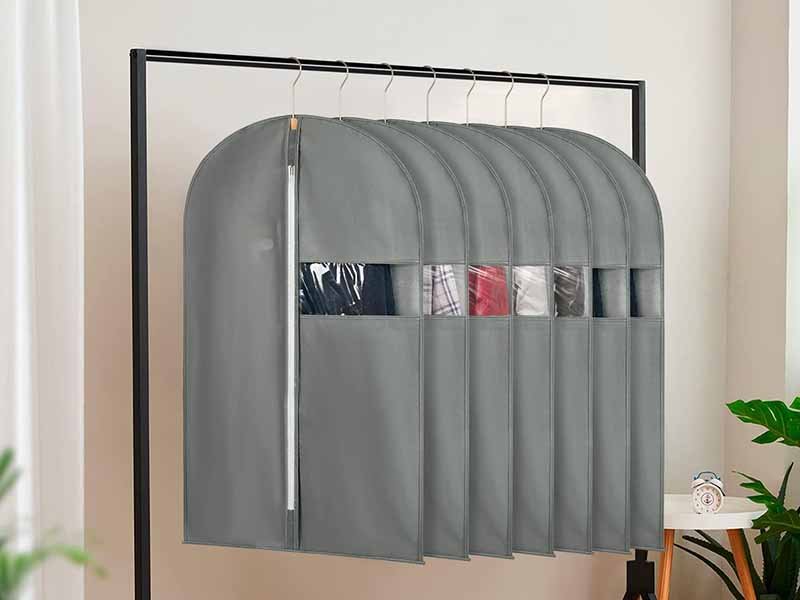
People often treat garment bags like a “simple accessory,” until the first batch lands and problems show up: hanger holes tear, zippers ripple, the bag collapses on the rack, or the fabric feels so thin that customers assume it’s disposable. In most cases, the root cause is not the zipper brand or stitching—it’s the GSM choice. GSM decides how the nonwoven behaves under daily stress: hanging weight, repeated opening, friction against coats, and the pressure of packing.
For nonwoven garment bags, GSM (grams per square meter) is the most practical indicator of fabric weight and feel. 40–60 GSM suits lightweight dust covers and short-term use, 70–90 GSM works best for reusable retail and e-commerce garment bags, and 100–120 GSM is often used for heavy garments, long-term storage, or laminated builds. The “best” GSM depends on garment weight, reuse frequency, and protection level.
If you’ve ever opened a wardrobe and seen a garment bag torn right at the hanger hole, you already know why GSM matters. In the next sections, we’ll translate GSM into what you can actually test, touch, and measure—so your garment bags feel solid on day one and still hold up months later.
What Is GSM for Nonwoven Garment Bags?

GSM in nonwoven garment bags means fabric weight per square meter. It strongly affects thickness, stiffness, tear resistance, and perceived quality. Higher GSM usually improves durability and structure, but also increases cost and shipping weight. The right GSM is the minimum level that prevents tearing at stress points (hanger hole, top seam, zipper area) while keeping the bag breathable and cost-effective.
What GSM really controls
When customers touch a nonwoven garment bag, they instantly judge these things—often without saying it:
- “Does it feel flimsy?” → GSM too low, or weak bonding
- “Does it stand and hang nicely?” → needs enough GSM + stiffness
- “Will it tear at the top?” → hanger hole area needs strength
- “Is it breathable or plastic-like?” → depends on nonwoven type + coating
- “Does it look premium on a rack?” → higher GSM hides creases better
In short: GSM influences both performance and impression.
What Does GSM Mean in Nonwoven Garment Bags?
GSM is simply the weight of 1 square meter of fabric. In nonwoven garment bags, brands use GSM because it’s easy to specify and compare. But you should treat GSM as a range, not a single magic number—because the final “feel” also depends on the nonwoven structure.
Here’s how GSM usually translates in real life:
| GSM Range | Hand Feel | Rack Appearance | Best For |
|---|---|---|---|
| 30–40 GSM | paper-light | wrinkles easily | promo dust covers |
| 40–60 GSM | light, flexible | soft drape | short-term storage |
| 70–90 GSM | firm, balanced | holds shape better | reusable garment bags |
| 100–120 GSM | thick, structured | premium presence | coats / long-term use |
Two fabrics can both be “80 GSM” but behave differently. One can tear easily if fibers are weak or bonding is poor. That’s why smart sourcing pairs GSM with simple physical checks (tear test, hanger pull test, seam test).
Why Is GSM Important for Nonwoven Garment Bags?
Most problems happen at stress points, not in the middle panel. GSM choice determines whether those points survive real use.
Stress points that fail first
- Hanger hole / hook area (pull + friction)
- Top seam (load when hanging)
- Zipper seam (opening force + repeated bending)
- Bottom corners (dragging and folding)
What changes when GSM is too low
- Hanger hole tears after a few hangs
- Bag stretches and looks “collapsed”
- Zipper waves or distorts the front panel
- Fabric becomes see-through and looks cheap
What changes when GSM is too high
- Bag feels bulky for simple dust protection
- Shipping weight increases (especially e-commerce)
- Cost rises without meaningful benefit if garment is light
To make GSM more practical, many clients use a simple rule:
Light garments + short-term use → lower GSM
Heavy garments or reuse → mid/high GSM + reinforcement
How Does GSM Change Nonwoven Garment Bags Quality?
Quality is not just “thicker.” It’s whether the bag keeps doing its job after repeated use. GSM influences quality in these measurable ways:
1) Tear resistance
Higher GSM generally improves tear resistance, but only if fiber bonding is solid.
Factory test you can request during sampling:
- Hang a bag with a 2–3 kg load for 24 hours
- Pull the hanger area repeatedly 20–30 times
- Check for fiber splitting, hole enlargement, or seam tearing
2) Shape retention on racks
Garment bags used for retail displays need to look clean and structured. Mid to high GSM hides creases and gives a “fuller” look.
3) Reuse cycles
From order feedback across storage and apparel packaging projects:
- <50 GSM often feels disposable
- 70–90 GSM is where users start reusing willingly
- 100+ GSM feels “kept,” especially for coats and suits
4) Noise and “cheap feel”
Thin nonwoven fabrics rustle more and collapse. Mid GSM feels quieter and more textile-like, which improves perceived quality.
GSM vs Thickness
Many customers ask for “thicker” fabric and mean “stronger.” GSM helps, but thickness depends on:
- fiber diameter
- bonding method
- fabric loft
So instead of asking only for “higher GSM,” it’s smarter to request:
- a GSM target plus
- a quick tear and hanger pull test on the sample
Quick checklist customers use before approving GSM
This is a simple “go / no-go” list that works well for sampling:
| Check Item | What to Look For | Pass Signal |
|---|---|---|
| Hanger hole pull | hole doesn’t widen | no tearing after pulls |
| Rack look | bag doesn’t collapse | holds shape when hung |
| Zipper area | panel doesn’t wave | smooth seam line |
| Fabric feel | not paper-like | has body, not flimsy |
| Breathability | doesn’t trap moisture | air passes through |
Which GSM Is Common for Nonwoven Garment Bags?

The most commonly used GSM for nonwoven garment bags falls into three ranges: 40–60 GSM for lightweight dust covers, 70–90 GSM for standard reusable garment bags, and 100–120 GSM for heavy-duty or laminated garment bags. Each range serves a different purpose, garment weight, and price level. Choosing the correct GSM prevents tearing, reduces complaints, and avoids unnecessary cost.
Instead of guessing GSM, experienced buyers usually start from garment weight, usage frequency, and customer expectation. Below, we break GSM down by real use cases, not theory.
Which GSM Suits Lightweight Nonwoven Garment Bags?
Lightweight nonwoven garment bags are mainly used as dust covers, not as long-term storage or travel protection. These bags are often included with garments at retail or used for short-term closet protection.
Typical GSM range: 40–60 GSM
This range is popular because it balances low cost and basic function.
Where 40–60 GSM works well
- T-shirts, shirts, light dresses
- Retail dust covers
- Short-term storage (weeks, not years)
- High-volume promotional packaging
What customers should realistically expect
- Fabric feels light and flexible
- Bag protects against dust, not pressure
- Limited reuse cycles
- Must avoid overloading on hanger area
Practical guidance by garment type
| Garment Type | Recommended GSM | Risk Level |
|---|---|---|
| Shirts / blouses | 40–50 GSM | Low |
| Light dresses | 50–60 GSM | Low |
| Thin jackets | 60 GSM | Medium |
Common problems when GSM is too low
- Hanger hole stretches after a few uses
- Top seam deforms under weight
- Bag twists on the rack
For these GSM levels, reinforced hanger holes (extra patch or heat seal) make a noticeable difference at very low cost.
Which GSM Fits Standard Nonwoven Garment Bags?
This is the most widely used category for nonwoven garment bags sold online or used repeatedly. It’s where functionality and perceived quality start to matter.
Typical GSM range: 70–90 GSM
This range is often chosen for reusable garment bags, especially for suits, dresses, and e-commerce orders.
Why 70–90 GSM is the “safe zone”
- Good balance of strength and flexibility
- Fabric holds shape better on racks
- Less tearing at hanger hole
- Customers tend to reuse the bag
Typical applications
- Suit covers
- Dress covers
- Retail + e-commerce garment bags
- Zippered nonwoven garment bags
Recommended GSM by garment weight
| Garment Type | Suggested GSM | Notes |
|---|---|---|
| Suits | 70–80 GSM | Add zipper reinforcement |
| Dresses (medium) | 70–80 GSM | Good drape + shape |
| Blazers | 80–90 GSM | Better hanger support |
Which GSM Is Used for Heavy-Duty Nonwoven Garment Bags?
Heavy-duty nonwoven garment bags are designed for long-term storage, heavier garments, or premium positioning. These are not impulse packaging items — they are part of the product experience.
Typical GSM range: 100–120 GSM
This range is often paired with lamination or reinforced construction.
Where 100–120 GSM makes sense
- Winter coats
- Wool overcoats
- Long-term closet storage
- Garment bags sold as standalone products
Performance characteristics
- Fabric feels thick and structured
- Excellent tear resistance
- Bag hangs straight even with heavy garments
- Longer lifespan and higher reuse
Practical limits to consider
- Higher material cost
- Increased shipping weight
- Overkill for light garments
Typical pairing at this GSM
- Laminated nonwoven (PP + film)
- Reinforced hanger hole patches
- Full-length zipper with backing tape
GSM Comparison by Use Case
| Use Case | Recommended GSM | Why |
|---|---|---|
| Dust cover only | 40–50 GSM | Lowest cost, basic protection |
| Retail garment bag | 60–70 GSM | Clean look, short-term use |
| Reusable garment bag | 70–90 GSM | Best balance overall |
| Heavy coats | 100–120 GSM | Strength + shape retention |
| Premium garment bag | 90–120 GSM | Higher perceived value |
GSM and Cost: What Changes When You Increase GSM?
Many buyers worry that higher GSM always means “too expensive.” In reality, cost rises step by step, not linearly.
What usually increases with GSM
- Fabric cost per bag
- Shipping weight
- Handling rigidity (more structure)
What does NOT always improve
- Breathability (may decrease if laminated)
- Visual appeal (beyond a point)
- Customer satisfaction (if overbuilt)
A common mistake is jumping from 70 GSM straight to 120 GSM without testing 80–90 GSM first. In many cases, mid-GSM + small reinforcements performs just as well.
How Does GSM Affect Nonwoven Garment Bags?

GSM affects nonwoven garment bags in four practical ways: strength at stress points, fabric stiffness, breathability, and usable lifespan. Higher GSM generally improves tear resistance and shape retention but increases cost and weight. Lower GSM keeps costs down but shortens reuse cycles. The right GSM is the lowest level that reliably supports the garment’s weight and expected reuse.
Most GSM mistakes happen because buyers look at GSM in isolation. In reality, GSM only makes sense when viewed alongside how the bag is used, how often it’s reused, and where it fails first.
Let’s break down what GSM really changes in daily use.
How Does GSM Affect Strength in Nonwoven Garment Bags?
Strength is the first reason GSM matters, and it’s also the most misunderstood.
In garment bags, failure almost never happens in the middle of the panel. It happens here:
- Hanger hole
- Top seam
- Zipper edge
- Bottom fold
What GSM actually improves
- Higher GSM means more fiber mass, which increases resistance to tearing.
- Mid-to-high GSM fabrics resist hole enlargement around hangers.
- Fabric recovers better after repeated bending.
What GSM does NOT fix by itself
- Poor hanger hole design
- Weak heat sealing or stitching
- Bad zipper installation
Realistic strength expectations by GSM
| GSM Range | Hanger Area Performance | Real Risk |
|---|---|---|
| 40–50 GSM | Tears easily under load | High |
| 60–70 GSM | Acceptable for light garments | Medium |
| 80–90 GSM | Stable for suits & dresses | Low |
| 100–120 GSM | Very stable for heavy coats | Very Low |
If hanger holes tear in samples, going +10 GSM helps—but reinforcement helps more than raw GSM increase.
How Does GSM Affect Thickness and Structure?
Customers don’t ask for “thickness,” but they react to it immediately.
Low GSM behavior
- Fabric collapses when hanging
- Bag twists and wrinkles
- Looks temporary or disposable
Mid GSM behavior
- Bag hangs straight
- Holds zipper alignment
- Looks clean on racks and in closets
High GSM behavior
- Bag feels structured and “kept”
- Stays flat even with heavy garments
- Signals long-term use
Visual impact by GSM
| GSM | Visual Impression |
|---|---|
| <50 GSM | Dust cover |
| 60–70 GSM | Basic retail |
| 80–90 GSM | Reusable quality |
| 100+ GSM | Premium storage |
For brands selling garment bags as products, structure matters almost as much as strength.
How Does GSM Affect Breathability in Nonwoven Garment Bags?
This is where many buyers get surprised.
GSM vs breathability
- Higher GSM ≠ lower breathability by default
- Breathability depends on fabric structure and lamination
How GSM interacts with air flow
- Low GSM spunbond → very breathable
- Mid GSM spunbond → balanced
- High GSM laminated → limited airflow
Why this matters
Garments stored long-term need airflow to avoid:
- Moisture buildup
- Odor
- Fabric yellowing
Recommended GSM approach for breathable storage
- Use 70–90 GSM spunbond for long-term closet storage
- Avoid full lamination unless moisture resistance is required
- Add small ventilation zones if GSM is high
Common mistake: choosing laminated 120 GSM for wardrobe storage, then getting customer complaints about trapped moisture.
How Does GSM Affect Lifespan and Reuse?
Reuse is where GSM starts paying for itself.
Observed reuse behavior
- <50 GSM → often discarded after use
- 70–80 GSM → reused multiple seasons
- 100+ GSM → kept for years
Why reuse matters
- Higher perceived value
- Better brand impression
- Lower complaint rate
- Stronger sustainability message
GSM vs reuse expectation
| GSM | Typical Reuse Cycles |
|---|---|
| 40–50 GSM | 1–3 |
| 60–70 GSM | 3–8 |
| 80–90 GSM | 8–20 |
| 100–120 GSM | 20+ |
If your brand promotes sustainability, mid GSM with durability performs better than ultra-light fabric with eco messaging.
Which Nonwoven Types Match Garment Bags GSM?

When customers ask about GSM, many suppliers stop at the number. In real garment bag projects, nonwoven type matters just as much as GSM. The same 80 GSM can behave very differently depending on how the fibers are bonded, whether the fabric is laminated, and how it reacts to load, air, and time.
Below is how nonwoven types actually match garment bags GSM in real production, not just on spec sheets.
How Nonwoven Type and GSM Work Together
GSM tells you how heavy the fabric is.
Nonwoven type tells you how that weight behaves.
- GSM controls: weight, thickness, cost level
- Nonwoven type controls: tear pattern, breathability, stiffness, surface feel
If GSM is chosen without matching the right nonwoven type, garment bags often fail even when GSM looks “high enough.”
Spunbond Nonwoven and Garment Bags GSM
Why spunbond is the most common choice
Spunbond nonwoven is the default material for most garment bags because it offers the best balance of strength, airflow, and cost.
How spunbond behaves across GSM ranges
| GSM | Real Performance in Garment Bags | Typical Use |
|---|---|---|
| 40–50 GSM | Soft, flexible, breathable | Dust covers, promo bags |
| 60–70 GSM | Light structure, still breathable | Retail garment bags |
| 70–90 GSM | Stable, reusable, good hanger strength | Standard reusable bags |
| 100+ GSM | Very firm, heavier feel | Heavy garments (limited use) |
What customers usually like about spunbond
- Air passes through easily (good for closets)
- Fabric does not trap moisture
- Lightweight even at mid GSM
- Lower cost compared to laminated options
Where spunbond can fail
- Hanger hole tearing if GSM <60 and not reinforced
- Stretching at top seam under heavy coats
- Less “premium look” compared to laminated surfaces
Practical tip:
For most brands, 70–80 GSM spunbond + reinforced hanger hole outperforms higher GSM without reinforcement.
Laminated Nonwoven and Garment Bags GSM
Laminated nonwoven combines spunbond fabric + film layer (usually PP or PE). This changes how GSM works.
What lamination really adds
- More stiffness at the same GSM
- Cleaner, smoother surface
- Better moisture resistance
- Higher perceived quality
How laminated nonwoven behaves by GSM
| GSM | Behavior | Risk |
|---|---|---|
| 70–80 GSM laminated | Stiff but thin | Can crack if folded |
| 90–100 GSM laminated | Structured and stable | Reduced airflow |
| 110–120 GSM laminated | Very rigid | Heavy, less breathable |
When laminated nonwoven makes sense
- Travel garment bags
- Coat covers for shipping
- Garment bags sold as products (not free packaging)
- Situations where moisture resistance matters more than airflow
When laminated nonwoven causes problems
- Long-term wardrobe storage (moisture buildup)
- Hot or humid climates
- Customers expecting breathable storage
Common mistake:
Using 120 GSM laminated nonwoven for closet storage → customers complain about trapped humidity and odor.
SMS / SMMS Nonwoven and Garment Bags GSM
SMS (Spunbond–Meltblown–Spunbond) is less common in garment bags but sometimes requested.
What SMS actually offers
- Finer fiber structure
- Higher tear resistance at the same GSM
- More uniform surface
How SMS compares at similar GSM
| Fabric Type | GSM | Tear Resistance | Breathability | Cost |
|---|---|---|---|---|
| Spunbond | 80 | Medium | High | Low |
| SMS | 80 | Higher | Medium | Higher |
When SMS is worth considering
- Premium reusable garment bags
- Garment bags for heavier clothing
- Clients who want thinner fabric with better strength
Why SMS is not widely used
- Higher cost
- Breathability lower than spunbond
- Overkill for most garment bags
Recycled Nonwoven and Garment Bags GSM
Many brands now ask for recycled content. GSM behavior changes slightly.
How recycled nonwoven behaves
- Needs higher GSM to match virgin material strength
- Fiber consistency varies by supplier
- Slightly rougher hand feel
Practical GSM adjustment for recycled content
| Virgin GSM | Recycled Equivalent GSM |
|---|---|
| 60 GSM | 70 GSM |
| 80 GSM | 90 GSM |
| 100 GSM | 110–120 GSM |
Recycled nonwoven below 70 GSM often fails at hanger holes unless reinforced.
Breathability vs Protection: GSM + Type Trade-off
This is one of the most important decisions customers make.
| Priority | Best Choice |
|---|---|
| Closet storage | Spunbond 70–90 GSM |
| Shipping protection | Laminated 90–110 GSM |
| Heavy coats | Spunbond or SMS 90–120 GSM |
| Humid climate | Non-laminated spunbond |
| Premium appearance | Laminated or SMS |
If garments stay in a closet for months → airflow matters more than stiffness.
How Customers Should Match Nonwoven Type to GSM
- Decide storage time
- Short → laminated acceptable
- Long → breathable spunbond
- Check garment weight
- Light → 50–70 GSM spunbond
- Medium → 70–90 GSM spunbond
- Heavy → 90–120 GSM spunbond or SMS
- Decide if bag is sold or free
- Free → avoid overbuilding
- Sold → structure and feel matter
How to Choose GSM for Nonwoven Garment Bags?
To choose GSM for nonwoven garment bags, start with garment weight and expected reuse. Then balance structure, breathability, and cost. Most brands succeed with 70–90 GSM plus reinforcement. Sampling with real garments is the fastest way to confirm the correct GSM before mass production.
A practical GSM selection framework
Step 1: Identify garment weight
- Light (shirts)
- Medium (suits, dresses)
- Heavy (coats)
Step 2: Decide reuse expectation
- One-time / included
- Occasional reuse
- Long-term storage
Step 3: Choose GSM range
| Garment | Reuse Level | GSM Range |
|---|---|---|
| Shirts | Low | 40–60 |
| Suits | Medium | 70–80 |
| Dresses | Medium | 70–90 |
| Coats | High | 100–120 |
Step 4: Reinforce instead of overbuilding
Often, 80 GSM + hanger reinforcement performs better than jumping to 120 GSM.
Final
With over 18 years of experience in fabric, webbing, and bag manufacturing, Lovrix supports clients
GSM is not about choosing the highest number—it’s about choosing the right balance. The best nonwoven garment bags feel strong where they need to, breathe where they should, and cost no more than necessary.
If you’re developing custom nonwoven garment bags for retail, e-commerce, or private label programs, Lovrix can help you define the right GSM, build samples quickly, and move to production with confidence.
Contact Lovrix to request samples, GSM testing, or a custom quotation.


