Skip to content
 At Lovrix Webbing, we design and manufacture premium reflective webbing that enhances visibility, endurance, and aesthetics for every application—from safety apparel and outdoor gear to pet accessories and industrial equipment. Our products combine durable base materials, precision weaving, and reflective technology to ensure maximum performance day and night.
We transform your ideas into durable, high-visibility webbing solutions with full OEM/ODM design freedom — from reflective patterns and material blends to precise color alignment and logo integration.
Any color. Any finish. Any reflective style.
Lovrix creates reflective webbing that doesn’t just enhance visibility — it strengthens your product identity, keeping users safe, stylish, and seen day or night.
Certified high-visibility performance, long-term durability, and complete customization — helping your brand stay visible and reliable in every environment.
Since 2007, Lovrix has focused on the R&D and production of high-performance webbing. Our reflective series has been refined through thousands of successful OEM/ODM projects for safety, outdoor, and apparel brands around the world.
As a vertically integrated manufacturer, Lovrix provides full in-house production—from yarn extrusion, weaving, and reflective lamination to QC inspection. This structure ensures competitive pricing, consistent quality, and transparent communication at every stage of your order.
Start small and scale fast. We support custom reflective webbing orders from as low as 50 meters, with free physical samples delivered in 3–5 days. Confirm brightness, texture, and color accuracy before committing to full production—no risk, all control.
All Lovrix reflective webbings are tested and certified under ISO 9001, EN471, and CE standards. Each batch undergoes tensile, abrasion, wash-fastness, and UV exposure tests both in-house and through accredited third-party labs, guaranteeing consistent performance and durability.
Our dedicated design team offers free artwork setup, reflective pattern development, and logo integration, ensuring your webbing perfectly represents your brand. From subtle reflective trims to bold branded straps, Lovrix helps you achieve both safety and style.
With optimized production and global logistics, Lovrix ensures fast delivery within 7–10 days after order confirmation. We manage FOB, CIF, and DDP shipping, plus full export documentation, to guarantee that your reflective webbing arrives safely and on schedule worldwide.
Technical attributes that deliver unmatched visibility, durability, and performance in any environment.
Lovrix reflective webbing incorporates micro-prismatic or glass-bead reflective layers that achieve consistent brightness up to 500 cd/lux/m² from any viewing angle. Whether in motion or static, it ensures full-scope visibility for enhanced safety across all lighting conditions.
Engineered for high-performance detection, our webbing remains visible to vehicle headlights and spotlights at distances of up to 200 meters. It provides critical visibility for workers, cyclists, and outdoor gear, meeting professional-grade safety demands.
Equipped with UV-blocking and hydrophobic coatings, Lovrix reflective webbing resists sun fading, water penetration, and mildew formation. It retains brightness and structure even after prolonged exposure to rain, fog, or extreme sunlight.
Designed for repeated use, our reflective webbing withstands 50+ industrial wash cycles without peeling or fading. It resists oils, solvents, and detergents, maintaining adhesion and color integrity for workwear and outdoor applications.
Maintains full tensile and reflective efficiency between −40 °C and +80 °C, ensuring reliability in extreme climates—from icy operations to desert heat—without cracking or delamination.
Built on high-tenacity nylon or polyester cores, the webbing remains lightweight, pliable, and comfortable. It integrates smoothly into apparel and accessories, avoiding stiffness or added bulk while retaining exceptional strength.
Available with heat-sealed, folded, or stitched edges to prevent fraying during heavy use. These finishes extend service life, enhance handling, and maintain a clean, professional appearance over time.
Lovrix reflective webbing is tested and certified to EN ISO 20471, ANSI 107, and CE high-visibility standards. Each batch undergoes strict inspection to ensure consistent reflectivity, durability, and compliance with global safety requirements.
From roadway safety gear to outdoor adventures and pet accessories, Lovrix’s custom reflective webbing enhances both visibility and design value across multiple industries. Choose your reflective type, base material, and weave construction to achieve the perfect balance of performance, comfort, and brand distinction.


Empower your products with tailored high-visibility solutions by choosing from these customizable features.
Select a nylon, polyester, or cotton-blend core paired with either glass-bead reflective film or micro-prismatic tape. This flexibility lets you control softness, durability, and brightness levels—from standard safety grades to ultra-high intensity reflection exceeding 500 cd/lux/m².
Customize widths from 10 mm to 75 mm, covering fine garment trims to heavy-duty straps. Available in cut lengths starting from 50 cm or continuous rolls, our reflective webbing adapts to both small OEM samples and large-scale production runs.
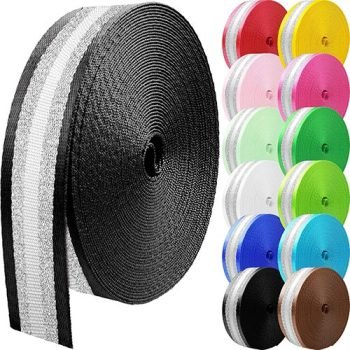
Match your brand identity with over 10 base colors or custom Pantone shades. Add logos, text, or graphic patterns directly onto the reflective surface using woven inlay or heat-transfer techniques—ensuring every meter reinforces your brand visibility.
Enhance strength and appearance with heat-sealed edges or reinforced stitching. For load-bearing webbing, Lovrix offers single, double, and box-X stitch configurations, ensuring long-term integrity and a clean, professional finish under tension.
Fortify your webbing for harsh conditions with UV-block, waterproof, anti-mildew, and wash-fast coatings. These advanced treatments preserve reflective brightness, prevent fading, and maintain flexibility even after repeated laundering or outdoor exposure.
Streamline your supply chain with optional buckles, D-rings, hooks, or Velcro backings pre-assembled to your webbing. Lovrix also manages export packaging, palletizing, labeling, and full documentation (CO, CI, packing lists) for hassle-free, on-time global delivery.
Ready to customize your webbing? Contact us now!
From your initial inquiry to on-time delivery, here’s how Lovrix ensures every reflective strap meets your exact specifications.
We start by defining your application, visibility goals, and branding needs. Our design team provides digital mockups showing tape type, material, width, color, and logo placement—ensuring full alignment before sampling.
Lovrix sources high-tenacity nylon, polyester, or cotton blends along with glass-bead or micro-prismatic reflective films. Every incoming batch is tested for tensile strength, reflectivity, color accuracy, and coating adhesion to guarantee consistent performance from the start.
Reflective materials are laminated onto the webbing base under precise temperature and pressure control. This process ensures uniform bonding, smooth texture, and even light reflection across the entire surface—preventing peeling or delamination during use.
The laminated layers are woven or bonded into a stable composite webbing with minimal stretch and excellent flexibility. This step locks the reflective elements securely in place, maintaining both tensile integrity and reflective brightness throughout the product’s lifespan.
Edges are heat-sealed or double-stitched to prevent fraying and enhance structural strength. For heavy-duty straps, we apply box-X or cross-lock stitching patterns tested for high-tension performance, ensuring durability under repeated mechanical stress.
Automated cutting machines trim each strap to precise lengths with millimeter accuracy. If required, buckles, D-rings, Velcro, or snap hooks are pre-attached, creating a fully assembled reflective strap that’s ready for immediate use or retail packaging.
Each production lot is tested for reflective intensity (cd/lux/m²), tensile strength, UV and abrasion resistance, and wash durability. Certified according to EN ISO 20471, ANSI 107, and CE standards, all data is recorded and provided with the shipment for traceability.
Finished straps are coiled, labeled, and packed in reinforced export cartons. Lovrix manages FOB, CIF, or DDP shipping, including all documentation—CO, CI, and packing lists. Our team provides post-delivery support to assist with reorders, customization updates, or quality feedback.
At Lovrix, we prioritize quality at every stage of the production process to ensure our webbing meets the highest industry standards. Our commitment to excellence is backed by rigorous quality control, internationally recognized certifications, and a dedication to sustainability.


Our state-of-the-art webbing manufacturing facility ensures high-quality, fully customizable webbing solutions. With strict quality control and advanced production techniques, we meet the needs of global brands and businesses.


If you have your own tech packs, logo designs, or even just an idea, please share your project details with us, including preferred fabric, color, and customization options. We’re eager to help bring your webbing designs to life through our sample production process.
Proudly Partnered With Leading Brands Worldwide


Answers to your top questions on selection, customization, and care for Lovrix’s high-performance reflective straps
Reflective webbing is a woven strap integrated with light-reflective materials—either glass-bead coatings or micro-prismatic films—that bounce light back toward its source. This property dramatically improves visibility in low-light or nighttime environments, making it ideal for safety apparel, pet leashes, outdoor gear, and industrial straps.
Lovrix primarily uses nylon, polyester, and cotton blends as base materials. These can be paired with reflective yarns, laminated films, or stitched-on tapes. Nylon provides flexibility and strength; polyester offers UV and moisture resistance; cotton adds comfort and softness for wearable applications.
Reflective webbing is used in safety clothing, backpacks, workwear, pet harnesses, vehicle tie-downs, rescue gear, and outdoor sports equipment. It enhances both the product’s aesthetic and safety performance, meeting EN ISO 20471 and ANSI 107 visibility standards.
We provide three main reflective types:
Woven reflective yarns for subtle and flexible brightness.
Heat-laminated glass-bead films for standard visibility.
Micro-prismatic coatings for maximum reflectivity (up to 500 cd/lux/m²).
Yes. We offer custom logo printing, woven text, jacquard designs, and Pantone color matching. Reflective elements can be integrated into the weave or printed on the surface, ensuring your brand identity remains visible even in low-light conditions.
Absolutely. Our reflective webbing withstands 50+ industrial wash cycles while maintaining brightness and structure. It’s also resistant to UV, moisture, and abrasion, ensuring long-term use in professional and outdoor environments.
Standard widths range from 10 mm to 75 mm, with customizable thicknesses between 0.8 mm and 3 mm. Lengths can be cut to size or provided in continuous rolls for automatic assembly or machine use.
Yes. We provide flame-retardant, water-repellent, UV-block, and anti-mildew coatings upon request. These finishes enhance performance for industrial safety gear, outdoor products, and emergency equipment operating in harsh environments.
Reflective webbing is essential in industries where visibility equals safety — from high-visibility workwear and outdoor gear to pet accessories and emergency equipment. Among all reflective technologies, the two most common options are glass-bead reflective webbing and micro-prismatic reflective webbing. Both systems work by returning light to its source, but their optical structure, brightness level, flexibility, and durability differ significantly. Understanding these differences helps brands and manufacturers choose the right solution for their intended use.
1. How Glass-Bead Reflective Webbing Works
Glass-bead reflective technology is based on microscopic glass spheres embedded in a clear resin layer applied to the surface of the webbing or film. Each bead acts as a tiny convex mirror that bends incoming light rays and reflects them back toward their source — a process known as retroreflection.
This type of reflective webbing is valued for its soft hand-feel, flexibility, and cost efficiency. Because the glass beads are spherical and randomly oriented, the reflective pattern is diffused, giving the webbing a smooth, uniform shine under light. It performs best for applications like safety vests, pet leashes, apparel trims, and accessories, where comfort and flexibility are critical.
However, glass-bead technology has some limitations. The outer resin coating that holds the beads can wear down over time due to washing, abrasion, or UV exposure, slightly reducing its brightness. Its typical reflectivity level ranges between 100–300 cd/lux/m², which is sufficient for general safety and fashion applications but may not meet the extreme brightness needed for industrial or emergency conditions.
2. How Micro-Prismatic Reflective Webbing Works
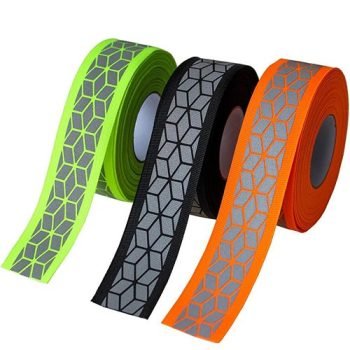
Micro-prismatic technology uses a completely different optical design. Instead of tiny spheres, it features a layer of microscopic prism-shaped cells molded into a transparent polymer film. Each prism acts like a mirror with multiple internal angles that direct light precisely back to the source with far higher efficiency.
Because of this geometric precision, micro-prismatic webbing delivers greater reflectivity (300–500 cd/lux/m²) and long-distance visibility of up to 200 meters under car headlights or searchlights. It maintains strong performance even when wet or dirty because the flat surface repels moisture and dust better than bead-based coatings.
Micro-prismatic reflective webbing is generally used for workwear, rescue harnesses, backpacks, tactical gear, and industrial safety products, where durability and visibility under extreme conditions are non-negotiable. Its only drawback is slightly higher stiffness and cost compared to glass-bead types, due to the precision molding and lamination process required.
3. Durability and Maintenance Comparison
In real-world performance, micro-prismatic reflective webbing offers superior resistance to washing, abrasion, and weathering. It can endure 50+ industrial wash cycles without losing reflectivity, while glass-bead coatings typically last for 25–35 cycles. The prismatic structure is encapsulated within a sealed layer, preventing the reflective elements from being exposed or worn away.
Both technologies can be combined with UV-blocking and water-repellent coatings to extend service life, but the micro-prismatic version maintains brightness longer under outdoor exposure, making it ideal for long-term professional use.
4. Flexibility and Application Suitability
For applications requiring softness and comfort, such as pet straps or apparel trims, glass-bead reflective webbing remains the preferred option due to its supple feel and excellent drape. In contrast, micro-prismatic types are slightly stiffer but far more rugged, excelling in load-bearing straps, rescue gear, and workwear that face physical stress and environmental hazards.
5. Cost and Aesthetic Considerations
From a cost standpoint, glass-bead reflective webbing is more economical and easier to produce in custom colors or printed designs, making it suitable for fashion-oriented brands. Micro-prismatic webbing, while 20–30% higher in cost, delivers unmatched brightness and compliance with global safety standards such as EN ISO 20471 and ANSI 107, justifying its price for professional markets.
6. Summary Table
| Feature | Glass-Bead Reflective Webbing | Micro-Prismatic Reflective Webbing |
|---|---|---|
| Reflectivity | 100–300 cd/lux/m² | 300–500 cd/lux/m² |
| Flexibility | Very soft and pliable | Moderately stiff |
| Wash Resistance | 25–35 cycles | 50+ cycles |
| Brightness Retention | Gradually decreases | Long-term stable |
| Cost Level | Lower | Higher |
| Ideal Applications | Apparel, pet gear, light safety | Workwear, industrial, rescue gear |
7. Final Recommendation
In conclusion, the choice between glass-bead and micro-prismatic reflective webbing depends on where and how the product will be used.
For lightweight, flexible, or fashion-driven applications, glass-bead reflective webbing provides a cost-effective and comfortable solution.
For demanding industrial, rescue, or outdoor environments, micro-prismatic reflective webbing delivers superior durability, visibility, and compliance.
At Lovrix, we supply both technologies—and even hybrid constructions that combine the flexibility of glass beads with the brightness of prisms—allowing brands to achieve the ideal balance between safety performance, aesthetic design, and manufacturing efficiency.
Reflective webbing plays a vital role in personal safety, occupational protection, and outdoor performance gear. To guarantee its reliability, every Lovrix reflective webbing product undergoes a multi-stage testing and certification process in accordance with EN ISO 20471, ANSI/ISEA 107, and ISO 9001 quality management standards. These evaluations ensure that each batch meets or exceeds the reflective brightness, tensile strength, and durability required for global safety markets.
1. The Purpose of Reflective Webbing Testing
Testing ensures that reflective webbing performs consistently under real-world conditions such as rain, UV exposure, washing, and friction. Since the primary function of reflective material is to return light toward its source (retroreflection), its reflective coefficient (cd/lux/m²) and long-term brightness retention are the key quality indicators. At Lovrix, both in-house testing and third-party certification are integrated into the production process to guarantee transparency and traceability.
2. Reflectivity Measurement (Brightness Test)
The most critical test measures coefficient of retroreflection, which defines how effectively a surface returns light to its origin. Lovrix uses certified goniophotometers and retroreflectometers under standardized geometry (typically 0.33° observation angle and 5° entrance angle).
EN ISO 20471 requirements: Minimum 330 cd/lux/m² for high-visibility class materials.
Lovrix reflective webbing performance: Ranges from 350–500 cd/lux/m² for micro-prismatic types, exceeding standard values.
Testing is conducted before and after washing, UV exposure, and abrasion to assess reflectivity retention over time.
3. Tensile Strength and Elongation Testing
Since reflective webbing also serves as a load-bearing component, Lovrix verifies mechanical strength using ASTM D5034 (Grab Test) or ISO 13934-1. Samples are clamped and pulled at a constant rate until rupture.
Nylon-based webbings typically achieve 1,500–2,000 N tensile strength.
Polyester versions reach 1,000–1,500 N, ensuring adequate resistance under tension.
This confirms the webbing’s ability to maintain safety and integrity under real use—especially in belts, harnesses, and heavy-duty gear.
4. Abrasion and Wear Resistance
Reflective surfaces are prone to frictional wear during use. Lovrix evaluates durability using the ISO 12947 Martindale Abrasion Test, simulating repetitive rubbing cycles under controlled pressure. Our reflective webbings endure 5,000+ cycles without surface cracking or delamination, maintaining both texture and reflectivity.
5. UV, Weathering, and Colorfastness Tests
Outdoor use exposes webbing to intense sunlight and varying climates. UV stability is tested under xenon arc light for 1,000 hours following ISO 105-B02, measuring any loss of brightness or color. Lovrix also performs hydrolysis and humidity tests, replicating tropical and marine environments.
Results show less than 5% reflectivity loss and no visible degradation, ensuring longevity even in challenging outdoor conditions.
6. Wash and Chemical Resistance
Washing can degrade reflective performance, especially for glass-bead types. Lovrix tests per ISO 6330 and AATCC 135, washing samples 50 times at 60°C using industrial detergents. The webbing must retain at least 80% of initial brightness with no delamination or peeling. Chemical resistance is also verified against oils, solvents, and cleaning agents to ensure safe use in industrial settings.
7. Flame Retardancy (Optional Test)
For firefighting or military applications, flame resistance is evaluated following NFPA 701 and ISO 15025. Lovrix’s flame-retardant reflective webbing self-extinguishes within 2 seconds after flame removal, preventing spread and maintaining mechanical integrity.
8. Certification and Quality Documentation
Every Lovrix production lot is accompanied by a complete documentation package, including:
Internal QC reports (reflectivity, tensile, wash, and UV test data)
Third-party certificates from SGS, TÜV, or Intertek
EN ISO 20471 and ANSI/ISEA 107 compliance reports
Material safety and REACH/ROHS compliance statements
All test data are stored digitally for traceability, ensuring customers receive verifiable, globally recognized compliance evidence.
9. Lovrix Quality Assurance Framework
Beyond standard testing, Lovrix operates under a closed-loop quality control system certified to ISO 9001. Each roll of webbing is labeled with a traceable batch code, enabling customers to track performance history. Our in-house lab continually revalidates materials, coatings, and adhesives to maintain stable quality across large-scale orders.
10. Summary
Reflective webbing is more than a design element—it’s a life-saving safety component. Lovrix’s rigorous testing and certification process ensures that every meter meets international performance benchmarks for brightness, durability, and mechanical reliability.
By combining advanced optical
Reflective materials are essential for enhancing safety, visibility, and branding in modern product design. While reflective tape and reflective webbing share the same goal — returning light to its source for visibility — they differ greatly in structure, strength, lifespan, comfort, and customization potential. Understanding these distinctions helps brands choose materials that maximize performance, aesthetics, and long-term value.
1. Structural Integrity and Strength
The most significant advantage of reflective webbing over reflective tape is its woven base construction. Reflective webbing consists of a durable textile core (nylon, polyester, or cotton blend) with reflective material integrated directly into or bonded onto the weave. This gives it tensile strength up to 2,000 N, far exceeding the thin PVC or PET film base of reflective tape.
Reflective tape works best as a surface decoration or visibility accent, but it lacks load-bearing capacity. When subjected to pulling or bending, tape can crack, wrinkle, or peel. Reflective webbing, by contrast, is engineered for tactical straps, safety harnesses, pet leashes, and outdoor gear — applications that require both reflectivity and mechanical performance.
2. Durability and Longevity
Reflective webbing is built to last. The textile base, combined with micro-prismatic or glass-bead coatings, maintains brightness even after long-term use. Lovrix webbing endures over 50 industrial wash cycles and 5,000 abrasion cycles with minimal reflectivity loss, verified under ISO 20471 and ASTM D5034 standards.
Reflective tape, on the other hand, relies on adhesive bonding to attach to fabrics or surfaces. Over time, exposure to UV rays, moisture, detergents, and flexing causes the adhesive to degrade, leading to peeling and delamination. This makes reflective webbing the superior option for outdoor, industrial, and professional environments where reliability matters most.
3. Flexibility and Comfort
Because reflective webbing uses woven fibers as its foundation, it offers greater flexibility and softness than film-based tape. This makes it far more comfortable for wearable applications such as vests, apparel trims, and pet accessories. The webbing naturally conforms to curves and edges without cracking or stiffening.
Reflective tape often feels rigid or plasticky due to its laminated film structure, which can compromise comfort and appearance on flexible garments or accessories. Lovrix reflective webbing combines comfort with strength, providing a premium, fabric-like feel that brands appreciate for both performance and aesthetics.
4. Customization and Branding Potential
Lovrix reflective webbing offers unmatched customization versatility. Clients can choose widths (10–75 mm), base colors, reflective patterns, and logo integration methods such as woven text, jacquard graphics, or laser engraving. Pantone color matching ensures consistent brand alignment across products.
Reflective tape is usually limited to silver or gray tones and relies on surface printing for branding, which may fade or wear off over time. Reflective webbing, however, allows the reflective element to become part of the material’s identity — enabling both functional performance and visual differentiation.
5. Environmental and Cost Efficiency
From a lifecycle perspective, reflective webbing offers better sustainability and cost efficiency. Because it combines the reflective layer and fabric base in a single manufacturing step, it reduces waste, minimizes separate stitching or lamination processes, and lowers energy consumption. Over long production runs, this integrated approach leads to lower per-unit costs and fewer product failures.
Reflective tape, by contrast, often requires manual application, secondary bonding, or heat pressing — processes that increase labor time and production variability. For OEM brands and factories, reflective webbing simplifies assembly while improving consistency and output speed.
6. Broader Applications and Performance Range
Reflective webbing’s hybrid structure makes it ideal for load-bearing, outdoor, and safety-critical uses beyond what reflective tape can handle. It performs reliably in:
Safety harnesses, belts, and tactical gear
Pet leashes and collars
Industrial and rescue equipment
Outdoor backpacks and sportswear
Automotive straps and tie-downs
This adaptability allows brands to consolidate material sourcing — using one durable reflective solution across multiple product lines.
7. Aesthetic and Design Versatility
Beyond function, reflective webbing offers a modern, textured appearance that enhances visual quality. It can be woven in patterns such as herringbone, twill, or jacquard, integrating reflective yarns directly into the design. Reflective tape, in comparison, remains a flat, film-like strip with limited design options. Lovrix’s woven reflective structures provide premium aesthetics that merge safety with style, appealing to fashion-forward and performance-driven markets alike.
8. Conclusion
In short, reflective webbing outperforms reflective tape in nearly every category of importance — strength, lifespan, flexibility, customization, and overall value. It’s not just a reflective surface, but a structural material designed for real-world performance.
For brands and manufacturers looking to build products that are safer, more durable, and visually distinctive, Lovrix reflective webbing provides the ideal solution. By merging advanced optical technology with textile engineering, Lovrix delivers reflective materials that shine brighter, last longer, and elevate your brand’s identity — day or night, in any environment.
From custom polyester straps to eco-friendly bands, Lovrix is your trusted webbing manufacturer, supplier, and wholesale factory in China. With certified quality, fast sampling, and scalable production, we help global brands achieve personalized, bulk-ready solutions.
Send us a message if you have any questions or request a quote. We will be back to you ASAP!