 Skip to content
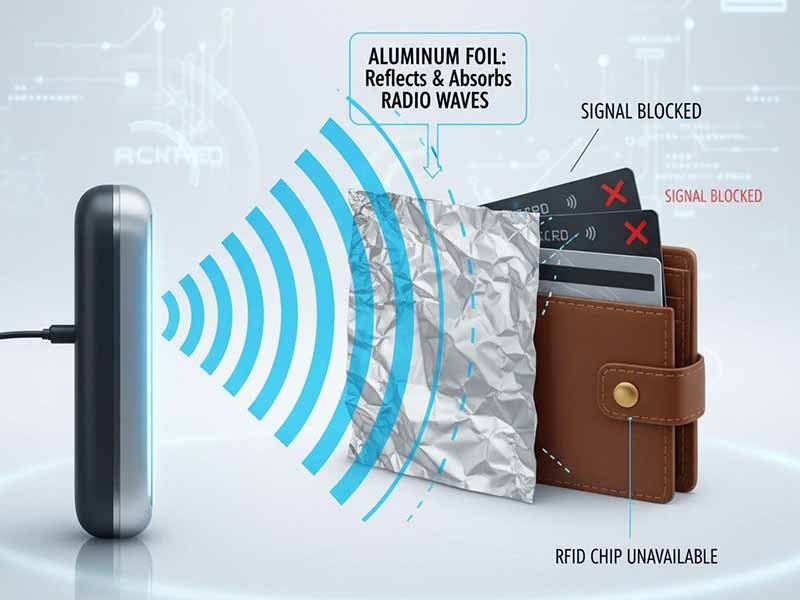
RFID blocking is one of those bag features that looks almost effortless from the outside. A traveler puts a passport or contactless card inside a small zip pocket, closes it, and expects an invisible radio-frequency connection to stop. Inside that pocket, however, several things have to work together: the shielding material must suit the target frequency, the conductive layer has to cover the right area, the opening and seams cannot undermine the enclosure, and the finished pocket still needs to perform after sewing, folding, rubbing, and repeated use.
RFID blocking in bags works by surrounding a card, passport, or other contactless item with a conductive shielding layer that reduces the electromagnetic communication needed for an external reader to interact with it. Reliable performance depends on the target frequency, conductive material, coverage, pocket opening, closure design, seam construction, wear resistance, and verification of the finished product rather than the fabric alone.
This distinction is important because an “RFID fabric” label does not automatically make a bag RFID resistant. Two pockets made from the same conductive textile can perform differently if one leaves more exposed area around the zipper, uses a different seam transition, or allows the functional coating to wear against stored cards. Once those details are understood, RFID blocking becomes much easier to evaluate as an engineered bag feature rather than a vague security claim.
What Is RFID Blocking in a Bag?

RFID blocking in a bag means creating a conductive barrier around selected contactless cards, passports, credentials, or electronic items so an external reader cannot communicate with them normally while they remain inside the protected compartment. The result depends on the combination of shielding material, target frequency, enclosure coverage, opening geometry, closure condition, seams, and long-term material condition.
What Is RFID and How Does It Communicate?
RFID, or Radio Frequency Identification, allows a reader to communicate with a compatible electronic tag or chip through radio-frequency energy. Many cards and travel documents use passive contactless technology, meaning the chip does not need a conventional battery for each interaction. When it enters a suitable electromagnetic field, enough energy can be transferred for the chip to respond according to its communication protocol, allowing a reader to identify or exchange information with the item.
That interaction can be understood as a short sequence. The reader generates an electromagnetic field, a compatible tag enters the usable field, the chip receives sufficient energy to respond, and the reader receives that response. RFID blocking does not erase the chip or permanently disable the item. Instead, the conductive enclosure interferes with the electromagnetic environment around the protected object so the reader cannot establish the normal communication path while the compartment remains closed.
For bag development, this difference matters because the goal is not to “turn off” a passport or card. The goal is to create temporary physical shielding during storage. Once the protected item is removed from the pocket, it should be available for normal contactless use again. This makes RFID blocking primarily a materials-and-construction problem rather than a modification to the electronic device itself.
Which Cards and Documents Use RFID?
Electronic passports are among the most familiar RFID-related products carried inside travel bags. Modern ePassports generally use contactless technology around 13.56 MHz, and many contactless payment cards and NFC applications also operate around that frequency. Other access systems can work differently. Some proximity credentials operate around 125–134 kHz, while UHF RFID systems commonly operate within approximately 860–960 MHz, depending on the country, system, and application.
These differences are one reason the phrase “RFID blocking” is not a complete engineering specification. A travel wallet intended to protect an electronic passport and contactless cards should be developed around that specific use case. A pouch intended for another type of credential or electronic device may need different materials, broader shielding performance, or another testing method before the same protection claim can be made responsibly.
A useful development brief normally identifies the protected item, relevant frequency or protocol, expected reader type, size of the protected zone, closure method, and acceptance test. Defining those points before material selection gives the pattern maker, sampling team, material supplier, and quality team a shared performance target rather than asking everyone to work from a broad marketing phrase such as “RFID safe.”
| RFID Range | Approximate Frequency | Common Examples | Main Bag Development Concern |
|---|---|---|---|
| LF | 125–134 kHz | Some proximity and identification systems | Requires low-frequency verification |
| HF | 13.56 MHz | ePassports, many contactless cards, NFC | Highly relevant to wallets and travel bags |
| UHF | 860–960 MHz | Inventory, logistics and asset tags | Requires UHF-specific testing |
Is NFC the Same as RFID?
NFC belongs to the broader family of contactless radio-frequency technologies, but RFID and NFC should not be treated as completely interchangeable terms. RFID covers a wide range of frequencies, reading distances, antenna systems, protocols, and applications. NFC is a shorter-range technology associated with 13.56 MHz communication and is widely used for contactless payment, device interaction, access functions, ticketing, and other consumer applications.
For bag manufacturers and brands, the practical concern is not the terminology alone but what the finished product is expected to block. If a pocket is developed to protect ePassports and common contactless cards at 13.56 MHz, the specification should say so. Broader language can create unnecessary confusion when customers later assume the same pocket has also been tested for cellular, Bluetooth, Wi-Fi, keyless-entry systems, or unrelated RFID frequencies.
Clear specifications also make sampling easier. A project brief can define the product as a travel passport wallet, identify the protected items as a passport and contactless cards, set the intended frequency at 13.56 MHz, describe the compartment as a fully enclosed conductive lining, and require finished-sample verification. That provides a usable manufacturing standard rather than leaving RFID performance to interpretation.
What Does an RFID-Blocking Bag Actually Block?
An RFID-blocking compartment does not block information in a general sense. It reduces the electromagnetic interaction required for an external reader to communicate with a protected chip. Conductive materials surrounding the card or document alter the electromagnetic field and reduce the energy available for successful communication. If attenuation is sufficient under the relevant test conditions, the reader cannot complete its normal exchange with the item inside the closed compartment.
This is also why material coverage matters. A conductive textile with excellent laboratory shielding values may produce disappointing finished-product performance if it only covers one side of the pocket or stops too far below a zipper opening. A somewhat less impressive material can sometimes perform more reliably when it forms a better enclosure around the actual passport or card and remains intact through production and normal use.
A useful development question is therefore not simply, “Is this RFID fabric?” A better question is, “Does this material, inside this exact sewn pocket, prevent the intended reader from communicating with the intended item under the specified conditions?” That shift turns a material label into a measurable product requirement and makes quality control more meaningful.
How Does RFID Blocking Work?
RFID blocking works by introducing conductive material between the reader and the protected chip. The conductive layer changes how electromagnetic energy reaches the item, reducing the coupling or signal strength required for communication. Actual performance depends on frequency, conductivity, material structure, coverage, reader distance, orientation, closure design, seams, openings, and the condition of the shielding layer after use.
How Does a Reader Communicate With an RFID Chip?
A passive RFID device depends on an electromagnetic relationship with the reader. The reader’s antenna produces a field, and when the tag or card enters a usable area of that field, energy can couple into the tag’s antenna. At high-frequency applications such as 13.56 MHz contactless systems, short-range interaction is strongly influenced by magnetic coupling, which makes distance, antenna orientation, geometry, and nearby conductive materials important variables.
This is why a contactless card may read easily when held flat against a reader but respond less consistently at another angle or greater distance. The same principle applies when shielding material is introduced. Once a conductive layer surrounds the item, the electromagnetic environment changes, reducing the amount of usable field reaching the chip or altering the path through which the reader and card would otherwise communicate.
A loose fabric test therefore cannot fully represent a finished bag. A commercial pocket introduces foam, standard lining, PU leather or textile shell materials, seam allowance, binding, zipper tape, reinforcement, hardware, folds, and overlapping pattern pieces. The reader interacts with the finished assembly, so development teams need to evaluate that complete structure rather than assuming the raw-material specification alone determines final performance.
How Does Conductive Shielding Interrupt the Signal?
Conductive materials contain mobile electrical charge, and incoming electromagnetic energy can create currents within the conductive layer. These currents alter the local electromagnetic field, reducing the amount of useful energy that reaches the protected area. Depending on material and frequency, part of the energy may be reflected, redistributed, or absorbed, producing the shielding effect used in RFID pockets and signal-blocking enclosures.
The term “Faraday cage” is often used to explain the idea, but a soft sewn pocket is rarely a perfect enclosed metal cage. Real bags include zipper openings, stitch lines, textile folds, gussets, seam transitions, flexible coatings, and repeated movement. For this reason, signal attenuation is usually a more useful manufacturing concept than imagining that every conductive pocket behaves like an ideal laboratory enclosure.
Shielding performance can be expressed in decibels, or dB. For power ratios, a 20 dB reduction corresponds to a 100-fold reduction in power, while a 40 dB reduction corresponds to a 10,000-fold reduction. These mathematical relationships help explain attenuation, but they do not mean a fabric carrying a high dB value will automatically block every reader. Test frequency, reader power, distance, sample setup, layer count, and enclosure geometry still have to be considered together.
Does RFID Frequency Affect Blocking Performance?
Frequency can have a major effect on shielding behavior because different RFID systems interact with materials in different ways. A lining that performs well around 13.56 MHz should not automatically be assumed to provide equal performance around 125 kHz or throughout the UHF range. Electromagnetic coupling mechanisms, antenna geometry, wavelength, reader power, and the shielding material’s electrical properties all change as frequency changes.
This becomes especially important when a simple passport-pocket concept expands into broader marketing language such as “signal blocking.” A travel wallet intended for ePassports and contactless payment cards has a relatively clear target around 13.56 MHz. A pouch designed to isolate a vehicle key, phone, or multiple wireless technologies is a different engineering task and generally requires a broader test range and tighter enclosure design.
Frequency should therefore be defined early in product development. Material comparisons become much more useful when two samples are measured using comparable test conditions at the same target band. Without that control, one supplier may appear to provide a better RFID lining simply because the materials were tested at different frequencies, with different equipment, or under different sample configurations.
What Changes the Shielding Result?
The finished result can change even when the same shielding fabric is used. Reader distance is one obvious variable. A compartment may prevent communication at a normal distance but allow a response if a powerful reader is brought directly against a weak area near the opening. Orientation also matters because contactless cards contain antennas whose relationship to the reader can affect coupling efficiency.
Construction introduces further variables, including pocket-mouth width, zipper position, amount of overlap between conductive panels, seam allowance, card position, folds, crease lines, coating wear, and nearby hardware. Even the number and orientation of cards stored in the compartment can alter the physical environment around the protected item, so a single successful demonstration should not become the complete product standard.
Repeatable testing solves much of this uncertainty. Development teams can record the reader model, protected item, test frequency, distance, orientation, pocket state, prototype version, and material batch. When a later sample is modified or a production batch is checked, the same method can be repeated. This creates a useful comparison rather than relying on a visual impression that one RFID pocket “seems to work.”
Which Materials Block RFID Signals?

RFID-blocking bags generally use conductive textiles, metallized fabrics, conductive coatings, metallic films, or composite shielding layers. Common options include silver-coated fabric, copper-nickel fabric, metallized polyester, conductive woven textiles, and specialized Faraday linings. Material selection should consider target frequency, measured attenuation, flexibility, abrasion resistance, sewing behavior, thickness, coating durability, cost, and future supply consistency.
Which Conductive Fabrics Are Used in Bags?
Flexible conductive fabrics work well in soft-goods manufacturing because they can be cut, folded, sewn, laminated, and combined with conventional bag materials. Depending on the supplier and application, the conductive structure may be created with silver, copper, nickel, mixed-metal coatings, metallized layers, conductive fibers, or composite constructions designed to form a flexible shielding surface.
Typical RFID material categories include silver-coated textiles, copper-nickel coated fabric, conductive polyester, conductive woven fabric, conductive nonwoven material, metallized film laminates, and purpose-built Faraday lining. The metal may not appear as a solid sheet. In many products, conductivity comes from a thin treatment over the fibers or surface of a textile substrate, which helps the material remain flexible enough for wallet and bag production.
The textile construction is just as important as its initial conductivity. A thin lining may keep a passport wallet light but require another protective layer to prevent direct rubbing. A stiffer material can be easier to handle in sewing yet make a premium wallet feel bulky. A conductive coating that performs well when new may become less reliable after repeated abrasion, so real use conditions need to influence material selection.
How Do Silver-Coated and Copper-Nickel Fabrics Differ?
Silver-coated textiles are often associated with high conductivity, while copper-nickel fabrics are widely used in commercial shielding products because they can provide useful conductivity at a workable cost. The metal name alone, however, does not predict finished performance. Coating thickness, substrate structure, surface continuity, adhesion, oxidation resistance, lamination, and manufacturing consistency can all affect the final result.
A silver-coated material from one supplier should therefore not be assumed superior to every copper-nickel material. If the copper-nickel textile has more uniform conductivity, stronger coating adhesion, or better performance under the required frequency and test method, it may be the more suitable product. The same applies in reverse when a premium project values extremely low resistance, finer hand feel, or another characteristic available from a particular silver-coated construction.
| Material Type | Typical Advantage | Main Production Concern | Common Application |
|---|---|---|---|
| Silver-coated fabric | High conductivity and flexible options | Cost and surface protection | Premium wallets and security pouches |
| Copper-nickel fabric | Practical conductivity and availability | Coating durability and oxidation control | Passport pockets and RFID organizers |
| Metallized polyester | Thin and lightweight | Creasing and laminate durability | Slim wallet linings |
| Conductive composite | Can balance flexibility and strength | Performance depends heavily on construction | Larger shielded compartments |
When comparing suppliers, useful questions include the test frequency, measured attenuation, test method, number of layers, whether the material was tested flat or formed, and whether performance was measured after bending or abrasion. These details tell a sourcing team far more than the metallic appearance of the sample.
Is Metal Foil the Same as RFID Fabric?
Metal foil and conductive textile can both contribute to shielding, but they behave very differently in a sewn product. Conventional metal foil offers strong electrical conductivity and can create a continuous barrier, yet it is not naturally suited to repeated folding, stitching, compression, and abrasion. Without protective lamination, a thin metal layer may crack, crease permanently, or delaminate under the stress of normal bag use.
Conductive textile behaves more like an ordinary fabric and is usually easier to integrate into wallets, organizers, backpacks, and travel pouches. This does not mean foil-based structures are unsuitable. Some commercial materials laminate a thin metallic layer between protective textile or polymer layers, allowing the finished composite to combine conductivity with greater flexibility and mechanical protection.
The product’s movement pattern should guide the choice. A passport wallet folded and opened many times each day creates concentrated flexing around the spine and card slots. A shielded internal pocket in a backpack experiences more rubbing, compression, and zipper movement. Evaluating bend resistance, lamination strength, stitching behavior, abrasion, and thickness buildup is therefore just as important as checking the initial shielding value.
How Does Wear Affect the Shielding Layer?
Wear is one of the most practical reasons to protect conductive lining inside a bag. Cards slide in and out, passport edges rub against corners, wallets fold, backpacks compress, and zipper openings stretch during daily use. If conductivity depends on a surface coating, repeated friction can gradually reduce coating continuity and change the electrical behavior of the shielding layer.
For that reason, a layered construction is often preferable. The exterior material handles appearance, branding, abrasion, and environmental exposure. The conductive material provides electromagnetic shielding. A conventional user-facing lining then protects the conductive surface from repeated contact with cards, keys, passport edges, and other objects. This separation allows each layer to perform a specific job instead of forcing the shielding material to act simultaneously as a decorative and wear surface.
Lovrix’s material documentation specifically recognizes RFID shielding fabric, conductive fabric, silver-coated and copper-nickel constructions, Faraday fabrics, and signal-blocking linings as relevant options for RFID-oriented products. It also notes that long-term friction can affect the functional layer, which is why material choice and pocket construction should be considered together rather than independently.
How Is RFID Blocking Built Into Bags?

RFID blocking can be integrated into a bag as a card slot, passport sleeve, dedicated internal pocket, wallet section, security compartment, or larger conductive enclosure. Reliable construction requires the shielding layer to surround the intended protected zone while controlling seams, openings, closures, folds, and wear points. Good design also keeps the feature easy enough to use during normal travel or everyday carry.
Is a Full Lining Better Than an RFID Pocket?
A fully shielded bag is not automatically better than a dedicated RFID pocket. The most appropriate solution depends on what needs protection and how customers use the product. A commuter backpack carrying two contactless cards and a passport may only need one well-designed security pocket. Lining the entire main compartment could add cost, weight, complexity, and material consumption without creating a meaningful improvement in everyday use.
A larger shielded zone becomes more logical in a passport organizer, document case, or specialized security pouch where several protected items need to remain together. Even then, more conductive material does not compensate for poor enclosure design. A large compartment with a wide unshielded opening can perform less reliably than a smaller pocket with properly controlled conductive overlap and a more suitable closure.
Material consumption should also be considered early. Shielding fabrics generally cost more than ordinary polyester lining, so using them only where required can improve cost control. For larger product programs, the difference becomes significant across thousands of units. The design team should therefore decide the size of the protected zone based on actual use rather than treating full RFID lining as a premium feature by default.
How Do Seams and Openings Affect Coverage?
An RFID pocket should be thought of as a three-dimensional enclosure, not as two pieces of special lining sewn together. Every transition between panels introduces a structural decision. A typical zip pocket contains front and rear shielding panels, side and bottom seams, seam allowance, zipper tape, an upper opening, folded edges, and sometimes binding or another decorative internal layer.
If the conductive panels stop too far below the zipper, the unshielded area at the pocket mouth can become an important weak point. In some designs, extending conductive material farther toward the closure or allowing layers to overlap behind the zipper creates more complete coverage. A flap construction can provide another form of overlap, although it may affect user convenience and the visual design of the product.
A pattern revision that appears minor can change functional performance. Moving a zipper down by 10–15 mm, reducing pocket depth, trimming seam allowance, changing the gusset, or replacing a lining piece can alter the conductive enclosure. When a change affects the shielding geometry, the revised sample should be treated as a new functional version and tested again rather than approved only by appearance.
Does the Pocket Closure Matter?
The closure is often the most challenging part of an RFID pocket because every usable compartment needs a way to open. Zippers are convenient and familiar, but they introduce a long linear opening. Flaps can create more overlap around the shielding layers but may slow access. Fold-over or envelope-style closures can provide greater enclosure continuity, although they may not suit every wallet or backpack.
Good closure design balances electromagnetic performance with actual user behavior. A pocket that only performs when carefully flattened, folded twice, and pressed completely shut may produce impressive laboratory results but frustrate travelers who need quick access to passports or payment cards. In a travel wallet, the best design is usually the one that achieves adequate shielding while remaining intuitive enough that customers close it properly without thinking about the technology inside.
The closure should also be tested in the exact condition described in the product claim. If performance depends on a fully closed zipper, the acceptance method should test that state. Testing an open pocket provides useful development information but should not be confused with the defined operating condition of the product. Consistency between design, test method, instructions, and marketing language reduces future disputes.
Where Should an RFID Pocket Be Placed?
RFID pocket placement affects usability, durability, and sometimes the ease of keeping the shielding layer intact. In backpacks, practical locations include an internal upper pocket, concealed rear-panel pocket, passport organizer section, or other area that remains accessible without being exposed to constant rubbing against the outside shell. A pocket buried beneath the main load may work technically but become frustrating when travelers need documents quickly.
The design team should consider access frequency, passport and card dimensions, nearby metal hardware, zipper direction, external abrasion, pressure from other contents, and whether the user can recognize the protected compartment easily. The pocket should feel like a natural part of the bag rather than an afterthought added only to support an extra feature in the product description.
Branding and decoration should generally remain on the exterior or a separate decorative lining rather than directly on the conductive functional layer. Embroidery creates many needle penetrations, while heat-transfer processes and adhesives can expose coatings to heat or chemicals. Keeping these processes separate from the shielding layer reduces unnecessary variables and makes production control easier when the product moves from sample approval into repeatable bulk manufacturing.
How Do You Test RFID Blocking?

RFID blocking should be evaluated using the intended card or device, relevant frequency, defined reader, controlled distance, multiple orientations, and the finished compartment in its normal closed condition. Strong validation typically moves from raw-material screening to prototype testing, closure evaluation, durability checks, and production sampling so the approved result can be repeated after bulk manufacturing begins.
Which Frequencies Should Be Tested?
Testing should match the actual product claim. A passport wallet designed for electronic passports should prioritize the 13.56 MHz environment associated with modern contactless travel documents. A wallet designed for common contactless payment cards often focuses on the same frequency range. A product intended for another credential, logistics tag, vehicle system, or electronic device may require a different frequency or a broader group of test bands.
The specification should ideally record the target frequency, card or tag type, reader, orientation, distance, pocket state, and acceptance criterion. This prevents a common sourcing problem in which a supplier presents a shielding report for a material, but the report covers another frequency or uses a test setup that does not represent the actual finished product.
For long-term product programs, the approved material and test method should be linked to the BOM or another controlled specification. If the shielding fabric later changes because of price, availability, or supply-chain reasons, the replacement should be evaluated against the same test conditions rather than assumed equivalent simply because the new supplier also describes the material as “RFID blocking.”
How Is Signal Attenuation Tested?
Testing can range from a straightforward functional reading test to instrumented shielding-effectiveness measurements. A basic functional method first confirms that the reference card responds normally outside the pocket. The card is then placed inside the closed shielding compartment and tested again using the same reader. Repeating the procedure at several orientations and positions gives a more useful picture than performing one reading attempt at the center of the pocket.
A technical material test can measure attenuation and report the result in dB over a defined frequency range. These measurements are useful for comparing candidate materials, but the laboratory material value should not replace a finished-product test. The final pocket includes openings, seams, folds, stitching, lining layers, and manufacturing tolerances that do not exist when a flat fabric swatch is measured.
| Test Stage | Sample | Main Question | Useful Record |
|---|---|---|---|
| Material screening | Flat shielding swatch | Does it attenuate the target band? | Frequency, dB value, method |
| Prototype test | Sewn pocket | Does the real construction block reading? | Reader, card, distance, orientation |
| Closure test | Finished compartment | Is the opening a weak point? | Open/closed comparison |
| Wear test | Conditioned sample | Does shielding remain after use simulation? | Cycles, abrasion method, retest result |
| Production check | Bulk-made unit | Does production match approval? | Lot, quantity checked, result |
For commercial development, consistency is often more valuable than a dramatic one-time test. The same reader, item, test position, pocket state, and procedure should be used when comparing samples so a later result means something relative to the approved version.
How Does Closure Position Affect Testing?
A finished pocket should be checked at more than one point because shielding performance is not always uniform across the enclosure. The center of the rear panel may perform well while the same card responds when a reader is moved toward the zipper opening or another seam transition. Testing around the full compartment helps reveal whether construction details create predictable weak areas.
Useful test positions include the front center, rear center, both sides, bottom edge, corners, zipper area, and other openings or transitions. The card can also be rotated inside the pocket to change antenna orientation. The goal is not to create an unrealistic test designed to force failure, but to identify whether the product performs consistently during the positions customers may reasonably encounter.
Functional retesting becomes especially important after sample changes. Changing the zipper, moving the pocket opening, adding embroidery, reducing pocket depth, modifying seam allowance, replacing the shielding fabric, or changing the way a lining panel folds can all affect the enclosure. These changes may look small in a tech pack, but the function depends on geometry, so appearance approval alone is not enough.
Does RFID Blocking Still Work After Abrasion?
The first-day result tells only part of the story because bags are flexible products that experience repeated mechanical stress. Cards are inserted and removed, zipper openings flex, passports rub against inner surfaces, wallets bend inside pockets, and backpacks are compressed during travel. A conductive coating that performs well when new can lose continuity if the protective construction allows too much direct rubbing or repeated sharp creasing.
A practical durability study compares the same pocket before and after controlled conditioning. The new sample is tested first, then subjected to a defined combination of insertion cycles, flexing, rubbing, zipper cycling, or other relevant use simulation. After conditioning, the shielding layer is inspected and the RFID test is repeated with the same reader, protected item, orientation, and distance.
There is no single abrasion-cycle number that fits every RFID bag because a slim wallet, security pouch, travel backpack, and corporate document case experience different use patterns. The test should match the intended product and customer requirement. Lovrix’s material guidance specifically identifies RFID shielding tests, signal attenuation tests, frequency tests, closure-structure evaluation, and post-abrasion shielding performance as relevant verification items for these materials.
Do RFID-Blocking Bags Really Work?
Properly engineered RFID-blocking compartments can prevent normal communication between a compatible reader and a protected item under the conditions for which the product was designed and tested. Their performance is not universal. Frequency, shielding material, enclosure coverage, closure design, reader strength, distance, orientation, wear, and manufacturing consistency all influence the finished result.
Do RFID Bags Block Every Wireless Signal?
RFID blocking should not be understood as universal wireless isolation. A compartment designed and tested around 13.56 MHz contactless cards is not automatically validated for cellular signals, Bluetooth, Wi-Fi, GPS reception, keyless-entry systems, low-frequency proximity cards, or every UHF RFID application. These technologies use different frequencies, protocols, antenna arrangements, and signal environments.
This distinction is important because ordinary RFID card pockets and broader Faraday pouches may look similar in product photos while serving very different technical purposes. A passport compartment normally has a narrow, clearly defined job. A full electronic isolation pouch intended for phones, vehicle keys, or several wireless systems needs a wider performance range, more complete conductive enclosure, and additional testing before equivalent claims can be made.
Specific language is therefore stronger than absolute language. A statement such as “shielded compartment developed for the specified 13.56 MHz contactless application” tells an informed customer what the product was built to do. Phrases such as “blocks every signal” or “100% protection in all situations” create expectations that are difficult to support without much broader test evidence.
Which Items Benefit From RFID Protection?
RFID blocking is most relevant when people regularly carry contactless documents or credentials and want a physical layer of control while those items remain stored. Passport organizers, travel wallets, card cases, business-travel bags, security pouches, and selected anti-theft backpacks are natural applications because the protected items already need a defined storage location inside the product.
The feature is less compelling when there is no clear connection between the use case and contactless items. Adding RFID lining solely because competing products list it can increase cost and design complexity without materially improving the customer experience. Functional features create more value when customers can understand where the protected compartment is, which items belong inside it, and when the shielding is active.
Product teams should therefore consider the feature in the context of the complete product story. A passport pocket inside a travel bag may combine naturally with document organization, hidden storage, lockable openings, and durable travel materials. That creates a coherent travel-security concept rather than relying on RFID blocking as an isolated technical phrase that customers may never use.
Are RFID Blocking and Anti-Theft Features the Same?
RFID blocking and physical anti-theft design address different risks. RFID shielding deals with radio-frequency communication between an external reader and a contactless item. Anti-theft bag construction is more likely to deal with unauthorized physical access through concealed zippers, locking zipper pullers, hidden pockets, reinforced straps, cut-resistant components, security clips, tether points, or harder-to-reach openings.
A bag can include one type of protection without the other. A simple RFID passport wallet may have no physical anti-theft hardware, while a highly secure backpack can use hidden zipper access and cut-resistant reinforcement without any conductive lining. When both features are included, they should still be described separately so customers understand exactly what each one is designed to do.
A well-developed travel backpack might combine an internal shielded passport pocket, concealed rear access, lockable main zipper, reinforced carrying points, and organized compartments. In that product, RFID blocking is one part of a broader security system rather than a substitute for physical theft prevention. Clear separation of these functions also gives the manufacturing team more precise inspection points during production.
When Is RFID Blocking Worth Adding?
RFID blocking is worth adding when the protected item, target frequency, pocket structure, test requirement, and user behavior can all be clearly defined. Travel products, passport accessories, card storage, business organizers, security-oriented bags, and selected privacy products often provide a natural reason for the feature because contactless credentials already form part of their everyday use.
The decision should ideally be made early in product development. Adding shielding after the pattern and lining layout have already been finalized can require new panels, altered zipper positions, revised seam construction, extra material, another sample, and additional testing. Defining the protected zone during the first material-and-structure review makes it easier to control both cost and function.
For custom programs, the strongest development approach treats RFID blocking as a complete system: target frequency + shielding material + pocket coverage + closure geometry + wear protection + testing + bulk-production control. Lovrix’s documented material-driven development model supports RFID shielding fabrics alongside broader material, structural, sampling, and production evaluation, allowing the functional layer to be considered as part of the complete bag rather than as a last-minute accessory.
Conclusion
RFID blocking in bags is not especially mysterious once the feature is viewed as a combination of electromagnetic shielding and ordinary soft-goods engineering. Conductive material reduces the communication path between a reader and a protected card or document, but the fabric alone does not determine whether the finished product works. Frequency, panel coverage, zipper openings, seams, protective layers, abrasion, and the way the compartment is actually used all influence the final result.
For brands developing RFID wallets, passport organizers, backpacks, document bags, or specialized security pouches, the most reliable approach is to begin with a clear use case and then build the material specification, pocket structure, sample, and test method around it. A measured, frequency-specific, tested claim is far more useful than an exaggerated promise of universal protection. When the feature is treated as a real engineered function from the first sample through bulk production, it becomes easier to manufacture consistently, easier to explain to customers, and easier to support with credible evidence.
FAQ
Do RFID-blocking bags really stop contactless cards from being read?
A properly constructed RFID-blocking compartment can prevent normal communication between a compatible reader and a contactless card under the conditions for which the pocket was designed and tested. Performance depends on the target frequency, shielding material, reader strength, card position, pocket coverage, closure design, and wear. A finished-product test is more meaningful than relying only on a material supplier’s RFID label or laboratory swatch result.
What material is used inside an RFID-blocking bag?
Common constructions use conductive fabrics, metallized textiles, copper-nickel coated materials, silver-coated fabrics, conductive polyester, or specialized Faraday linings. The RFID layer is usually placed inside the product rather than used as the main exterior material. A normal polyester, nylon, leather, or PU outer shell can provide appearance and physical durability while the hidden conductive layer performs the shielding function.
Do RFID-blocking bags also block NFC?
Many NFC applications operate at 13.56 MHz, which is also relevant to numerous contactless-card and ePassport systems. An RFID compartment specifically developed and tested around this frequency may therefore interfere with NFC communication while the protected item remains inside. That does not mean every product marketed as RFID blocking has been verified for every NFC device or test condition, so the actual specification should always be checked.
Can an RFID pocket stop working after long-term use?
Shielding performance can change if a conductive coating becomes heavily worn, cracked, delaminated, or repeatedly creased. The risk depends on the material and how the pocket is constructed. Protecting the RFID layer behind a conventional lining reduces direct rubbing from cards and passports. For products expected to see frequent use, testing the finished compartment again after abrasion, bending, or insertion cycles provides a more realistic indication of durability.
Does the zipper affect RFID-blocking performance?
The zipper can influence performance because it creates a long opening in what would otherwise be a conductive enclosure. The result depends on the shielding material around the zipper, how much conductive overlap exists, the geometry of the opening, and the target frequency. A good material can still perform poorly if the pocket leaves too much unshielded area near the closure, which is why finished-pocket testing is important.
Is RFID blocking necessary in every travel bag?
No. RFID blocking makes the most sense when the product is designed to carry contactless cards, electronic passports, access credentials, or similar items and users value a dedicated protected compartment. A bag that has no clear reason to store those items may gain little from the feature. Product development should begin with the real use case rather than adding RFID lining only because it appears on competing product listings.
How can a brand verify that a custom RFID bag actually works?
A practical verification process starts by defining the protected item and target frequency, screening the shielding material, testing a sewn prototype, checking several reader positions and orientations, evaluating the closure area, and repeating the test after relevant wear or flex conditioning. For larger commercial programs, the approved material, test method, sample version, and acceptance result should be recorded so production units can be compared with the same standard.


