 Skip to content
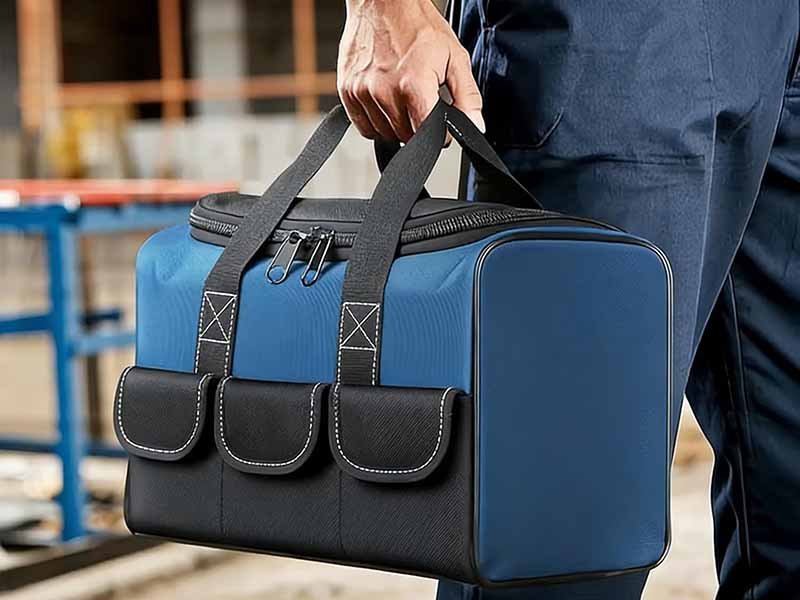
A tool bag looks simple until it starts failing in the field. At the sample stage, many bags appear strong enough. The fabric feels thick, the stitching looks acceptable, and the photos look good on a website. But once the bag is filled with pliers, wrenches, drill bits, testers, tape measures, and steel hardware, the real test begins. Corners start rubbing against concrete floors. The bottom panel gets dragged in trucks and workshops. Pockets stretch under sharp tool edges. In a few months, two bags that looked almost identical at the beginning can perform very differently.
The best fabric for a tool bag is usually not the most expensive fabric on paper. It is the fabric that matches the real job. For light-duty products, 600D polyester can be enough. For mid-range commercial use, 900D polyester often offers a good balance of cost and durability. For heavier wear, 1680D polyester gives stronger abrasion resistance and a firmer body. For demanding professional use, 1000D nylon is often the stronger long-term option because nylon handles friction and repeated abuse better than polyester.
That is why serious product development starts with fabric logic, not with color, pocket count, or zipper style. If the fabric choice is wrong, the rest of the bag is forced to carry a weak foundation. If the fabric choice is right, the bag has a much better chance of surviving daily work, protecting the tools inside, and earning repeat orders instead of complaints. Many product problems start quietly at the material stage, long before the first customer ever touches the bag.
What Do 600D, 900D, 1680D Polyester and 1000D Nylon Mean for Tool Bag Fabric?

600D, 900D, 1680D, and 1000D describe the yarn size used in the fabric. In simple terms, higher denier usually means thicker yarn and a stronger, heavier fabric. But denier alone does not decide performance. Fiber type matters too. A 1000D nylon fabric can outperform a 1680D polyester fabric in abrasion resistance because nylon itself is tougher under repeated friction.
When customers compare tool bag fabrics, they often focus too much on the number and not enough on the whole construction. Denier is important, but it is only one part of the decision. A tool bag fabric is really a combination of several variables working together:
- fiber type
- yarn thickness
- weave density
- coating type
- backing thickness
- reinforcement design
- seam construction
This is why two fabrics with similar numbers can behave very differently in real use. One may feel stiff and strong in hand but wear quickly at the bottom. Another may feel slightly softer but last longer under daily abrasion.
For brands developing custom tool bags, the real goal is not to chase the biggest number. The goal is to choose the right fabric level for the product’s price point, tool load, user type, and sales channel. A bag sold to professional electricians has a different material logic from a household tool kit sold online at a low entry price.
The table below gives a practical view of the four fabrics most often discussed in this category:
| Fabric | Fiber | General Position | Main Advantage | Main Limitation |
|---|---|---|---|---|
| 600D Polyester | Polyester | Entry level | Low cost, light weight | Lower wear resistance |
| 900D Polyester | Polyester | Mid-range | Better balance of cost and strength | Still below nylon in abrasion |
| 1680D Polyester | Polyester | Heavy-duty polyester | Stronger body, better wear resistance | Heavier, still less tough than nylon |
| 1000D Nylon | Nylon | Professional heavy-duty | Better abrasion resistance and toughness | Higher cost |
A smart factory will not only explain the numbers. It will ask what tools the bag will carry, how much weight is expected, whether the bag is for workshop use or outdoor use, and what retail price the final product must hit. That is where practical material engineering begins.
What Is Denier in Tool Bag Fabric?
Denier is a unit used to describe the thickness of synthetic yarn. Technically, it measures how many grams 9,000 meters of yarn weigh. For tool bag sourcing, the technical formula matters less than the practical meaning: a higher denier usually means a thicker yarn, a heavier fabric, and stronger resistance to tearing and wear.
In the tool bag market, denier helps define product level. A 600D fabric usually sits in the lighter-duty range. A 900D fabric moves into stronger commercial use. A 1680D fabric is generally chosen when brands want a firmer, tougher shell. A 1000D nylon fabric is often selected for more demanding professional work because the nylon fiber itself performs strongly in abrasion-heavy conditions.
Still, denier should never be read as a shortcut for quality. A bag made with “high denier fabric” can still disappoint if:
- the weave is loose
- the coating is weak
- the bottom panel is underbuilt
- the seam allowance is too small
- stress points are not reinforced
A useful way to read denier is this: it tells you the class of fabric you are looking at, but it does not tell you whether the whole bag is engineered well.
Here is a practical denier guide for tool bags:
| Denier | Weight Feel | Common Use | Recommended Position |
|---|---|---|---|
| 600D | Light | Household or occasional use | Basic price-sensitive bags |
| 900D | Medium | Daily light-to-medium work | Mid-range commercial bags |
| 1000D | Medium-heavy | Regular professional use | Electrician, service, repair bags |
| 1680D | Heavy | High-abuse use | Contractor and industrial bags |
For customers comparing quotations from multiple factories, asking only “What denier is this?” is not enough. It is far better to ask for denier together with coating type, finished fabric weight, abrasion level, and load test method.
How Does Polyester Tool Bag Fabric Differ from Nylon?
Polyester and nylon are the two main synthetic fibers used in tool bags, but they solve different problems. Polyester is widely used because it is more economical, easier to control in large-scale production, and generally stable in color and appearance. Nylon is used when the bag needs stronger abrasion resistance, better toughness, and a longer working life in rough environments.
The easiest way to understand the difference is to look at how each fiber behaves under pressure.
Polyester is a good commercial material. It works well for many tool bags because it offers:
- competitive material cost
- stable sourcing
- good color consistency
- decent strength for general use
- lower risk of overspending on entry and mid-level products
Nylon is more performance-driven. It tends to offer:
- better abrasion resistance
- stronger toughness under repeated friction
- better long-term durability in hard use
- stronger performance in premium work bags
This difference matters in the field. A bag carried occasionally for home repairs may perform perfectly well in polyester. A bag dragged daily through construction sites, garages, service vans, and dusty workshops is more likely to show the limits of polyester earlier than nylon.
The comparison below makes this clearer:
| Property | Polyester | Nylon |
|---|---|---|
| Material Cost | Lower | Higher |
| Abrasion Resistance | Good | Better |
| Tear Resistance | Good | Better |
| UV Stability | Better | Good |
| Texture Options | Broad | Broad |
| Premium Perception | Medium | Higher |
Another point customers care about is price discipline. Not every project should move to nylon. If the end market is highly price-sensitive, 900D or 1680D polyester may be the more profitable and more realistic choice. The best material is not the one with the strongest lab story. It is the one that delivers the right level of performance at the right price without creating avoidable complaints.
This is where experienced manufacturers like Lovrix create value. Instead of pushing every project to the most expensive fabric, the better approach is to match the material to the actual tool load, target customer, and market position.
Why Are 600D, 900D, and 1680D Polyester Tool Bag Fabrics Common?
These three polyester levels are common because together they cover most of the market. They give brands a clear path from entry-level products to heavier-duty products without moving immediately into the higher cost structure of nylon.
600D polyester is common because it works for basic tool bags sold for light-duty use. It is light, affordable, and easy to manufacture. It suits projects where cost control is the first priority and the expected use is moderate.
900D polyester is common because it is often the most commercially balanced option. It is strong enough for a large share of everyday tool bag use while still keeping cost under control. For many distributors and eCommerce sellers, 900D polyester offers the best mix of:
- durability
- manageable shipping weight
- acceptable price
- good product appearance
- fewer performance risks than 600D
1680D polyester is common because it lets brands offer a visibly stronger and more premium-feeling bag without necessarily switching to nylon. The fabric feels denser, the bag body can stand better, and the product usually looks more serious in photos and in hand.
A useful commercial comparison looks like this:
| Fabric | Main Market Level | Tool Weight Range | Product Style |
|---|---|---|---|
| 600D Polyester | Entry | 3–8 kg | Home use, starter kits |
| 900D Polyester | Mid-range | 8–15 kg | General work bags |
| 1680D Polyester | Upper mid to heavy-duty | 12–20 kg | Contractor-style bags |
But there is an important warning here. Many low-grade tool bags fail even when they claim to use 900D or 1680D polyester. The problem is usually not the denier itself. It is the rest of the specification:
- weak backing
- poor webbing quality
- thin bottom board
- weak zipper sewing
- lack of bartack reinforcement
- poor panel balance
So when customers ask which polyester level is best, the honest answer is that it depends not only on denier, but on whether the whole bag has been built to match that denier properly.
Why Is 1000D Nylon Used in Professional Tool Bag Fabric?
1000D nylon is used in professional tool bags because it is one of the most reliable materials for resisting abrasion, repeated handling, and hard-use damage over time. In work environments where bags are dragged, kicked, stacked, overloaded, and used every day, nylon usually holds up better than polyester.
The biggest reason is toughness under friction. Tool bags rarely fail because someone tries to pull the fabric apart in a straight line. They fail because surfaces wear them down over time. The bottom scrapes against floors. Pocket edges rub against metal tools. Corners hit rough concrete. Nylon performs well in exactly these conditions.
That is why 1000D nylon is often chosen for:
- electrician bags
- field service bags
- mechanic bags
- industrial maintenance bags
- premium contractor bags
It also supports a better product story for higher-end clients. When a brand positions a bag for serious work, the material needs to support that promise. Saying a bag uses 1000D nylon with reinforced wear zones is much easier to defend than simply saying the bag is “heavy duty.”
A practical comparison between 1680D polyester and 1000D nylon often looks like this:
| Fabric | Surface Toughness | Wear Resistance | Cost Level | Best Use |
|---|---|---|---|---|
| 1680D Polyester | Strong | Good to very good | Mid to high | Strong polyester-based bags |
| 1000D Nylon | Very strong | Very good to excellent | High | Professional heavy-use bags |
Still, nylon is not always the automatic answer. It costs more, and not every sales channel can support that cost. If the customer is targeting a lower retail band, 900D or 1680D polyester may create a healthier product than pushing nylon into a price level where the rest of the construction has to be downgraded to compensate.
Which Tool Bag Fabric Is Stronger: Polyester or 1000D Nylon?

When brands compare polyester and 1000D nylon for tool bag production, the real question is not simply “which one is stronger.” What customers actually care about is how the fabric performs after months or years of daily work. Tool bags are exposed to abrasion from concrete floors, friction against metal tools, repeated lifting, and environmental exposure such as moisture, dust, and oil. In these conditions, the performance difference between polyester and nylon becomes clearer.
In most heavy-use environments, 1000D nylon generally offers better abrasion resistance and long-term durability than polyester fabrics, even when the polyester fabric has a higher denier such as 1680D. This is because nylon fibers are naturally tougher and more elastic, allowing them to absorb stress and friction without breaking down as quickly as polyester fibers.
However, polyester fabrics—especially 900D and 1680D polyester—still perform very well for many commercial tool bag applications. The best material choice depends on the expected tool weight, working environment, and the price range of the product.
How Nylon and Polyester Behave Under Real Tool Bag Conditions
In laboratory comparisons, nylon fibers usually show higher tensile strength and abrasion resistance than polyester. But what matters more to tool bag users is how the fabric behaves under repeated friction and load.
When a tool bag is placed on rough surfaces every day, the bottom panel experiences constant abrasion. Over time, this abrasion gradually removes the protective coating and begins to break down the yarn fibers. Nylon fibers typically resist this process longer.
The table below shows typical abrasion resistance ranges measured through standard textile testing methods.
| Fabric | Abrasion Resistance (cycles) | Expected Wear Life |
|---|---|---|
| 600D Polyester | 15,000–20,000 | Light use |
| 900D Polyester | 20,000–30,000 | Moderate daily use |
| 1680D Polyester | 35,000–45,000 | Heavy commercial use |
| 1000D Nylon | 45,000–60,000 | Heavy professional use |
These numbers explain why many heavy-duty tool bags use nylon fabrics. The extra abrasion resistance helps extend the lifespan of the bag when it is used in demanding work environments.
Tear Strength and Load Performance
Another important factor is tear strength. Tool bags often experience concentrated stress around seams, pocket corners, and handle attachments. When the bag is lifted with heavy tools inside, the fabric around these areas must resist tearing.
Nylon fibers stretch slightly under stress, which allows them to distribute force more evenly across the fabric. Polyester fibers are more rigid, which means they can reach their breaking point faster when heavily loaded.
A simplified comparison of tear strength looks like this:
| Fabric | Tear Strength | Behavior Under Stress |
|---|---|---|
| Polyester | Good | Less flexible under heavy load |
| Nylon | Excellent | More flexible and resistant to tearing |
Because of this flexibility, nylon fabrics often perform better in tool bags that carry 15–25 kg of tools, especially when the bag is lifted repeatedly throughout the workday.
Surface Wear and Abrasion Points
In real usage, tool bags rarely fail in the middle of a fabric panel. Failure usually begins at specific abrasion points.
Common wear zones include:
- bottom corners
- base panels
- outer pocket edges
- areas where metal tools rub against fabric
Nylon fabrics handle these abrasion points better because their fibers recover from friction more effectively. Polyester can still perform well, but it may show visible surface wear sooner.
Manufacturers often reinforce these high-wear areas regardless of fabric type. Common reinforcement strategies include:
- double-layer bottom fabric
- rubber base pads
- reinforced seam binding
- EVA structural panels
These structural reinforcements can significantly extend the lifespan of polyester tool bags, making them competitive with nylon in many situations.
Cost Considerations for Polyester vs Nylon
While nylon may offer better performance, polyester remains extremely popular in tool bag production because it provides better cost efficiency.
Material cost differences can vary depending on market conditions, but the general comparison looks like this:
| Fabric | Relative Material Cost |
|---|---|
| 600D Polyester | Low |
| 900D Polyester | Medium |
| 1680D Polyester | Medium–High |
| 1000D Nylon | High |
For brands selling tool bags in price-sensitive markets, polyester fabrics allow them to maintain competitive retail prices while still delivering acceptable durability.
This is why many successful tool bag designs use polyester fabric for the main body and nylon reinforcement for high-stress areas.
Choosing the Right Fabric for Different Tool Bag Applications
Rather than asking which fabric is universally stronger, it is more useful to match the material to the job.
The following table shows practical fabric choices based on typical tool bag applications.
| Tool Bag Type | Recommended Fabric |
|---|---|
| Household tool bags | 600D polyester |
| Service technician bags | 900D polyester |
| Contractor tool bags | 1680D polyester |
| Industrial or professional bags | 1000D nylon |
This approach allows manufacturers to control costs while still delivering the level of durability required for each product category.
Practical Recommendation for Tool Bag Development
For brands developing new tool bag products, the best material strategy usually involves balancing durability and cost rather than choosing the strongest fabric available.
- 600D polyester works for lightweight consumer products.
- 900D polyester offers a reliable middle ground for professional technicians.
- 1680D polyester provides heavy-duty performance with manageable cost.
- 1000D nylon delivers maximum durability for demanding work environments.
When combined with strong construction techniques—such as reinforced seams, durable webbing, and structured base panels—each of these fabrics can produce reliable tool bags that meet the expectations of different market segments.
For companies developing private label tool bags, the most effective approach is to evaluate the expected tool weight, working environment, and target retail price before selecting the fabric specification. This ensures the final product achieves the right balance between durability, performance, and cost.
How Do 600D, 900D, and 1680D Polyester Tool Bag Fabrics Compare?

600D, 900D, and 1680D polyester represent three different strength levels within polyester tool bag fabrics. They are not simply different thicknesses; they represent different product positioning, load capacity expectations, and durability performance. Understanding the differences helps brands avoid underbuilding or overbuilding their products.
Polyester fabrics dominate the global tool bag market because they allow manufacturers to produce durable products while keeping costs predictable. Polyester also offers stable color consistency, relatively low moisture absorption, and compatibility with coatings such as PU or PVC.
The most important difference between 600D, 900D, and 1680D polyester is yarn thickness and weave density. Thicker yarns create stronger fabrics that resist tearing and abrasion better. However, thicker fabrics also increase bag weight and production cost.
From a product development perspective, choosing the right polyester fabric usually involves balancing four factors:
- expected tool weight
- working environment
- product price target
- shipping weight
A contractor tool bag carrying 20 kg of tools requires a stronger shell fabric than a compact electrician pouch carrying only a few hand tools. When the fabric specification matches the real use case, the bag is far more likely to perform reliably in the field.
The following table gives a practical comparison of polyester fabric levels used in tool bags.
| Fabric | Approx Weight | Durability Level | Typical Tool Load |
|---|---|---|---|
| 600D Polyester | Light | Basic durability | 3–8 kg |
| 900D Polyester | Medium | Strong commercial durability | 8–15 kg |
| 1680D Polyester | Heavy | High durability | 12–20 kg |
Another factor customers should consider is how polyester fabrics behave under repeated abrasion. Polyester performs well in general use, but under very harsh conditions nylon may still outperform it.
However, polyester remains popular because it provides a strong cost-to-performance ratio. In large production projects, the ability to control cost while maintaining acceptable durability is often more important than maximizing fabric strength alone.
Is 600D Polyester Tool Bag Fabric Too Light?
600D polyester is not necessarily too light, but it is best suited for lighter-duty tool storage rather than heavy industrial use. Many entry-level tool bags use 600D polyester because it is affordable, lightweight, and flexible during manufacturing.
For homeowners or casual DIY users, 600D polyester often provides sufficient durability. These users typically carry smaller tool sets and use the bag occasionally rather than daily.
Situations where 600D polyester performs well include:
- household tool kits
- small repair kits
- portable organizer pouches
- entry-level hardware store products
However, when tool bags are used daily in demanding environments, the limitations of 600D polyester become more visible. Under heavy loads or constant friction, the fabric may show wear sooner, especially at corners and bottom panels.
Common wear points include:
- lower corners
- base panels
- pocket edges
- zipper seams
Manufacturers sometimes compensate for this by reinforcing critical areas with double fabric layers or rubber bottom pads. When these reinforcements are applied correctly, a 600D polyester bag can still perform reliably for moderate use.
The key is realistic product positioning. When a bag designed with 600D polyester is marketed honestly as a light or mid-duty product, it can satisfy customers and maintain strong sales performance.
Why Is 900D Polyester Tool Bag Fabric Popular?
900D polyester has become one of the most widely used fabrics in tool bag manufacturing because it offers a strong balance between durability, cost, and weight. Many brands consider it the most practical option for mid-range professional tool bags.
Compared with 600D polyester, 900D fabric uses thicker yarns and tighter weave structures, which significantly improve abrasion resistance. The fabric also feels more structured, helping tool bags maintain their shape when loaded with tools.
Common applications of 900D polyester tool bags include:
- electrician tool carriers
- service technician bags
- maintenance tool totes
- compact contractor bags
These bags often carry tools weighing between 8 and 15 kilograms, which fits well within the strength capability of 900D polyester fabrics.
Another reason for its popularity is manufacturing flexibility. 900D polyester works well with coatings, padding layers, and reinforcement panels. This allows factories to enhance durability without dramatically increasing production cost.
For many brands developing private label tool bags, 900D polyester offers an attractive balance:
| Feature | Performance |
|---|---|
| Durability | Strong for daily work |
| Weight | Moderate |
| Cost | Controlled |
| Manufacturing stability | High |
Because of this balance, 900D polyester remains one of the most commercially successful fabrics in the global tool bag market.
Is 1680D Polyester the Best Polyester Tool Bag Fabric?
1680D polyester is the strongest polyester fabric commonly used for tool bags. Its thick yarn construction creates a dense, rigid fabric that resists tearing and abrasion much better than lighter polyester fabrics.
When customers pick up a tool bag made with 1680D polyester, the difference is often immediately noticeable. The fabric feels heavier, stiffer, and more robust compared with lower-denier fabrics.
These properties make 1680D polyester suitable for:
- contractor tool bags
- wide-mouth tool totes
- large capacity storage bags
- heavy-duty field equipment bags
Because of its thickness, 1680D polyester also helps the bag maintain structure. Many large tool bags use this fabric to ensure the opening stays wide and accessible when tools are inside.
However, stronger fabric also means:
- higher fabric cost
- increased bag weight
- slightly higher shipping cost
This means that 1680D polyester is most suitable when durability and perceived quality are priorities.
For brands targeting professional markets, this fabric can create a strong product impression while still remaining more affordable than nylon.
How Do Coatings Improve Polyester Tool Bag Fabric?
Coatings play a crucial role in improving polyester fabric performance. Without coatings, polyester fabrics would be softer, less water resistant, and more prone to wear.
Two coatings are particularly common in tool bag production.
| Coating | Characteristics | Typical Use |
|---|---|---|
| PU coating | Flexible and lightweight | General tool bags |
| PVC coating | Thick and highly water resistant | Heavy-duty tool bags |
PU coatings help fabrics resist moisture and maintain flexibility. They are widely used in mid-range tool bags because they add protection without making the fabric overly stiff.
PVC coatings create a thicker protective layer that significantly improves abrasion resistance and water protection. Many heavy-duty tool bags use PVC-coated polyester for the bottom panels where wear is most severe.
Coatings also help fabrics maintain their shape. A coated fabric has more structural stability, which allows tool bags to remain open and accessible during use.
For professional products, combining polyester fabric with proper coating systems can greatly extend the service life of the bag.
Which Tool Bag Fabric Is Best for Different Jobs?

Different trades place different demands on tool bags. The ideal fabric depends not only on durability but also on tool weight, working conditions, and portability requirements.
Electricians, mechanics, contractors, and technicians all carry different types of equipment. As a result, tool bag manufacturers often tailor fabric selection to match the needs of each profession.
Understanding these differences helps brands develop products that perform well in real working environments rather than relying solely on marketing claims.
What Tool Bag Fabric Do Electricians Use?
Electricians often prefer tool bags that balance durability with portability. Electrical tools are typically heavy but compact, and electricians frequently move between work locations.
Because of this, tool bags for electricians usually prioritize:
- moderate weight
- strong pocket organization
- durable but flexible fabric
900D polyester and 1000D nylon are common choices. These fabrics provide enough durability to handle daily use while keeping the bag comfortable to carry.
Electrician tool bags often include reinforced pockets because sharp tools like screwdrivers and pliers can create concentrated stress points.
Which Tool Bag Fabric Works for Mechanics?
Mechanics usually need stronger fabrics because their tools are heavier and frequently covered in oil or grease. Tool bags used in automotive environments are exposed to rough surfaces and constant handling.
For this reason, many mechanic tool bags use:
- 1000D nylon
- 1680D polyester
- reinforced polyester fabrics with PVC coating
These fabrics handle friction and tool weight better than lighter materials.
Mechanic tool bags also benefit from oil-resistant coatings that help prevent stains and extend the life of the fabric.
What Tool Bag Fabric Do Contractors Prefer?
Contractors often carry the heaviest tools and work in the harshest environments. Their tool bags are frequently placed on concrete floors, gravel surfaces, and construction debris.
Because of this, contractor tool bags typically use stronger materials such as:
- 1680D polyester
- 1000D nylon
- reinforced canvas
Contractor bags also require reinforced bottom panels because the base of the bag experiences the most wear during daily use.
Is Polyester or Nylon Tool Bag Fabric Better for Outdoor Work?
For outdoor environments, durability and weather resistance are both important. Polyester fabrics generally offer better UV resistance, which helps them maintain color and structure when exposed to sunlight.
Nylon fabrics, on the other hand, provide better abrasion resistance and toughness.
The choice often depends on the working environment:
| Environment | Better Fabric Choice |
|---|---|
| Outdoor electrical work | Polyester |
| Construction sites | Nylon |
| Service vehicles | Polyester or nylon |
| Industrial maintenance | Nylon |
Many manufacturers combine the two materials to achieve the best balance of durability and environmental resistance.
How Do Manufacturers Choose Tool Bag Fabric?
Choosing the right fabric for a tool bag is not a simple decision based on thickness or denier alone. Professional manufacturers evaluate multiple variables before selecting materials for production. These decisions affect the bag’s durability, cost, weight, and long-term reliability.
A well-designed tool bag must survive several types of stress at the same time:
- friction against rough surfaces
- pressure from heavy tools
- repeated opening and closing
- exposure to moisture, dust, and oil
To handle these conditions, factories usually consider five main criteria when selecting fabric.
| Evaluation Factor | Why It Matters |
|---|---|
| Abrasion resistance | Prevents early wear from rough surfaces |
| Tear strength | Stops fabric from splitting under load |
| Coating quality | Improves water resistance and structure |
| Weight control | Ensures bag remains portable |
| Cost efficiency | Keeps product competitive in the market |
Balancing these factors is essential. A bag designed only for maximum strength may become too heavy or too expensive. On the other hand, choosing a fabric purely for cost savings can lead to premature wear and customer complaints.
Experienced manufacturers therefore approach fabric selection as a system decision, not a single material choice.
How Do Factories Test Polyester and Nylon Tool Bag Fabric?
Before fabrics are approved for tool bag production, many factories perform several physical tests to evaluate durability and reliability. These tests simulate real working conditions and help identify potential weaknesses in the material.
Common fabric tests include:
| Test Type | Purpose |
|---|---|
| Abrasion test | Measures resistance to surface wear |
| Tear strength test | Determines how easily fabric rips |
| Tensile strength test | Measures resistance to pulling force |
| Water resistance test | Evaluates coating effectiveness |
| Color fastness test | Ensures dye stability |
Abrasion testing is particularly important for tool bags because the bottom panel and outer pockets often experience heavy friction during daily use.
For example, fabrics may be tested using abrasion machines that rub the material repeatedly against a rough surface. The number of cycles a fabric can withstand before showing visible damage indicates its durability.
Typical abrasion ranges for common tool bag fabrics include:
| Fabric | Abrasion Cycles |
|---|---|
| 600D Polyester | 15,000 – 20,000 |
| 900D Polyester | 20,000 – 30,000 |
| 1680D Polyester | 35,000 – 45,000 |
| 1000D Nylon | 45,000 – 60,000 |
These results help manufacturers decide which fabric is appropriate for each product category.
How Do Tool Bag Fabrics Affect Load Capacity?
Fabric choice directly influences how much weight a tool bag can carry safely. While reinforcement structure and seam construction also play important roles, the fabric must still provide the core strength that supports the bag’s structure.
Load capacity depends on three main fabric characteristics:
- yarn thickness
- weave density
- fiber strength
Thicker yarns and stronger fibers allow the bag to distribute weight across the fabric surface more evenly. This reduces stress concentration at seams and corners.
The following table shows typical load capacities for different tool bag fabrics.
| Fabric Type | Estimated Load Capacity |
|---|---|
| 600D Polyester | 3–8 kg |
| 900D Polyester | 8–15 kg |
| 1680D Polyester | 12–20 kg |
| 1000D Nylon | 15–25 kg |
These ranges vary depending on bag design and reinforcement methods. For example, adding a rigid bottom panel or double-layer fabric can significantly increase load capacity.
Professional tool bags often include additional reinforcement elements such as:
- heavy webbing handles
- bartack stitching at stress points
- reinforced base panels
- internal support boards
Together, these features allow the bag to carry heavy tools without losing shape or tearing.
How Do Brands Balance Cost and Tool Bag Fabric Quality?
One of the biggest challenges in product development is balancing durability with cost. A tool bag built with premium materials may perform extremely well but could exceed the price range that the target market is willing to pay.
For this reason, brands often develop multiple product tiers based on fabric specification.
| Product Tier | Fabric Choice | Market Position |
|---|---|---|
| Entry level | 600D polyester | Household or DIY users |
| Mid-range | 900D polyester | Professional technicians |
| Upper mid-range | 1680D polyester | Contractors and heavy use |
| Premium | 1000D nylon | Industrial and professional markets |
Each level offers different advantages. Entry-level products focus on affordability, while premium products emphasize durability and long-term reliability.
The most successful tool bag brands carefully align fabric selection with their target customers. When the product specification matches the intended market, customers are more satisfied and the brand avoids unnecessary warranty costs.
How Does Lovrix Develop Custom Tool Bag Fabric for Brands?
Lovrix works with global brands and e-commerce companies to develop custom tool bags that match their exact product requirements. With more than 18 years of experience in fabrics, webbing, and bag manufacturing, Lovrix provides an integrated development process that covers material selection, design engineering, sampling, and production.
The development process typically follows several stages.
1. Product Requirement Analysis
The first step is understanding how the tool bag will be used. This includes evaluating:
- tool weight and size
- working environment
- target retail price
- brand positioning
These details determine which fabric categories are suitable.
2. Fabric Selection
Lovrix offers multiple material options including:
- 600D, 900D, and 1680D polyester fabrics
- 1000D nylon fabrics
- coated waterproof fabrics
- reinforced composite materials
Each fabric option is evaluated based on durability, cost, and design requirements.
3. Structural Engineering
The design team develops reinforcement structures that improve durability. These may include:
- double-layer base panels
- EVA bottom boards
- reinforced pocket stitching
- heavy-duty webbing handles
4. Rapid Sampling
Lovrix provides fast sampling services so clients can evaluate product quality before bulk production begins.
5. Quality-Controlled Production
During production, strict quality inspections ensure that materials and construction meet the agreed specifications.
Because Lovrix operates its own fabric factory, webbing factory, and bag manufacturing facility, it can control material quality and production timelines more effectively than suppliers that rely entirely on external sourcing.
This integrated manufacturing structure helps ensure consistent quality across repeat orders.
Request a Custom Tool Bag Quote from Lovrix
Choosing the right fabric is one of the most important steps in developing a successful tool bag. The difference between 600D polyester, 900D polyester, 1680D polyester, and 1000D nylon can significantly affect durability, cost, and customer satisfaction.
Brands that carefully match fabric specifications with their target market are far more likely to produce tool bags that perform well and generate repeat sales.
Lovrix specializes in helping brands design and manufacture custom tool bags with the right combination of:
- durable fabrics
- reinforced construction
- optimized cost structure
- reliable production capacity
Whether you need 600D polyester tool bags for entry-level markets or 1000D nylon heavy-duty tool bags for professional use, Lovrix can support your project from concept to mass production.
If you are planning a new tool bag product or looking for a reliable manufacturing partner, you are welcome to contact Lovrix to discuss your requirements and request a custom quotation.


