 Skip to content
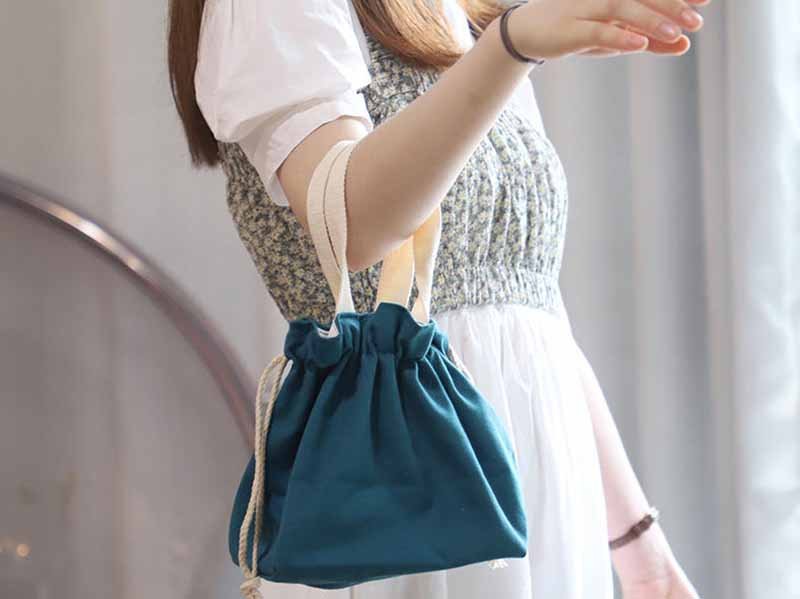
Most drawstring bag problems don’t start in the sewing room—they start on the fabric spec sheet. Two bags can look the same online, but one feels “cheap” and wrinkles like paper, while the other feels confident and holds its shape. The difference is often a number most people ignore: GSM (grams per square meter) or oz/yd². That number quietly controls the bag’s hand-feel, seam strength near the drawcord, printing crispness, and even how much you’ll pay to ship thousands of units.
Here’s the truth many brands learn the hard way: “Strong stitching” can’t save weak fabric. If the fabric is too light, the drawcord channel will tear sooner or later—especially when customers cinch it hard or carry sharp-edged items like shoes, books, or tools. On the other hand, choosing a fabric that’s too heavy can make the bag uncomfortable, stiff, and expensive to ship, which hurts conversion for e-commerce orders.
GSM and oz are fabric weight standards used to select the right drawstring bag material. Lower weights (about 120–180 GSM) fit short-term promo bags, mid weights (about 200–300 GSM) fit daily-use bags, and heavier weights (320+ GSM or 10+ oz canvas) fit long-life laundry and gear bags. The right number depends on use, fabric type, printing method, and shipping cost.
A small story you’ll recognize: a brand once told us their drawstring bags “kept failing at the top seam.” They changed thread, machines, even the pattern. The real fix? They moved from a thin fabric to a mid-weight fabric and added simple reinforcement. Same design—completely different result.
What isSM/Oz for drawstring bags?

GSM and oz are the two most common ways to describe fabric weight in drawstring bags. They indicate how thick, strong, and durable the material will feel in daily use. Lower numbers usually mean lighter and cheaper bags, while higher numbers suggest stronger structure, better printing stability, and longer lifespan. Choosing the correct range helps brands avoid tearing, wrinkling, or unnecessary shipping cost.
When brands compare drawstring bag samples, the first reaction is often emotional:
“This one feels soft.”
“That one feels stronger.”
Behind that feeling is usually fabric weight.
GSM and oz provide a measurable way to control that feeling, turning guesswork into a clear technical decision.
What does GSM actually tell you in real production?
GSM (grams per square meter) measures how much one square meter of fabric weighs after finishing.
For drawstring bags, this single number connects directly to several performance factors that customers care about:
- Resistance to tearing near the drawcord channel
- How flat and stable the surface is for printing
- How well the bag keeps its shape when filled
- How heavy the final shipment becomes
- How long the bag survives repeated daily use
Because of this, GSM is often the first parameter locked in before pattern making or pricing.
A useful real-world reference:
| GSM Range | Customer Perception | Typical Lifespan (daily use) |
|---|---|---|
| 120–150 | very thin, giveaway quality | weeks |
| 160–200 | light but usable | 1–3 months |
| 200–260 | balanced everyday feel | 6–12 months |
| 260–320 | strong, retail quality | 1–2 years |
| 320+ | thick, heavy-duty | multi-year use |
This table reflects actual usage patterns, not laboratory theory.
Many complaint cases in e-commerce happen when a bag expected to last a year is produced below 200 GSM.
Why oz is still widely used for drawstring bags
In North American sourcing, canvas fabrics are often described in ounces per square yard (oz/yd²) instead of GSM.
Both units measure the same idea—fabric weight—but in different measurement systems.
For example:
| oz/yd² | Approx. GSM | How the bag feels in hand |
|---|---|---|
| 4 oz | ~135 GSM | very soft and foldable |
| 6 oz | ~200 GSM | light everyday use |
| 8 oz | ~270 GSM | noticeable strength |
| 10 oz | ~340 GSM | structured, premium feel |
| 12 oz | ~405 GSM | heavy and rugged |
Understanding this conversion is important when communicating with different regions.
Without it, brands may accidentally approve a fabric that is 20–30% lighter than expected.
The simple conversion brands actually use
The working relationship between the two units:
1 oz/yd² ≈ 33.9 GSM
So in practice:
- 6 oz canvas ≈ 200 GSM
- 8 oz canvas ≈ 270 GSM
- 10 oz canvas ≈ 340 GSM
Most factories and sourcing teams memorize only a few key points like these, because they cover the majority of drawstring bag projects.
Why GSM alone is not enough
A common misunderstanding is assuming:
Same GSM = same durability
In reality, durability also depends on:
- Fiber type (cotton vs polyester vs nylon)
- Weave density (tight canvas vs loose plain weave)
- Finishing process (washing, coating, shrinking)
Two fabrics can both be 260 GSM, yet one tears much sooner because the yarn structure is weaker.
Example comparison:
| Fabric Type | GSM | Tear Resistance | Reason |
|---|---|---|---|
| Cotton plain weave | 260 | medium | softer yarn, looser weave |
| Cotton canvas | 260 | higher | dense weave structure |
| Polyester Oxford | 260 | very high | strong synthetic fibers |
This is why experienced product teams evaluate GSM together with material type, not separately.
How GSM affects real customer experience
From the end user’s perspective, fabric weight influences three visible things:
1. Appearance in photos
Thin fabric wrinkles easily and looks inexpensive online.
Heavier fabric holds shape and improves perceived value.
2. Comfort during carrying
Very heavy fabric may feel stiff on the back or shoulders.
Balanced GSM improves usability.
3. Long-term satisfaction
Customers rarely measure GSM, but they quickly notice:
- tearing corners
- stretched seams
- faded printing
These problems are often linked to insufficient fabric weight, not sewing quality.
A practical rule used by many brands
Instead of asking for the highest GSM, experienced brands follow a simpler rule:
Choose the lowest GSM that still meets durability expectations.
This approach:
- controls cost
- keeps shipping weight reasonable
- maintains comfort
- still protects product reputation
For most everyday drawstring bags, that balance point falls between:
200–280 GSM (≈6–8 oz canvas equivalent).
This deeper understanding of GSM and oz helps brands move from trial-and-error sampling to predictable product development, reducing delays and unexpected quality complaints before mass production even begins.
Which GSM fits different drawstring bags?

Different drawstring bags need different GSM because they face different loads, friction, and customer expectations. For short-term promotions, 120–180 GSM is common. For everyday gym/commute use, 200–300 GSM is usually the sweet spot. For long-life laundry/gear bags, 320+ GSM (or 10+ oz canvas) is preferred, often combined with reinforcement.
A fast “match the use” chart (what customers actually want)
| Use case | Recommended GSM (cotton/canvas) | Recommended oz | Notes brands should care about |
|---|---|---|---|
| Event giveaway, promo | 120–160 GSM | 3.5–5 oz | low cost, low lifespan; avoid heavy loads |
| School/club bag | 160–220 GSM | 5–6.5 oz | better seams; still light for kids |
| Gym sack (shoes + towel) | 200–280 GSM | 6–8 oz | best balance of feel + durability |
| Retail “premium” drawstring | 260–340 GSM | 8–10 oz | holds shape; looks better in photos |
| Laundry bag (home/hotel) | 320–420 GSM | 10–12 oz | needs strong drawcord channel |
| Gear/tool storage sack | 360–540 GSM | 11–16 oz | heavy; consider comfort + shipping |
Which GSM suits lightweight drawstring bags?
Lightweight drawstring bags are usually designed for:
- Maximum quantity per budget
- Simple printing
- Low shipping weight
- Short life (weeks or months, not years)
A practical range for cotton/nonwoven is 120–160 GSM.
If you go lower, you may face:
- Fabric “pinholes” after printing
- Weakness at the top seam
- Easy tearing when customers cinch hard
If you go slightly higher (160–180 GSM), you get a noticeable improvement in “feel” with a small cost increase—often worth it for brands that don’t want a cheap impression.
Where failures happen most: the top corners and the drawcord exit point. For lightweight fabrics, adding a small reinforcement patch is often cheaper than moving up a GSM level.
Which GSM suits daily drawstring bags?
Daily-use drawstring bags are the “make-or-break” category because customers actually use them repeatedly:
- Gym, commuting, travel day bag
- Shoes, clothes, small laptop/tablet
- Frequent opening/closing cycles
A reliable range for cotton/canvas daily use is 200–280 GSM (about 6–8 oz).
This range typically gives:
- Better seam holding strength at the drawcord channel
- Cleaner print edges (less texture distortion)
- Better shape retention for product photos
- More stable hand-feel across batches
This is also the range where brands can confidently offer private label versions without worrying about “why does this batch feel different?”
Which GSM suits heavy-duty drawstring bags?
Heavy-duty drawstring bags usually carry:
- Laundry (wet towels, heavy denim)
- Work gear
- Outdoor equipment
For cotton/canvas, aim at 320–420 GSM (about 10–12 oz).
But heavy-duty success is not only GSM. It’s also construction.
A strong heavy-duty setup often combines:
- Mid-heavy body fabric (320–380 GSM)
- Reinforced top channel
- Strong drawcord (and proper cord diameter)
- Stress-bar tack stitching at exits
Here is a simple durability rule many factories follow:
| Component | Minimum recommendation for heavy-duty drawstring bags |
|---|---|
| Body fabric | 320+ GSM canvas (or equivalent) |
| Drawcord channel | folded + double stitched |
| Cord diameter | thicker cord reduces cutting into fabric |
| Exit points | bar tacks + eyelets/grommets (optional) |
| Bottom panel | consider double layer for abrasion |
Which fabrics use GSM in drawstring bags?

GSM is mainly used for cotton, canvas, jute, and nonwoven materials in drawstring bags, while polyester and nylon are usually specified by denier. Understanding which measurement applies prevents wrong sourcing decisions, mismatched samples, and unexpected durability problems in mass production.
Fabric weight language changes depending on fiber type. Many sourcing mistakes happen because a brand asks for “300 GSM polyester,” while the factory quotes “210D polyester.” Both are valid—but they describe different technical dimensions. GSM measures area weight, while denier measures fiber thickness. To choose correctly, you must understand how each material behaves in real use.
Do cotton and canvas drawstring bags use GSM?
Yes. Cotton, canvas, and jute are almost always defined by GSM or oz. These fibers form woven fabrics where area density directly reflects thickness and strength, making GSM highly meaningful.
For cotton canvas drawstring bags, GSM closely correlates with:
- Fabric stiffness and structure
- Abrasion resistance
- Seam holding strength
- Printing surface stability
Because of this clear relationship, GSM becomes the primary decision metric for cotton-based bags.
Here is a realistic positioning table used in many factories:
| Cotton/Canvas GSM | Product Level | Real-World Impression |
|---|---|---|
| 120–160 | promotional | soft, flexible, short lifespan |
| 180–240 | standard retail | balanced feel and durability |
| 260–340 | premium retail | structured, long-lasting |
| 360+ | heavy duty | rugged, thick, utility focused |
For brands building mid-to-high-end product lines, the most common successful range is 220–320 GSM because it balances durability, comfort, and shipping weight.
Do polyester and nylon drawstring bags use denier instead of GSM?
Most of the time, yes. Polyester and nylon fabrics—especially Oxford or ripstop—are typically described using denier (D) such as:
- 190D
- 210D
- 420D
- 600D
Denier measures yarn thickness, not total fabric weight.
However, denier still connects indirectly to durability:
| Denier | Common Use in Drawstring Bags | Strength Level |
|---|---|---|
| 190D | ultra-light promo sacks | low |
| 210D | standard gym sacks | medium |
| 420D | durable sport bags | high |
| 600D | heavy utility sacks | very high |
Even though denier is primary, GSM still exists in the background because coatings, weave density, and finishing change total weight. Professional factories internally track both numbers.
How does fabric type change GSM choice for drawstring bags?
Different fibers deliver different strength-to-weight efficiency.
For example:
| Material | Strength at Same GSM | Key Advantage |
|---|---|---|
| Cotton canvas | medium | natural look, print friendly |
| Polyester Oxford | higher | lighter with strong tear resistance |
| Nylon | very high | excellent durability-to-weight ratio |
| Jute | bulky | eco image, rough texture |
This means a 220 GSM polyester bag may perform like a 300 GSM cotton bag in tearing resistance.
Therefore, correct GSM selection always depends on fiber type + use scenario, not weight alone.
How does GSM affect drawstring bags?

GSM directly influences durability, structure, printing quality, comfort, and total cost. Higher GSM usually improves strength and appearance but increases material usage, shipping weight, and stiffness. The best GSM is the point where durability meets customer comfort and price expectations.
How GSM changes strength and durability of drawstring bags
Fabric failure in drawstring bags usually occurs in three places:
- Drawcord exit points
- Top channel seam
- Bottom corner abrasion
Higher GSM improves resistance in all three zones because:
- Thicker yarn bundles resist tearing
- Dense weave spreads stress across fibers
- Heavier fabric tolerates repeated folding
A simplified durability comparison:
| GSM Range | Expected Lifespan (daily use) | Risk Level |
|---|---|---|
| <150 | weeks | tearing likely |
| 180–240 | months | moderate wear |
| 260–320 | 1–2 years | stable |
| 340+ | multi-year | very strong |
For brands selling online, moving from 180 GSM to 240 GSM often reduces complaint rates significantly without large cost increase.
How GSM affects printing on drawstring bags
Printing clarity depends heavily on surface stability.
Low GSM fabrics may cause:
- Ink bleeding through thin fibers
- Wrinkled print surfaces
- Distorted logo edges
Mid-to-high GSM fabrics provide:
- Flatter print plane
- Better color density
- Improved wash resistance
Printing suitability by GSM:
| GSM | Screen Print | Heat Transfer | Embroidery |
|---|---|---|---|
| <150 | fair | fair | poor |
| 180–240 | good | good | acceptable |
| 260–320 | very good | very good | good |
| 340+ | excellent | excellent | very good |
This is why premium retail drawstring bags rarely use very light fabric—print quality directly affects perceived brand value.
How GSM influences cost of drawstring bags
Fabric weight affects three major cost areas:
- Material consumption – heavier GSM = more raw fiber per bag
- Shipping weight – affects ocean freight and air freight
- Handling efficiency – thicker fabric reduces packing density
A practical cost trend:
| GSM Increase | Fabric Cost Change | Shipping Impact |
|---|---|---|
| +20% GSM | ~+12–18% fabric cost | small |
| +50% GSM | ~+30–40% fabric cost | noticeable |
| +100% GSM | ~+70–90% fabric cost | significant |
Because of this, experienced brands avoid choosing GSM based only on “stronger is better.”
Instead, they look for the lowest GSM that still meets durability expectations.
How to choose the right GSM for drawstring bags?

Choosing the correct GSM for drawstring bags requires balancing durability, comfort, appearance, and cost. The safest method is to define the real use scenario first, compare material performance at different GSM levels, confirm tolerance through sampling, and lock specifications before mass production.
Many sourcing problems happen not because factories lack capability, but because GSM expectations were never clearly defined. When brands only request “thick fabric” or “good quality canvas,” suppliers may interpret those words differently. Clear GSM selection prevents redesign, delays, and unexpected cost increases later.
What GSM should brands request from factories for drawstring bags?
The correct GSM always starts from how the customer will actually use the bag, not from the lowest quotation.
A practical decision flow used by experienced product teams:
- Define the main load
- Light items (flyers, T-shirts)
- Medium items (shoes, books, gym gear)
- Heavy items (laundry, tools)
- Define expected lifespan
- Event use (days or weeks)
- Seasonal retail (months)
- Long-term reuse (years)
- Match GSM range to both factors
| Use Level | Suggested GSM (cotton/canvas) | Why this range works |
|---|---|---|
| Short promotion | 120–160 | lowest cost, acceptable for brief use |
| Daily retail | 200–280 | balance of comfort, strength, and price |
| Premium reusable | 260–340 | stronger seams, better structure |
| Heavy-duty storage | 320–420 | resists tearing and abrasion |
Increasing GSM beyond the real need rarely improves customer satisfaction—but it always increases cost and shipping weight. The goal is sufficient strength, not maximum thickness.
How to confirm GSM with samples for drawstring bags?
Professional brands never rely only on a quotation sheet.
They confirm GSM through structured sampling.
A reliable sampling workflow:
Step 1 — Request at least two GSM options
Example: 220 GSM and 280 GSM.
Side-by-side comparison makes differences obvious.
Step 2 — Perform real-use testing
- Load weight simulation
- Repeated drawcord pulling
- Washing and drying
- Abrasion at bottom corners
Step 3 — Measure actual GSM
Factories typically allow ±5% tolerance.
Anything wider may cause batch inconsistency.
| Nominal GSM | Acceptable Range (±5%) | Risk if exceeded |
|---|---|---|
| 200 | 190–210 | uneven feel between batches |
| 260 | 247–273 | print variation, seam stress |
| 320 | 304–336 | shipping weight instability |
Step 4 — Freeze the specification before bulk order
This should appear in the purchase contract or tech pack, not only in email discussion.
Do custom drawstring bags need different GSM standards?
Yes.
Customization changes structural stress, which may require GSM adjustment.
Common situations where GSM must increase:
- Large logo embroidery → adds needle holes and tension
- Metal eyelets or grommets → concentrates stress near exits
- Extra-wide bags → spreads load across larger fabric span
- Heavier drawcord materials → stronger pulling force
A quick adjustment reference:
| Custom Feature | Recommended GSM Change |
|---|---|
| Standard screen print | no change |
| Large embroidery logo | +20–40 GSM |
| Metal eyelets added | +30–60 GSM |
| Oversized laundry bag | +60–120 GSM |
Ignoring these adjustments is a common cause of tearing complaints after launch.
Factory quality control that protects GSM consistency
Stable GSM in mass production depends on raw yarn control, weaving density monitoring, finishing shrinkage management, and final inspection sampling. Without these controls, even a correct GSM choice can fail in bulk delivery.
Key production stages that influence final GSM
- Yarn thickness variation Small yarn differences multiply across the fabric surface.
- Weaving density drift Loose weaving lowers GSM and strength simultaneously.
- Dyeing and washing shrinkage Fabric may tighten, raising GSM after finishing.
- Moisture regain during storage Cotton absorbs humidity, slightly changing measured weight.
Because of these variables, professional factories test GSM at multiple stages, not only at the end.
Bulk inspection method used in stable supply chains
Reliable suppliers usually apply a 4-point fabric inspection system combined with random GSM sampling per batch.
Typical bulk control plan:
| Production Stage | Control Action |
|---|---|
| Greige fabric | yarn + density check |
| After dyeing | shrinkage + GSM re-test |
| Before cutting | random roll verification |
| Finished bags | weight consistency sampling |
This layered control is what separates stable OEM production from inconsistent low-cost sourcing.
How Lovrix supports accurate GSM selection for custom drawstring bags
Choosing GSM is not only a technical task—it is a product strategy decision.
Lovrix works with global brands by combining material engineering, sampling speed, and production stability to ensure the selected GSM truly fits the market position.
What brands gain when working with Lovrix
1. Fast comparative sampling
Multiple GSM options prepared quickly for real-use evaluation.
2. Clear technical guidance
Recommendations based on:
- Load requirement
- Printing method
- Target retail price
- Shipping efficiency
3. Stable bulk production
Controlled weaving, finishing, and inspection ensure consistent GSM across orders, reducing complaint risk.
4. Flexible customization
- Cotton, canvas, polyester, nylon, jute, and blended fabrics
- Reinforced structures for heavy-duty use
- Private label and OEM development for global brands
With more than 18 years of fabric, webbing, and bag manufacturing experience, Lovrix helps clients avoid costly trial-and-error and move directly toward market-ready drawstring bag products.
Start Your Custom Drawstring Bag Project
If you are planning a new drawstring bag line—or improving an existing one—the right GSM choice is the foundation of durability, comfort, and brand perception.
Tell us your target use, price range, and preferred material.
Our team will recommend the most suitable GSM and prepare samples for evaluation.
Your next successful drawstring bag often begins with a single number—
but choosing that number correctly makes all the difference.


