 Skip to content
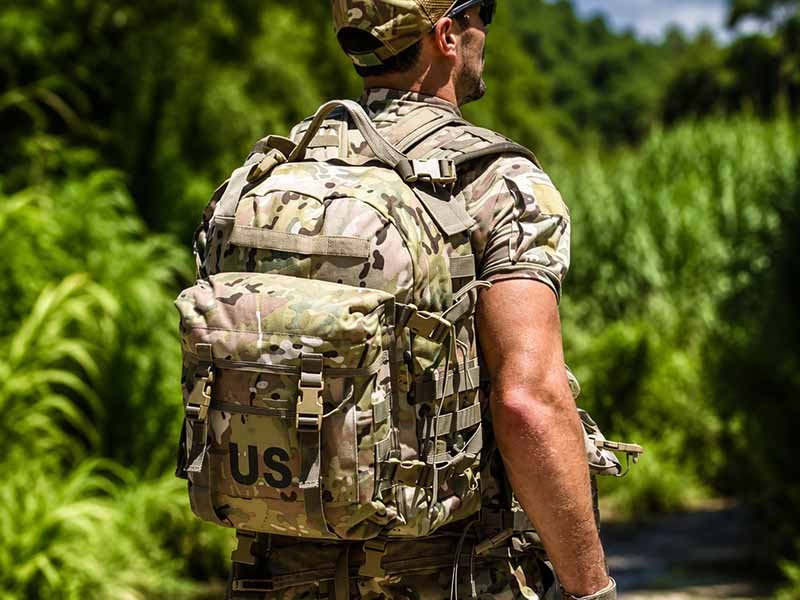
A camouflage pattern may look perfect on a computer screen and still become the wrong choice once it is turned into a hunting bag. A real hunting backpack is pushed through branches, dragged across rough ground, exposed to rain and mud, loaded with equipment, opened in cold weather, and sometimes handled when the hunter is only a short distance from game. That means camouflage fabric has to do much more than simply hide the product visually. It must work as part of the bag’s structure.
The right camouflage fabric for a hunting bag should match the hunting environment, expected load, abrasion level, moisture exposure, desired bag weight, surface noise, coating system, and camouflage pattern. A 500D nylon, 600D polyester, ripstop construction, or heavier 1000D material can all be good choices when they are used in the right product and in the right part of that product.
This is where many otherwise promising hunting bags go wrong. A development team chooses the most impressive camouflage print, orders a heavy fabric because “heavier sounds stronger,” and only later discovers that the finished backpack is too stiff, too noisy, or unnecessarily heavy. The better approach is to work backwards from how the hunter will actually use the bag. Once that is clear, fabric decisions become much easier.
What Does a Hunting Bag Need From Camouflage Fabric?

A hunting bag needs camouflage fabric that balances concealment, abrasion resistance, tear strength, weather protection, weight, flexibility, and noise. The correct specification depends on where the bag will be used, how much weight it will carry, which panels receive the most wear, and how closely the hunter may operate around game. No single fabric specification is ideal for every hunting application.
Field Conditions
Fabric selection should begin with the field rather than the fabric catalog. A small whitetail daypack used around a tree stand experiences different stresses from a 50-liter mountain hunting backpack carried over rock, deadfall, and dry scrub. A waterfowl blind bag may sit repeatedly on wet ground or a muddy boat floor, while a turkey hunting bag may be handled more quietly and opened frequently for calls, ammunition, or small accessories.
The important step is to identify where each part of the bag will experience stress. Bottom panels usually receive more abrasion and moisture than the upper shell. Side panels are more likely to scrape against branches and brush. Front pockets are touched, folded, and opened repeatedly. Shoulder areas flex under load, while bow, rifle, tripod, or tool attachment zones may experience concentrated friction that the rest of the bag rarely sees.
Temperature should also be considered during material selection. A coated textile that feels reasonably soft at 20–25°C can become noticeably stiffer in cold conditions. That change can affect panel movement, zipper operation, folding behavior, and sound. Hunting products intended for late-season or winter use should therefore not be judged only from swatches handled in a warm office or showroom.
Moisture exposure needs the same level of definition. “Outdoor use” can mean occasional wet grass, repeated light rain, several hours in heavy rain, or direct contact with wet ground. Those conditions require different levels of coating, lamination, seam protection, and construction. Good fabric selection begins by defining what the product is expected to survive instead of choosing a popular material and trying to fit every hunting bag around it.
Performance Priorities
Abrasion resistance is usually one of the first concerns for hunting bags because these products touch rough surfaces more frequently than many lifestyle backpacks. Abrasion resistance, however, should not be confused with tear resistance. A fabric can withstand repeated rubbing but still propagate a tear rapidly once a sharp branch or piece of equipment creates an initial cut. Serious outdoor specifications often need both properties considered separately.
Weight becomes increasingly important as the backpack gets larger. An additional 40–60 g/m² may seem insignificant when evaluating a small fabric swatch, but that extra weight is multiplied across the front, back, sides, lid, pockets, and reinforcements of a large hunting pack. When multiple layers overlap at seams, the difference becomes even more noticeable. Fabric weight should therefore be considered based on actual material consumption rather than only on a specification sheet.
Noise is another important performance factor that is often overlooked in ordinary bag manufacturing. A technically durable fabric may still be unsuitable for close-range bow hunting or whitetail hunting if it produces a sharp scraping or crackling sound whenever two panels rub together. Softer woven surfaces, brushed finishes, peached fabrics, and certain laminated structures can reduce this problem, although they may introduce trade-offs in abrasion resistance, cleaning, and water shedding.
Color stability also matters because camouflage is not merely decoration. Its effectiveness depends on the relationship between several colors and shapes. If dark sections fade more quickly than lighter sections after prolonged sunlight exposure, the overall camouflage pattern can change. For brands producing repeat orders, lot-to-lot print consistency may be equally important because noticeably different camouflage tones across production batches can make the product line look inconsistent.
Strongest Is Not Always Best
The strongest or heaviest available fabric is not automatically the best material for a hunting bag. Heavy constructions may provide more abrasion margin, but they can also increase finished weight, stiffness, sewing bulk, cost, and surface noise. Additional durability is valuable only when the product actually uses that extra performance in the field.
Denier is one of the most misunderstood numbers in bag development. Denier measures the linear density of the yarn. It does not independently describe fabric strength, fabric weight, weave density, coating thickness, tear resistance, or abrasion performance. Two fabrics labeled 500D can behave differently because one uses higher-tenacity yarn, tighter construction, a different weave, or a more substantial coating system.
This is why experienced bag developers often use material zoning instead of selecting one heavy fabric for the entire product. A 500D-class shell may provide sufficient durability across the upper and side panels, while a 700D, 900D, 1000D, or laminated material is reserved for the bottom and other high-contact zones. Internal reinforcement can strengthen shoulder straps and handles without forcing every visible panel to become unnecessarily heavy.
Material zoning also makes manufacturing easier. Around a shoulder-strap anchor, a sewing machine may need to penetrate shell fabric, reinforcement, webbing, foam, lining, and several folded layers at the same time. Using extremely heavy fabric everywhere can create thick seam stacks, needle deflection, poor corner definition, and inconsistent stitching. A balanced material system usually produces a more refined and more wearable hunting bag than a specification built around the largest possible numbers.
Which Camouflage Fabric Is Best for Hunting Bags?

There is no universal best camouflage fabric for every hunting bag. 600D polyester is practical for many general-purpose products, while 330D–500D high-tenacity nylon suits lighter technical packs. Heavier 700D–1000D materials work well in high-abrasion areas, while ripstop constructions help control tear propagation. Quiet hunting products may instead prioritize softer or brushed surfaces over maximum fabric stiffness.
| Fabric Direction | Typical Hunting-Bag Use | Main Strength | Main Trade-Off |
|---|---|---|---|
| 300D–420D polyester or nylon | Lightweight pockets, accessory bags, covers | Lower weight and easier folding | Less margin against severe abrasion |
| 500D high-tenacity nylon | Technical daypacks and premium hunting packs | Good durability-to-weight balance | Usually costs more than basic polyester |
| 600D polyester Oxford | General hunting backpacks and gear bags | Good availability, printability, and cost control | Performance varies greatly by weave and coating |
| 700D technical nylon | Premium high-wear construction | Higher durability without going directly to 1000D | Higher cost and narrower sourcing |
| 900D–1000D nylon or polyester | Bottom panels and heavy equipment bags | High abrasion margin and rugged structure | More weight, stiffness, and sewing bulk |
| Ripstop woven fabric | Lightweight shells and tear-sensitive panels | Helps limit tear propagation | Ripstop grid alone does not guarantee high abrasion performance |
| Brushed or peached fabric | Quiet-access hunting packs | Softer hand and reduced surface noise | May require more abrasion and pilling evaluation |
These ranges should be treated as development starting points rather than universal quality grades. Yarn quality, finished fabric weight, weave density, coating system, and surface finishing can make two materials with the same denier behave very differently once they are made into a finished backpack.
600D Polyester
600D polyester Oxford remains one of the most practical starting points for commercially positioned hunting backpacks. It normally provides enough structure for daypacks, hunting organizers, blind bags, equipment bags, and many general outdoor products without immediately creating the weight and stiffness associated with heavier 900D or 1000D constructions. Polyester is also widely used for printed camouflage, which makes it suitable for brands planning multiple terrain-specific colorways.
The term “600D polyester” is still too broad for a professional specification. Buyers should compare finished GSM, weave density, yarn quality, coating type, coating weight, hand feel, water-resistance target, and printing method. A light 600D Oxford with minimal backing can feel and perform very differently from a dense 600D construction with a substantial PU coating. Both may appear under the same short material description on a quotation.
For many medium-size hunting backpacks, 600D works especially well on the main body while the bottom or other high-wear panels are upgraded. This allows the product to maintain a reasonable finished weight while strengthening areas that repeatedly contact rocks, bark, soil, or vehicle surfaces. The same principle applies to internal reinforcement, which can often solve structural problems more effectively than simply using heavier shell fabric throughout the entire bag.
Printed appearance should also be approved on physical material. Camouflage artwork viewed digitally can change when printed because yarn texture, fabric density, surface gloss, ink penetration, and coating all influence the final appearance. A full-size strike-off or sample panel provides much more useful information than a small digital color chip.
Nylon vs Polyester
Nylon is often selected when durability-to-weight performance and abrasion resistance are important, while polyester remains attractive when cost, printability, color stability, and material availability carry more weight. Neither fiber is automatically superior in every hunting application. The better choice depends on how technical the product needs to be and where the available budget creates the most meaningful improvement.
High-tenacity nylon is widely used in technical outdoor, tactical, and load-bearing packs because good constructions can provide strong tear and abrasion performance at moderate weight. A 500D-class technical nylon can therefore be a sensible choice for premium hunting packs that need better durability without making the product feel as heavy or rigid as a 1000D shell.
Polyester remains a strong option for a large portion of the commercial hunting-bag market. A well-constructed 600D polyester Oxford can perform reliably in medium-load backpacks, blind bags, hunting organizers, and general outdoor gear. Polyester also provides good print compatibility, which is useful when camouflage graphics, multiple colorways, or proprietary artwork are important parts of the product.
The most expensive mistake is paying for a premium shell while leaving the rest of the structure unchanged. If the shoulder reinforcement, seam construction, bottom panel, zipper quality, webbing, or attachment points are weak, upgrading only the fabric may not meaningfully improve product life. Real hunting-bag durability comes from the complete load path, including fabric, thread, reinforcement, seam design, webbing, hardware, and construction.
500D vs 1000D
For many wearable hunting backpacks, 500D-class technical fabric offers a more balanced combination of durability, flexibility, and weight. For heavy equipment bags, pack bottoms, drag surfaces, or areas that repeatedly contact rocks and metal equipment, 1000D can provide additional abrasion margin. The best design frequently uses the two material classes together instead of choosing one for every panel.
A full 1000D shell can feel reassuringly rugged when the product is displayed on a table, but that extra material mass becomes more noticeable after several hours of carrying the bag. The added thickness also changes how curved panels, zipper ends, bindings, and folded corners behave during sewing. In smaller pockets, a very stiff heavy fabric may make the finished product feel awkward rather than premium.
Using 500D-class material on the upper shell and a heavier construction on the bottom is a common engineering approach because it places extra strength exactly where damage is most likely to occur. Shoulder and handle areas can be reinforced internally with additional fabric, webbing, bartacking, or reinforcement patches. That often produces a more efficient load path than increasing the weight of every exterior panel.
The practical question is therefore not whether 1000D is stronger than 500D in comparable constructions. The more useful question is whether the product is likely to experience a failure that justifies the extra weight and stiffness. Strength should be concentrated around real failure risks instead of added simply because a larger specification sounds more impressive.
Quiet Fabrics
Quiet hunting bags usually rely on softer fabric surfaces that create less sharp friction noise when the shell rubs against clothing, vegetation, or adjacent panels. Brushed polyester, peached woven fabric, microfiber-faced materials, and some soft laminated constructions can all be evaluated when low noise is important to the intended hunting style.
Fabric should never be evaluated in isolation because the shell is only one source of noise. Zipper pullers striking metal sliders, hard buckles, stiff webbing, hook-and-loop closures, loose tools, ammunition, and poorly organized internal equipment can all create more sound than the fabric itself. A quiet textile paired with a large hook-and-loop pocket flap may still produce a very loud finished backpack.
During sampling, candidate fabrics can be compared using identical movements. Equal-size panels can be rubbed together, folded sharply, compressed, dragged across representative outerwear, and tested inside a prototype pocket. When late-season use is expected, the same comparison can be repeated after the material has been conditioned at lower temperatures because some coatings become noticeably more rigid and noisy in the cold.
Softer surfaces create their own compromises. A brushed or peached face can collect dirt and plant debris more readily than a smooth Oxford textile and may require additional checks for pilling and surface abrasion. For a close-range bow-hunting pack, that compromise may be worthwhile. For a rough-use equipment duffel, easy cleaning and severe abrasion resistance may remain more important than extremely low surface noise.
How Do You Choose the Right Camo Pattern?

Camouflage should be chosen according to terrain, vegetation, season, hunting method, and typical viewing distance rather than personal preference alone. Dense woodland requires different color relationships and pattern scale from open mountain terrain, while marsh environments often benefit from lighter grasses and vertical reed structures. Effective camouflage should interrupt the visible outline of the bag in its intended environment.
| Hunting Environment | Camo Direction | Useful Visual Characteristics | Typical Bag Application |
|---|---|---|---|
| Dense hardwood woodland | Timber or woodland | Bark tones, shadow areas, medium-scale breakup | Whitetail daypack |
| Green vegetation | Subalpine or green-season | Green-brown contrast and vegetation breakup | Turkey or early-season pack |
| Open mountain terrain | Open-country | Larger neutral shapes and earth or rock tones | Backcountry hunting backpack |
| Marsh and reeds | Waterfowl or marsh | Tan, straw, grass, and vertical reed elements | Blind bag or shell bag |
| Late-season timber | Muted woodland | Brown, gray, bark, and reduced green | Late-season deer pack |
| Snow environment | Snow camouflage | White-dominant field with darker interruption | Winter pack cover or specialty bag |
Woodland Camo
Woodland camouflage needs to do more than reproduce realistic pictures of leaves. Its main job is to break up the visible outline of the bag against trunks, shadows, undergrowth, and multiple layers of vegetation. Pattern scale therefore matters just as much as the exact shapes contained inside the artwork.
Extremely fine photographic patterns can appear realistic when viewed at a distance of 30–50 centimeters but may merge into a large dark block when viewed from 10 or 20 meters away. Larger disruptive shapes remain visible at greater distance and help prevent the entire backpack from forming one obvious silhouette. Effective hunting camouflage often combines larger breakup elements with smaller detail rather than relying on one repeated texture.
Geography changes the appropriate palette. Dense eastern hardwood forests can contain deeper browns and darker shadow zones, while dry western woodland may be noticeably lighter. Early-season woodland may require stronger greens, while late-season forests can contain much more gray, tan, bark, and dead-leaf coloration. One generic “forest camouflage” is unlikely to perform equally well across all of these conditions.
Bag size should also be considered during artwork development. A camouflage repeat that works beautifully on a large jacket can behave differently on a 40-centimeter backpack panel because only a small portion of the repeat may be visible. A full-size printed panel or prototype should therefore be evaluated before artwork is locked for bulk production.
Marsh and Open Country
Marsh camouflage typically needs lighter colors and stronger vertical elements than dense woodland patterns. Reeds, cattails, dry grasses, agricultural stubble, and wetland vegetation create a very different background from dark timber. A camouflage pattern dominated by black and deep brown can become unusually visible when placed against pale straw-colored vegetation.
Waterfowl bags also tend to face greater moisture exposure, which means camouflage selection and physical material selection should be considered together. A realistic marsh print is less useful if it is placed on a fabric that absorbs excessive water or becomes difficult to clean after repeated contact with mud and wet boat floors. The visual and performance requirements should support the same use case.
Open-country hunting creates almost the opposite challenge from dense woodland. There may be less nearby vegetation available to hide the full shape of the backpack, so broader pattern breakup and more neutral earth tones become important. Gray, tan, muted brown, beige, and limited green can blend more naturally with rock, scrub, alpine vegetation, and prairie environments, depending on the region.
A useful development check is to print the camouflage at full scale and photograph the prototype at several distances in representative terrain. A highly detailed pattern may look impressive from 1 meter away but visually collapse into a single dark or light tone at 20–30 meters. Testing at realistic viewing distances often reveals problems that are impossible to see from artwork files.
Season and Game Type
Season changes both the visual background and the physical requirements of a hunting bag. Early-season environments can contain dense green vegetation, while late-season landscapes may shift toward brown, gray, tan, and bare branches. Snow creates another major change. A camouflage pattern that works naturally in September may be much less effective in November even when it is used in the same region.
Some product lines manage this through multiple camouflage colorways. Others use removable camouflage covers so the same technical backpack frame can adapt to different environments. This can be especially useful for higher-cost packs where replacing the entire bag for each season would be impractical.
Game type also influences material selection because it changes how the hunter moves and how the bag is handled. Bow hunters and many whitetail hunters may value quieter surfaces because they can operate at relatively short distances. Waterfowl users may care more about mud resistance, moisture protection, large access openings, and marsh-specific coloration. Backcountry hunters often place more emphasis on weight, load handling, abrasion, and open-country patterning.
The phrase “hunting backpack” therefore covers several very different products. A 20-liter whitetail daypack, a waterfowl blind bag, and a 50-liter mountain hunting pack should not automatically use the same fabric weight, coating, camouflage scale, or closure system. Product development becomes much more accurate when the hunting method is defined before the material is selected.
How Do Coatings Affect Hunting Bag Fabric?

Coatings and laminations strongly influence the water resistance, stiffness, hand feel, weight, and noise of camouflage fabric. PU coating is common for general hunting bags, while TPU lamination can support more demanding moisture barriers. PVC is useful in heavy wet-contact areas but adds weight and stiffness. DWR improves surface water shedding but should not be confused with a complete waterproof construction.
PU Coating
PU coating is widely used on polyester and nylon bag fabrics because it can improve resistance to water penetration without adding the extreme stiffness associated with some heavier surface systems. For general hunting backpacks, PU-backed Oxford fabric often provides a practical balance between cost, flexibility, structure, and weather resistance.
The phrase “PU coated,” however, does not define performance by itself. Two fabrics can both use PU backing while having very different coating weights, coating adhesion, hydrostatic resistance, hand feel, and durability. A light coating intended for occasional showers is not equivalent to a more substantial functional coating designed to withstand higher water pressure.
Finished-bag construction matters just as much as flat fabric performance. Conventional sewing produces needle holes. Water may also enter through zipper coils, zipper ends, exposed binding seams, bottom joints, and poorly designed lid openings. A fabric can therefore perform well in a laboratory water test while the finished backpack still allows water to enter through construction details.
For many hunting daypacks, the realistic goal is protection from wet vegetation, brief rain, and normal ground exposure rather than total submersion. Defining this use case helps prevent unnecessary material cost. If the product is intended to keep equipment dry during prolonged heavy rain, the coating target, zipper structure, seam design, and internal protection strategy all need to be upgraded together.
TPU and PVC
TPU lamination is worth considering when a hunting product requires a more engineered moisture barrier, washable surface, or flexible waterproof structure. TPU-laminated nylon or polyester can be used for wet compartments, technical shell panels, or products where ordinary PU-coated Oxford does not provide enough moisture protection.
The additional performance comes with sourcing and manufacturing considerations. Custom laminated fabrics can require higher minimum quantities, longer lead times, or more complicated color development than standard Oxford materials. If the finished product is intended to be truly waterproof, sewing alone may not be enough. Seam taping, welding, or another method of controlling needle holes may need to be incorporated into the construction.
PVC remains useful where wet-ground contact, dirt, and abrasion are concentrated. The bottom of a waterfowl gear bag, equipment duffel, or truck-storage bag is a good example. A PVC-coated or tarpaulin-style surface can be easier to wipe clean after contact with mud and wet decks and can provide a substantial moisture barrier.
Using PVC throughout an entire wearable hunting backpack is a different decision because the material can add significant stiffness and weight. Folded seams become bulkier, curved panels become harder to shape, and the product may feel less comfortable during long carrying periods. A mixed-material structure often works better: camouflage woven fabric on the body, stronger waterproof material on the bottom, and specialized liners inside wet compartments.
DWR and Noise
DWR, or Durable Water Repellent, is a surface treatment intended to help water bead on the face of the textile rather than immediately wetting the fabric. It is useful when hunters move through damp vegetation or experience brief rain, but it is not the same as a waterproof coating or membrane.
A DWR-treated woven shell can shed surface moisture effectively while still allowing water penetration under sustained pressure if there is no appropriate backing. The treatment can also become less effective over time as the fabric accumulates dirt, oils, abrasion, and general wear. For product claims, “DWR-treated shell” and “waterproof hunting backpack” should therefore never be treated as interchangeable descriptions.
Coatings also influence noise. A fabric using a stiff backing can produce a sharper crackling sound when it is folded or compressed, even when the face fabric looks identical to a softer construction. Low temperatures can increase this effect if the coating becomes less flexible.
The best solution is not automatically the thickest coating available. A thicker coating may increase water resistance while also adding mass and stiffness. Quiet hunting packs can sometimes use a softer exterior surface with a separate protective backing, while rough-use equipment bags may accept more noise in exchange for stronger water and abrasion performance. Coating selection should reflect the real priorities of the intended hunting style.
How Should Camouflage Fabric Be Tested?
Camouflage fabric should be tested according to the failure risks that matter to the finished hunting bag. Abrasion, tear strength, water repellency, water penetration, coating adhesion, and colorfastness are common material concerns. Finished products should also be checked for load, seams, straps, zippers, hardware, and noise. Test results are most useful when the method and acceptance criteria are agreed before bulk production.
| Performance Area | Common Test Direction | What It Evaluates | Important Limitation |
|---|---|---|---|
| Abrasion | ASTM D3884 | Controlled surface abrasion resistance | Lab cycles do not directly equal years of field use |
| Tear strength | ASTM D2261 | Resistance to propagation of an initiated tongue tear | Does not measure every puncture or cut event |
| Surface water repellency | AATCC TM22 | Resistance to surface wetting | Does not establish full waterproofness |
| Hydrostatic resistance | AATCC TM127 or agreed equivalent | Resistance to water penetration under pressure | Finished seams can behave differently |
| Crocking | AATCC TM8 | Color transfer caused by rubbing | Dry and wet results may differ |
| Lightfastness | AATCC TM16 series | Color response to controlled light exposure | Laboratory exposure does not reproduce every environment |
| Finished load test | Customer-defined test protocol | Strap, seam, handle, and structural performance | Test weight should reflect the intended product load |
Abrasion and Tear
Abrasion testing and tear testing answer different questions. Abrasion testing examines how a fabric responds to repeated rubbing against another surface, while tear testing evaluates how much force is required to continue an existing tear. Hunting bags can experience both types of failure because they repeatedly contact vegetation and rock while also being exposed to sharp branches and equipment.
ASTM D3884 is commonly used as one approach for evaluating textile abrasion resistance. The result is influenced by many variables, including yarn type, fabric construction, finishing, test pressure, abradant, and the selected endpoint. Abrasion-cycle figures should therefore not be compared blindly if the fabrics were evaluated using different conditions.
ASTM D2261 uses a tongue-tear method to measure the resistance of many woven, coated, or treated fabrics after a tear has already been initiated. This distinction matters because the force required to continue a tear is not the same as the force required to create the initial puncture.
Ripstop fabrics are a good example. Their reinforcement grid can help slow tear propagation, but the word “ripstop” does not automatically mean the fabric has excellent abrasion performance or high puncture resistance. The complete construction still matters. For hunting backpacks, abrasion and tear requirements should be assigned according to panel function rather than using the same target for every internal and external component.
Water Resistance
Water-resistance testing should begin by defining what the product claim actually means. Surface water repellency, rain resistance, impact penetration, and hydrostatic pressure are not the same condition. A fabric that beads water effectively during a brief spray can still behave differently when water pressure is maintained against its surface for a longer period.
AATCC TM22 is commonly used to evaluate resistance to surface wetting and can be useful when comparing DWR-treated fabrics or other water-repellent finishes. Higher-performance coated or laminated materials may also be tested using hydrostatic-pressure methods such as AATCC TM127 or another method agreed between the customer and manufacturer.
The finished bag should always be evaluated after the material itself. Zipper orientation, zipper garages, seam construction, needle holes, binding ends, and panel intersections can become water-entry points. A strong laboratory result on the shell fabric does not guarantee that the completed backpack will perform at the same level.
For a normal hunting daypack, a controlled spray or rain simulation may represent the intended use better than submersion. For a wet-environment equipment bag, a stronger requirement may be appropriate. The test method should be selected because it reflects the actual product claim, not because it generates the most impressive numerical result.
Noise and Colorfastness
There is no single universal “silent hunting backpack” figure that can automatically determine whether a product will satisfy every hunter. Bag noise is created by the complete system, including fabric, coating, zipper pulls, buckles, webbing, hook-and-loop fasteners, internal equipment, and the way adjacent panels move against each other.
Controlled side-by-side prototype comparison is useful during development. Candidate materials can be cut to the same dimensions, conditioned under the same environment, rubbed together at a consistent speed, folded, compressed, and tested against typical hunting clothing. The same materials can then be built into representative pocket prototypes because folded seam allowances and reinforcement can change the sound significantly.
If the product is intended for cold-weather hunting, the comparison should be repeated after lower-temperature conditioning. A fabric that remains relatively soft can sound very different from one whose coating becomes crisp in cold conditions.
Camouflage colorfastness can be evaluated more conventionally. Crocking tests such as AATCC TM8 help assess whether printed color transfers through rubbing, while lightfastness methods in the AATCC TM16 series can be used to evaluate changes caused by controlled light exposure. These properties matter because the relationship between multiple camouflage colors needs to remain visually stable rather than having one tone fade much faster than the others.
Finished-Bag Testing
Material testing cannot replace finished-product testing because many field failures begin where several materials and components meet. A highly abrasion-resistant shell does not guarantee that a shoulder strap is strong. A water-resistant textile does not prevent leakage through zipper seams. A strong camouflage print does not prevent poorly selected buckles, reflective logos, or hardware from creating unnecessary visual contrast.
Load evaluation should reproduce how the product is expected to be carried. The bag can be filled to an agreed load and checked at the shoulder anchors, top handle, bottom seam, side compression straps, and attachment points. Repeated dynamic loading can provide more information than hanging a weight once because real backpacks move continuously during use.
Zippers should be operated repeatedly while the bag is loaded. Compression straps should be tightened and released. Buckles should be handled with gloves when that reflects real hunting conditions. Pocket access should also be evaluated with the bag fully packed because panel distortion can change zipper movement and opening size.
A sensible development sequence usually includes material approval, prototype testing, revision, pre-production sample approval, first-piece confirmation, in-line inspection, and final inspection. The goal is not to create the largest possible testing program. It is to identify expensive failure modes while they are still inexpensive to correct.
How Do Brands Specify Camo Fabric for Production?
Brands should specify camouflage fabric as a complete material system rather than writing only “600D camo” on a specification sheet. A useful material standard includes fiber type, denier, construction, finished weight, coating or lamination, surface treatment, camouflage artwork, color reference, and required tests. Approved swatches, BOM records, and pre-production samples should then guide bulk manufacturing and repeat orders.
Material Specification
A professional material specification should contain enough information that different people in purchasing, sampling, production, and quality control interpret the requirement in approximately the same way. Starting with fiber and denier is useful, but those two items alone are not enough to prevent material substitution or unexpected changes in performance.
The specification should also identify the weave or construction, finished weight in g/m², coating or lamination type, surface treatment, camouflage artwork version, and target hand feel where flexibility or quietness matters. If a performance test is important to the product claim, the method and acceptance criteria should be included as well.
A more useful line might read: “500D high-tenacity nylon camouflage shell, approved woven construction, PU backing, DWR face treatment, approved camouflage artwork V3, target finished weight according to sealed sample, and agreed abrasion and water-resistance requirements.” That statement provides much more control than simply writing “500D waterproof camouflage.”
Camouflage artwork requires its own records. Repeat size, pattern orientation, design version, and approved color reference should be controlled before printing begins. When multiple panels meet, the team should also decide whether precise pattern alignment is required or whether random placement is acceptable. This can significantly affect fabric consumption and cutting cost.
Physical approval remains important even when the digital specification is detailed. A sealed fabric swatch gives the production and quality teams a reference for hand feel, stiffness, surface texture, and printed appearance that cannot be captured fully inside a spreadsheet or photograph.
Panel Zoning
Not every panel in a hunting bag needs the same material. A well-developed backpack often uses several textiles because the exterior, bottom, lining, pockets, reinforcement zones, and wet compartments have different jobs. Matching material strength to panel function can improve durability while reducing unnecessary weight and cost.
A typical main shell might use a balanced 500D or 600D camouflage fabric because those panels need both durability and reasonable flexibility. The lower portion of the bag can move to a heavier woven material or laminated construction where ground contact and abrasion are more frequent. Shoulder-strap and handle areas can rely on reinforcement patches, webbing, or structural backing rather than making the entire exterior shell heavier.
Quiet-access pockets may use a softer surface if the hunting application values low noise. Internal dividers and organization pockets can use much lighter fabrics because they rarely contact rough terrain. Wet or dirty equipment compartments may use coated or laminated liners that can be wiped clean more easily.
As a practical development exercise, the lower 15–25% of a backpack can be reviewed as a separate abrasion and moisture zone, although the exact percentage depends on bag geometry and use. The important point is to look at actual contact areas rather than apply one specification blindly across the product.
Multi-material designs create engineering challenges at seam transitions. A stiff bottom panel joined to a softer shell can behave differently during sewing. Seam allowances, binding, corner radius, material stretch, and coating thickness need to be considered in the prototype so the finished product feels like one integrated backpack rather than several unrelated textiles stitched together.
Trims and Artwork
Camouflage fabric is only one part of the visible exterior. Webbing, zipper tape, buckles, binding, elastic, thread, hardware, and logo patches can create large blocks of contrast that make an otherwise well-designed camouflage product more noticeable than intended.
Trim selection should begin with the dominant and secondary colors of the camouflage artwork. A dark timber pattern may work naturally with dark brown, olive, or black trims, while marsh camouflage often looks more coherent with tan, coyote, straw, or muted olive components. Open-country designs may benefit from neutral earth tones rather than a high-contrast black trim package.
Exact color matching between different materials is difficult because polyester, nylon webbing, acetal buckles, coated metal, rubber patches, and zipper tape respond differently to pigments and lighting. The realistic goal is controlled visual compatibility. Physical trim cards should be reviewed beside the actual printed shell material because computer renderings cannot accurately show surface gloss, texture, or reflected light.
Branding should also respect the intended use. A reflective metallic logo may look premium on an urban backpack but may conflict with concealment on a hunting product. Tonal embroidery, subdued woven labels, rubber patches, PVC badges, or removable patches may be more appropriate depending on the product positioning.
When third-party camouflage artwork is used, the brand should confirm whether reproduction rights, licensing requirements, or approved material sources apply before printing begins. For proprietary patterns, artwork version control is equally important. Small changes in repeat scale, orientation, or color can become obvious when several SKUs are displayed together.
Sample-to-Bulk Control
Sample-to-bulk consistency begins before cutting and sewing. The approved prototype needs to be converted into physical and documented references that purchasing, incoming inspection, cutting, production, and quality-control teams can all use.
The approved camouflage swatch, print strike-off, trim card, BOM, construction specification, and finished sample should be retained together. Incoming fabric can then be compared for color, print appearance, hand feel, width, GSM, coating condition, and visible defects before large quantities are cut.
Custom camouflage printing deserves particular attention because shade variation can occur between print lots. Rolls should be compared before they are mixed inside the same production order. When variation is noticeable, shade grouping can prevent one finished backpack from containing panels with visibly different camouflage tones.
First-piece approval provides another important checkpoint. The first completed production unit can be compared with the sealed sample for panel orientation, dimensions, logo position, webbing color, zipper placement, sewing structure, and overall appearance. Correcting an issue at this stage is far less expensive than discovering the same mistake after several thousand pieces have been packed.
Textile production naturally involves tolerances, so responsible manufacturing should not be described as promising microscopic color or material identity between every future batch. The stronger approach is to maintain approved references, define acceptable variation, perform incoming checks, and identify abnormal material before it reaches bulk assembly.
Repeat-order programs benefit greatly from organized records. Material references, artwork versions, BOM revisions, approved samples, packaging requirements, and inspection standards can be retained so a product reordered six or twelve months later does not need to be developed from memory. This is particularly important for hunting brands that maintain successful camouflage backpack styles across several seasons or expand one product into multiple sizes and colorways.
Choosing camouflage fabric for hunting bags ultimately requires more than deciding between polyester and nylon or selecting the most attractive woodland print. The strongest products come from matching terrain, hunting method, expected load, abrasion risk, water exposure, temperature, noise, and camouflage pattern with a material construction that can be produced consistently.
A 600D polyester shell can be an excellent choice for a general-purpose hunting backpack. A 500D high-tenacity nylon may make more sense for a technical product where strength-to-weight performance matters. A heavier 1000D material may belong on the bottom rather than across the entire shell. A quiet brushed fabric can work well around frequently accessed pockets but may need additional evaluation for abrasion and water shedding.
The same logic applies to coatings and camouflage artwork. More waterproofing is not automatically better if it makes a stalking pack stiff and noisy, and a highly detailed pattern is not automatically more effective if it visually collapses into one dark block at realistic viewing distances.
For brands developing custom hunting backpacks, blind bags, equipment bags, or outdoor accessories, the most reliable process is to define the use case, build a measurable material specification, produce a representative prototype, test the likely failure points, and lock approved materials before mass production. Lovrix’s documented development model supports material evaluation, outdoor-bag sampling, performance-oriented quality control, and production preparation for custom bag projects.
Frequently Asked Questions
What is the best fabric for a hunting backpack?
There is no single best fabric for every hunting backpack. A well-built 600D polyester Oxford is suitable for many general hunting bags, while 500D high-tenacity nylon is often chosen for more technical backpacks where durability-to-weight performance matters. Heavier 700D–1000D materials are useful on pack bottoms and severe abrasion zones. The best specification depends on load, terrain, expected moisture, noise requirements, product weight, and target cost.
Is 600D polyester strong enough for a hunting bag?
600D polyester can be strong enough for many hunting daypacks, blind bags, organizers, and medium-load backpacks when the fabric construction, coating, seams, and reinforcement are appropriate. The denier number should not be evaluated alone because fabric density, yarn quality, GSM, coating, and sewing construction all influence durability. For severe ground abrasion or heavy equipment use, designers may combine 600D on the main shell with a heavier bottom or reinforcement material.
Is 500D nylon better than 1000D for hunting backpacks?
500D nylon is often more suitable for wearable hunting backpacks because it can provide a good durability-to-weight balance, while 1000D offers additional abrasion margin at the cost of extra weight, stiffness, and sewing bulk. Many high-performance designs use 500D-class material across the main body and reserve heavier material for pack bottoms and equipment-contact zones. The better choice depends on expected abuse rather than assuming that a higher denier automatically creates a better backpack.
What camouflage pattern is best for deer hunting?
The most suitable deer-hunting camouflage depends on terrain, vegetation, season, and hunting method. Dense hardwood areas may benefit from timber and woodland patterns with bark tones and medium-scale breakup, while late-season terrain may require more gray, tan, and brown with less green. Bow hunters should also consider surface noise because concealment involves movement as well as color. A full-size pattern should be evaluated against the intended environment rather than selected only from a digital image.
Does PU coating make hunting bag fabric waterproof?
PU coating can improve water resistance, but the words “PU coated” do not automatically mean the finished fabric or backpack is completely waterproof. Performance depends on coating formulation, coating weight, base textile, adhesion, and the target water-pressure requirement. Finished-bag seams, needle holes, zippers, and openings can also allow water to enter. The product claim should therefore be matched to an appropriate water test rather than based only on the name of the coating.
How do you make a hunting backpack quieter?
A quieter hunting backpack normally combines softer shell materials with careful component selection. Brushed, peached, or softer woven fabrics can reduce panel-to-panel friction noise, while zipper pullers, buckles, hook-and-loop closures, webbing, and loose internal equipment also need attention. Prototype materials should be rubbed, folded, compressed, and tested at representative temperatures. A quiet fabric alone cannot compensate for a loud pocket closure or hard components moving against each other.
How should camouflage fabric be tested before mass production?
Testing should focus on the performance risks that matter to the specific hunting bag. Common evaluations include abrasion resistance, tear strength, surface water repellency, hydrostatic resistance when relevant, coating adhesion, crocking, and lightfastness. The finished bag should also be checked for shoulder-strap strength, handle strength, seams, zippers, hardware, load performance, and noise. The most useful test plan defines methods and acceptance criteria before mass production begins rather than investigating performance only after problems appear.


