 Skip to content
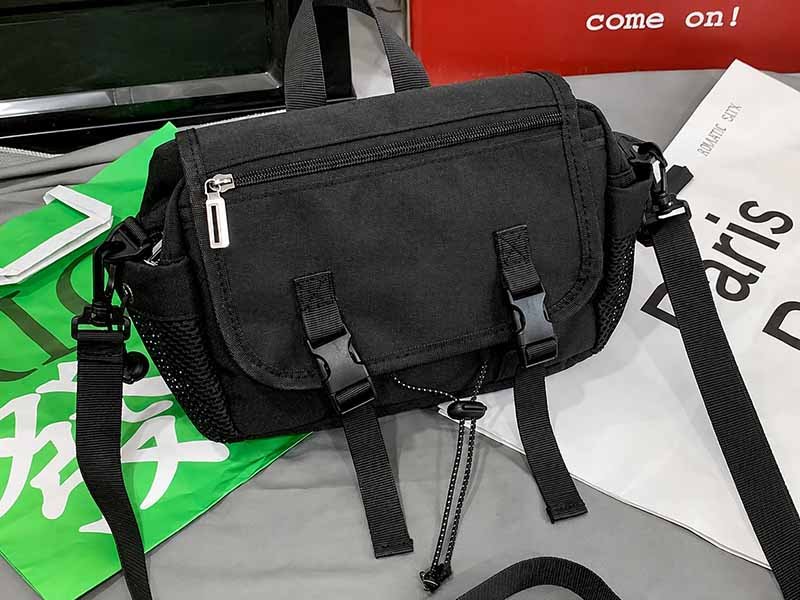
A side-release buckle may represent only a small percentage of a bag’s total material cost, yet it can determine whether the finished product feels dependable or frustrating in everyday use. When the buckle is poorly selected, the webbing may slip, the locking arms may crack, the release tabs may feel uncomfortable, or the complete strap system may fail under a load that appeared harmless during sampling.
The best side-release buckle should match the webbing width and thickness, product load, adjustment method, operating environment, user profile, and intended service life. Buyers should evaluate the buckle together with the actual webbing, stitching, reinforcement, and bag structure, then verify the completed assembly through dimensional, slippage, tensile, cycle, impact, and environmental testing before mass production begins.
This is where many bag projects quietly develop problems. A buckle can look excellent in photographs and feel acceptable on an empty prototype, yet begin slipping after the bag is loaded or become difficult to open when the strap is tightened. Making the right decision during development costs very little compared with replacing hardware, remaking finished goods, or managing customer complaints after thousands of products have already entered the market.
What Are Side-Release Buckles?

A side-release buckle is a two-part fastening system that locks when flexible male prongs enter a female housing and opens when both side tabs are pressed. It is widely used on bags because it provides fast operation, low weight, secure closure, and optional strap adjustment. Its reliability depends on material quality, molded geometry, webbing fit, load direction, and the strength of the complete sewn assembly.
How the Mechanism Works
A standard side-release buckle consists of a male insert and a female socket. When the male component is pushed into the socket, its flexible arms compress inward, move past the internal retaining shoulders, and then spring outward into the locked position. Pressing both release tabs inward reduces the effective width of the arms, allowing the components to separate.
Although the mechanism appears simple, small dimensional differences can significantly change its performance. The male arms must be flexible enough to withstand repeated compression without cracking or remaining permanently deformed. At the same time, they must be stiff enough to resist accidental release when the bag is dropped, squeezed, twisted, or pulled from an uneven angle.
Clearance inside the female housing is equally important. Insufficient clearance may increase insertion force, make the buckle difficult to release, or cause accelerated wear around the locking areas. Excessive clearance can produce unwanted movement, rattling, or an uncertain locking feel that makes the complete product appear poorly manufactured.
A well-designed buckle should connect with a clear and controlled click. It should release intentionally without requiring excessive finger strength, yet it should not open when the bag is compressed against another object. The final evaluation should always be performed with the intended strap under realistic tension rather than with a loose buckle held casually in the hand.
Main Buckle Components
The male and female molded parts are only the most visible elements of the fastening system. Actual product performance depends on the complete load path, which usually includes the buckle arms, housing shoulders, webbing slots, adjustment bars, anti-slip teeth, strap material, sewing thread, bartacks, reinforcement layers, and the fabric panel where the webbing is attached.
The following components should be reviewed as one connected system:
- Male locking arms
- Female retaining shoulders
- Webbing slots
- Adjustment bars
- Anti-slip teeth
- Webbing material
- Sewing thread
- Bartacks or box stitching
- Webbing folds
- Internal reinforcement
- Bag attachment panels
A buckle may withstand a substantial pulling force while the webbing gradually slides through its adjustment bar. In another construction, the strap may remain secure while the stitching pulls out or the surrounding bag fabric tears. The weakest element determines the practical strength of the entire assembly, regardless of how impressive the buckle specification appears.
Molded details also deserve close inspection. Sharp edges may abrade webbing fibers, while flash around the release tabs can scratch the user or interfere with operation. Thin material around the female housing may crack during impact, and uneven male arms can create inconsistent locking or release force across different pieces from the same production batch.
Common Bag Applications
Side-release buckles are commonly selected where a strap must open quickly, close securely, or support repeated adjustment. They are widely used on backpack chest straps, waist belts, compression systems, roll-top closures, messenger-bag stabilizers, travel-bag retention straps, sports equipment, tool bags, outdoor packs, pet carriers, removable shoulder straps, and modular storage products.
Typical applications include:
- Backpack chest straps
- Waist and hip belts
- Compression straps
- Roll-top closures
- Travel-bag retention systems
- Messenger-bag stabilizers
- Outdoor accessory straps
- Sports equipment bags
- Tool-bag closures
- Pet carriers and harnesses
- Modular pouches
- Detachable shoulder straps
The required performance changes considerably between applications. A 20 mm buckle used on a lightweight chest strap carries a different load from a 50 mm buckle installed on a heavily filled tool bag. The smaller buckle may prioritize comfort and easy release, while the larger buckle must also manage greater force, repeated impact, and stronger attachment stitching.
A buckle used primarily as a decorative fashion detail may be selected partly for its shape, finish, and visual balance. Hardware used on an outdoor backpack must also tolerate dirt, moisture, low temperatures, UV exposure, vibration, and repeated tightening. Product function should therefore remain the first selection criterion, even when appearance is commercially important.
When Buckles Are Unsuitable
Side-release buckles are practical, but they should not automatically be used in every closure system. They may be inappropriate where accidental opening could cause serious harm, where tamper resistance is required, or where the closure must remain airtight, waterproof, or mechanically locked under extreme conditions.
Ordinary bag buckles should not be treated as life-safety components unless the buckle and complete assembly have been specifically engineered, tested, and certified for the intended application. Standard backpack hardware is not a substitute for climbing equipment, fall-protection devices, vehicle restraints, or certified child-safety systems.
User ability must also be considered. Some buckles require substantial simultaneous pressure from both sides, which may be difficult for children, older users, or people wearing thick gloves. At the opposite extreme, very soft release tabs may open when the product is pressed against luggage, furniture, or the wearer’s body.
The best closure balances security with usability. Product developers should consider who will use it, how often it will be opened, whether it will be operated under tension, where it will touch the body, and what consequences could follow if the closure opens unexpectedly.
Which Buckle Size Fits Your Webbing?

Buckle size normally refers to the internal width of the webbing slot rather than the total outside width of the buckle body. A 25 mm buckle is generally intended for approximately 25 mm webbing, but nominal width alone is not sufficient. Webbing thickness, weave, stiffness, coating, edge construction, and surface friction must also suit the slot height, adjustment-bar geometry, and holding teeth.
How Buckle Size Is Measured
Most hardware suppliers identify a buckle according to the width of webbing it is designed to accept. The most useful measurement is therefore the clear internal width of the strap slot. Measuring the buckle’s outer body can result in an incorrect order because the housing is normally considerably wider than the stated nominal size.
A complete dimensional inspection should record the internal slot width, internal slot height, overall buckle width, overall buckle length, adjustment-bar thickness, male insertion depth, and female housing depth. These dimensions help determine whether the selected hardware can accommodate the intended strap and operate correctly after the webbing has been folded or doubled back.
A digital caliper is more reliable than an ordinary ruler, especially when evaluating smaller buckles or comparing two models described by the same nominal size. Two 25 mm buckles can behave differently because their slot heights, tooth profiles, bar radii, wall thicknesses, and internal clearances may not be identical.
Slot height is frequently overlooked. Thick jacquard or heavy nylon webbing may match the buckle width but become difficult to route around the adjustment bar. A thin PP strap may pass through easily but fail to create sufficient friction, allowing the tail to move when the bag is loaded.
| Nominal Buckle Size | Matching Webbing | Typical Applications | Primary Development Concern |
|---|---|---|---|
| 10–15 mm | 10–15 mm | Small pouches, accessory straps, organizers | Small gripping area and limited load capacity |
| 20 mm | 20 mm | Chest straps, compact bags, light compression straps | Release comfort and strap slippage |
| 25 mm | 25 mm | Daypacks, shoulder straps, travel accessories | General adjustment and broad availability |
| 32 mm | 32 mm | Utility bags, pet products, equipment straps | Supplier availability and fit consistency |
| 38 mm | 38 mm | Waist straps, travel bags, larger backpacks | Load distribution and buckle bulk |
| 50 mm | 50 mm | Tool bags, heavy belts, equipment bags | Weight, rigidity, and sewing strength |
These dimensions are useful starting points, but they should not be interpreted as universal load ratings. Final selection must be confirmed through testing with the actual webbing, sewing structure, and load conditions of the finished product.
Matching Width and Thickness
The nominal buckle width should normally match the nominal webbing width. Pairing a 25 mm strap with a 25 mm buckle helps keep the material centered and allows pressure to be distributed evenly across the adjustment bar. Nevertheless, identical nominal numbers do not guarantee a successful combination.
Actual woven width may vary slightly because of yarn size, weave density, dyeing, heat setting, edge finishing, coating, and production tolerance. A strap that is marginally too wide may curl against the buckle walls, rub during adjustment, or become difficult to thread. A strap that is too narrow may move sideways, twist, or load the buckle unevenly.
Thickness creates another important variable. Lightweight promotional PP webbing may be relatively thin and flexible, while dense nylon, polyester, cotton, or jacquard webbing can be much thicker and less compressible. Two straps with exactly the same width may therefore create very different adjustment and holding behavior.
The production-intended webbing should always be used during buckle approval. Testing a convenient substitute can produce misleading results, especially when the final strap has a different texture, coating, density, or thickness.
Practical fit checks should include:
- Confirm that the webbing can enter the slot without forcing it.
- Check that the strap can double back around the adjustment bar without folding.
- Verify that adjustment remains smooth under moderate tension.
- Confirm that the webbing remains fixed when loaded.
- Inspect the edges after repeated adjustment for abrasion or distortion.
- Pull the strap diagonally to check for twisting or sideways movement.
The correct fit should feel controlled rather than excessively tight. Users must be able to adjust the strap intentionally, while the buckle must retain the selected position during ordinary carrying, movement, and vibration.
Preventing Strap Slippage
Webbing slippage occurs when the friction generated between the strap and buckle is not sufficient to resist the applied load. Although the buckle is often blamed, the true cause may involve webbing thickness, weave, surface coating, strap stiffness, threading path, adjustment-bar shape, or tooth geometry.
Smooth seatbelt-style webbing often slides more easily than a textured basket weave. Thin PP webbing may not press firmly enough against the adjustment bar, while glossy printed or coated surfaces can further reduce friction. Even a high-quality buckle can perform poorly when paired with an incompatible strap.
Possible corrections include:
- Select a buckle with a more suitable tooth profile.
- Increase webbing thickness or density.
- Change the webbing weave or fiber type.
- Add a tri-glide or ladder lock.
- Increase the free tail length.
- Add a folded webbing keeper.
- Sew a stop near the webbing end.
- Modify the threading path.
- Move printed areas away from friction zones.
More aggressive teeth are not always the best solution. Sharp gripping surfaces may abrade yarns, damage printed logos, or create visible pressure marks. The objective is reliable holding without unnecessary material damage or difficult adjustment.
A practical slippage evaluation can be performed by marking the webbing where it enters the buckle, applying an agreed load for a fixed period, and measuring any movement afterward. The acceptable amount depends on the application, because a chest strap may require almost no movement while a low-risk compression strap may allow a different tolerance.
Fit Under Real Use
The buckle and webbing combination should be tested on the completed product rather than only as a loose strap sample. Bag construction changes load direction, user access, adjustment angle, and the way force is transferred through the hardware.
A chest strap may pull upward because of the curve of the shoulder straps. A compression buckle may be loaded diagonally when the bag contents are uneven. A roll-top closure can twist as the opening is folded and tightened. These forces may stress one male arm more heavily or cause the webbing to shift across the adjustment bar.
Useful finished-product tests include:
- Straight pulling
- Diagonal pulling
- Repeated tightening and loosening
- Walking or vibration simulation
- Loaded drop testing
- One-sided loading
- Wet webbing testing
- Operation with gloves
- Adjustment while the product is worn
The most reliable fit is not necessarily the tightest combination. A buckle that grips so strongly that the user cannot adjust the strap comfortably creates a different form of product failure. The correct system should hold during use while remaining manageable and intuitive.
Which Buckle Material Should You Choose?

POM, also called acetal, is the most common starting choice for quality bag buckles because it provides good stiffness, dimensional stability, low friction, and repeated snap performance. Nylon may offer greater toughness in certain impact conditions, while PP suits lighter and more cost-sensitive products. Metal can add rigidity and a premium appearance but also introduces weight, cost, coating, temperature, and corrosion considerations.
POM Buckles
POM is widely used on backpacks, travel bags, sports products, outdoor equipment, pet accessories, and other commercial soft goods. Its stiffness allows the male locking arms to recover after repeated compression, while its relatively low moisture absorption supports more stable dimensions under changing humidity.
A well-made POM buckle often provides a crisp engagement sound, smooth insertion, and controlled release. Its relatively low surface friction allows the male and female parts to slide together without excessive wear, which contributes to consistent operation throughout the expected life of the product.
However, the material name alone does not guarantee quality. Finished performance also depends on resin grade, virgin or recycled content, pigments, additives, mold design, injection temperature, cooling conditions, weld-line position, residual stress, and molded wall thickness.
A poorly processed POM buckle may crack despite being made from the correct general resin family. Excessive regrind, contamination, internal voids, sharp corners, thin sections, or unstable molding conditions can significantly reduce impact and fatigue performance.
For commercially important projects, the development team should confirm the supplier model, material type, production mold, color formulation, and available test information. Final approval should be based on actual molded pieces and completed strap assemblies rather than on a generic material description.
Nylon and PP Buckles
Nylon is frequently selected where toughness and resistance to repeated impact are important. Different nylon grades behave differently according to formulation, reinforcement, conditioning, and moisture content, so the term “nylon buckle” should not be treated as a single fixed performance category.
Nylon generally absorbs more moisture than POM. This can influence stiffness, dimensions, and release feel, especially when the product moves between dry indoor conditions and humid or wet environments. The material can still perform well, but qualification testing should reflect the expected climate and exposure.
PP is lighter and generally more economical. It is commonly used on promotional bags, lightweight drawstring products, simple storage items, packaging straps, and other applications where load and service-life requirements are moderate.
Its flexibility and chemical resistance can be valuable, but PP normally offers less rigidity than POM. Replacing a POM buckle with PP purely to reduce cost may change the locking feel, release force, dimensional stability, and resistance to sustained loading.
| Material | Typical Advantages | Main Limitations | Common Applications |
|---|---|---|---|
| POM/Acetal | Stiff, stable, low friction, good repeated operation | Can fracture if poorly molded or severely impacted | Backpacks, travel bags, outdoor products |
| Nylon/PA | Tough, flexible by grade, good impact potential | Moisture can change dimensions and stiffness | Outdoor and impact-focused products |
| PP | Lightweight, economical, useful chemical resistance | Lower rigidity and demanding-load capability | Promotional bags and light-duty straps |
| Zinc Alloy | Premium appearance and complex molded shapes | Heavy, possible finish wear and corrosion | Fashion bags and branded closures |
| Aluminum | Lower weight than many metals and good rigidity | Surface scratching and higher cost | Premium travel and outdoor products |
| Steel | High stiffness and strength potential | Heavy and requires corrosion protection | Selected industrial and heavy-duty products |
Plastic Versus Metal
Metal buckles are often perceived as stronger or more premium, but they are not automatically better than engineering plastic. A properly designed plastic buckle may offer a more suitable combination of weight, comfort, corrosion resistance, noise control, color flexibility, and manufacturing cost.
Plastic hardware is particularly practical on backpacks, chest straps, waist belts, pet products, and outdoor bags because it is lightweight, does not rust, remains quiet during movement, and does not become as hot or cold against the body as exposed metal.
Metal may be preferred when the product needs a luxury appearance, distinctive finish, magnetic function, compact rigid profile, or visible branded hardware. It can also suit certain industrial or heavy-duty products when the surrounding structure has been designed to manage the additional weight and stiffness.
The disadvantages of metal may include higher cost, additional weight, plating wear, corrosion, sharp edges, increased noise, and rapid temperature change. A zinc-alloy buckle may look premium but feel unnecessarily heavy on a chest strap, while an aluminum component may reduce weight but show visible scratches after repeated travel.
The decision should follow the product’s intended function, market position, and user experience. A hiking backpack may benefit from lightweight engineering plastic, while a fashion or luxury bag may justify custom metal hardware because the closure is an important visual feature.
Environmental Conditions
Buckles used on outdoor, travel, sports, pet, marine, and industrial products may encounter UV radiation, rain, high humidity, saltwater, sweat, mud, sand, detergents, low temperatures, high temperatures, repeated impact, and cleaning chemicals.
Low temperatures may increase brittleness in certain materials, while high heat can cause deformation or change release force. Prolonged UV exposure may fade pigments and gradually reduce mechanical performance. Sand and dust can enter the female housing, interfering with engagement or increasing surface wear.
The selected material should reflect the real market and operating environment. A buckle used on an indoor cosmetic organizer does not require the same environmental qualification as hardware used on a fishing bag, ski bag, bicycle pack, or hiking backpack.
After environmental conditioning, samples should be tested again for locking, release force, cracking, warpage, discoloration, webbing adjustment, accidental disengagement, and tensile performance. The important question is not simply whether the material survives exposure, but whether the complete buckle continues to function reliably afterward.
Which Buckle Design Fits the Product?

The correct buckle design depends on where adjustment is required, how the hardware attaches to the product, whether it follows the wearer’s body, and whether it must be replaceable. Single-adjust buckles suit one fixed and one adjustable end, dual-adjust designs allow movement from both sides, curved buckles improve body contact, and repair models simplify replacement without reopening sewn seams.
Single- and Dual-Adjust Designs
A single-adjust buckle normally includes an adjustment bar on one side, while the opposite component is attached through a permanently sewn webbing loop. This design is common because it is compact, stable, economical, and easy for most users to understand.
Single-adjust models work well on compression straps, roll-top closures, simple chest straps, bag flaps, accessory retention straps, and fixed-position waist systems. They are especially suitable where only one end must move and the opposite side should remain stable.
A dual-adjust buckle allows webbing to be adjusted on both ends. This can help center the buckle, balance two strap tails, accommodate a wider range of users, or simplify construction where neither component should be permanently fixed.
Dual-adjust models are commonly considered for waist belts, removable harnesses, symmetrical closures, pet products, modular systems, and variable-position attachments. However, additional adjustment does not automatically improve the user experience.
Two loose webbing tails can make the product look untidy and create more opportunities for incorrect threading. The final decision should follow the user’s adjustment sequence, the desired buckle position, the location of excess webbing, and the production sewing process.
Flat and Curved Buckles
Flat buckles are suitable for bag panels, compression straps, roll-top systems, and accessory attachments where the hardware lies against a relatively flat surface. They are widely available, easy to integrate into straight strap paths, and generally simple to handle during sewing and assembly.
Curved buckles follow the shape of the body and are commonly installed on chest straps, waist belts, pet harnesses, padded shoulder systems, and close-contact outdoor equipment. Their shape can reduce pressure from the buckle edges and allow the strap to follow a more natural path.
Curvature alone does not guarantee comfort. Overall buckle length, housing thickness, edge radius, release-tab size, strap entry angle, padding thickness, body position, and applied load all influence how the hardware feels during actual use.
Orientation must be controlled carefully. A curved buckle installed backward or upside down may press away from the body instead of following it. Technical drawings, approved samples, photographs, and production instructions should clearly indicate the correct installation direction.
Comfort testing should be completed with the actual filled product. A buckle that feels acceptable on an empty backpack may create pressure or become difficult to release after the shoulder straps are tightened and the load is transferred to the body.
Repair and No-Sew Buckles
Repair buckles allow damaged hardware to be replaced without cutting the original stitch line or disassembling the complete bag. They may use screw pins, removable bars, hinges, or slotted attachment structures.
These designs are useful for outdoor equipment, travel products, rental gear, field-repair kits, long-life bags, replaceable component systems, and constructions that are difficult to reopen after production.
Repairability can extend product life and reduce after-sales costs because the customer can replace one damaged part instead of discarding the entire bag. This feature may also support sustainability claims when spare components are genuinely available and easy to install.
The additional convenience introduces new risks. Screws may loosen, users may install the buckle in the wrong direction, removable bars may not be fully secured, and slotted structures may rotate or twist when loaded.
A repair buckle should be selected when replacement is an intentional part of the product system. Clear instructions, model codes, compatibility records, directional marks, and spare-part availability are necessary to make the feature practical.
For most conventional mass-produced bags, a permanently sewn molded buckle remains the simplest and most consistent solution because it has fewer components and less opportunity for incorrect installation.
Shape and User Experience
Buckle shape influences everyday usability as much as it affects appearance. Longer buckles offer a larger gripping area but occupy more space, while compact models create a cleaner visual result but may be harder to operate with gloves or limited finger strength.
Large release tabs improve accessibility but may be more exposed to accidental pressure. Low-profile housings can suit minimalist bags, while thicker and more substantial buckles may feel appropriate on outdoor, tool, or equipment products.
Rounded edges are especially important when the hardware touches clothing or skin. Sharp corners can create discomfort, damage fabric, or become noticeable when the user carries the product for extended periods.
Release force should also match the intended user. Products for children, older adults, or users with limited hand strength may need easier operation, while outdoor products may require tabs large enough to press when wearing gloves.
Useful user trials should include:
- Operation with one hand
- Operation with two hands
- Use while wearing the bag
- Release under strap tension
- Use with wet fingers
- Use while wearing gloves
- Operation without looking directly at the buckle
- Repeated opening and closing during a normal-use simulation
Small usability problems become significant when the buckle is handled several times each day. A closure should not only pass a mechanical test; it should also feel intuitive and dependable to the person using the product.
How Strong Should the Buckle Be?
Buckle strength should be determined by the highest realistic force applied to the complete strap system, including sudden lifting, drops, vibration, pulling, twisting, and uneven loading. Breaking strength is not the same as a safe working load. The buckle, webbing, stitching, reinforcement, and bag panel should be tested together with a product-specific safety margin and clearly defined failure criteria.
Breaking Strength
Breaking strength is the force at which a buckle or complete strap assembly fails during a defined test. Failure may involve buckle fracture, permanent deformation, accidental opening, webbing slippage, adjustment-bar damage, stitching rupture, fabric tearing, or loss of normal function.
A strength value has limited meaning unless the test method is known. Results can change according to webbing type, strap thickness, loading speed, pull direction, temperature, humidity, conditioning, stitch construction, and buckle orientation.
A useful test record should identify the buckle model, nominal size, material, production batch, webbing specification, threading method, sewing construction, pull direction, test speed, sample quantity, lowest result, average result, and observed failure mode.
The lowest result deserves particular attention because consumers receive individual products rather than statistical averages. Large variation between samples may indicate inconsistent molding, resin mixing, webbing tolerance, stitching quality, or assembly conditions.
A supplier’s general buckle strength figure should never be assumed to represent the finished bag. The actual product may fail first at the webbing, bartack, seam, reinforcement layer, or attachment panel.
Working Load and Safety Margin
Working load describes the force a product is expected to experience during normal use, while breaking strength describes the force at which the tested component or assembly fails. These values should never be treated as interchangeable.
For ordinary non-life-safety bags, an early engineering review may begin with a safety factor of approximately three to five times the expected static load. This is a preliminary planning range rather than a universal standard, because the final factor depends on dynamic impact, misuse, aging, product category, market requirements, and the consequences of failure.
| Expected Static Load | Approximate Static Force | 3× Initial Target | 5× Initial Target |
|---|---|---|---|
| 5 kg | 49 N | 147 N | 245 N |
| 10 kg | 98 N | 294 N | 490 N |
| 15 kg | 147 N | 441 N | 735 N |
| 20 kg | 196 N | 588 N | 980 N |
| 30 kg | 294 N | 882 N | 1,470 N |
These calculations use approximately 9.8 newtons per kilogram. Real use can create much higher peak forces when a bag is lifted suddenly, dropped, swung, pulled from a vehicle, or caught on another object.
The load may also concentrate on one buckle. A bag with two compression straps should not automatically be assumed to divide the force equally, especially when the contents are uneven or one strap is adjusted more tightly.
The product team should document expected packed weight, maximum claimed capacity, number of load-bearing buckles, likely load direction, dynamic-use conditions, reasonable misuse, required safety margin, and acceptance criteria.
Products involving climbing, fall protection, restraint, or other safety-critical applications require dedicated standards, certified components, and qualified engineering evaluation beyond ordinary bag testing.
Webbing and Stitching Strength
A strong buckle cannot compensate for weak webbing or inadequate sewing. The complete load path must transfer force from the bag panel through the reinforcement, stitch line, webbing, and buckle without creating an obvious weak point.
Important variables include webbing fiber, weave structure, strap width, thickness, adjustment-bar radius, thread type, stitch density, bartack dimensions, number of stitch rows, fold length, seam allowance, reinforcement area, and load direction.
Failure patterns help identify the cause of a problem. If the strap slips without visible damage, the friction system is inadequate. If the webbing tears at the buckle bar, the local radius or stress concentration may be too severe.
If the bartack pulls out, the thread specification, stitch pattern, fold length, or sewing quality may need improvement. When the outer fabric tears around an intact seam, the load should be spread over a larger reinforcement area or transferred into a stronger structural panel.
The ideal assembly is balanced. Making one component extremely strong may simply move the failure to another location, which is why separate material specifications cannot replace testing of the completed construction.
Load Direction and Dynamic Use
Laboratory tensile tests often apply force in a straight line, but bags rarely experience perfectly aligned loading. Compression straps can pull diagonally, waist belts curve around the body, chest straps move during walking, and tool bags are often lifted from one side.
Off-axis loading may twist the buckle, concentrate force on one male arm, change release behavior, increase webbing slippage, deform the adjustment bar, or load the attachment seam unevenly.
Dynamic events should also be considered:
- Dropping a loaded bag
- Pulling a strap suddenly
- Catching the buckle on another object
- Repeated walking vibration
- Swinging luggage during carrying
- Sitting against a waist buckle
- Throwing a bag onto a conveyor or vehicle floor
- Loading only one side of a symmetrical strap system
A buckle with a strong straight-line laboratory result may perform differently when twisted, impacted, or repeatedly vibrated. Finished-product testing should reproduce realistic use as closely as practical instead of relying only on a single static tensile value.
How Do You Test Buckles Before Production?
Buckle approval should cover component inspection, complete sample testing, and bulk-production verification. Dimensions, appearance, locking, release force, webbing retention, tensile strength, repeated operation, impact resistance, and environmental behavior should all be reviewed. Testing must use the intended production buckle, webbing, stitching, reinforcement, and attachment construction rather than isolated hardware or convenient substitute materials.
Sample Evaluation
Sample approval should begin with a structured visual and dimensional inspection. The buckle should be compared with the technical specification, supplier reference, color standard, and intended product design.
Important checks include internal slot width, slot height, overall dimensions, male and female fit, surface finish, color consistency, flash, sharp edges, sink marks, internal voids, warpage, engagement sound, release force, strap adjustment, webbing slippage, and installation direction.
Testing only one perfect buckle does not reveal production variation. An early development review may use five to ten pieces from the intended mold and material batch, while higher-risk projects may require a larger and more formal sampling plan.
The buckle should then be installed on the completed bag. Reviewers should operate it when the product is empty, fully loaded, worn on the body, compressed, pulled diagonally, repeatedly opened, and handled with wet fingers or gloves.
The approved sample record should include the supplier, model number, material, nominal width, color code, finish, webbing pairing, threading path, orientation, and test status. These records help prevent unapproved substitutions during mass production and support repeat-order consistency.
Tensile and Slippage Tests
A tensile test applies force to the buckle assembly at a controlled speed. The test may stop at a specified proof load or continue until failure, depending on the product specification and the information the development team needs.
A proof-load test confirms whether the complete assembly can hold the required force without opening, cracking, permanently deforming, allowing excessive webbing movement, damaging the stitches, or tearing the surrounding fabric.
A destructive test identifies the maximum force and the failure mode. The failure mode is often as important as the numerical result because it reveals which component or structural detail requires improvement.
For a webbing-slippage test, the strap is marked at the buckle before loading. After the agreed force has been applied for a defined period, the movement is measured and compared with the acceptance limit.
Multiple assemblies should be tested because individual results may vary. Five samples can serve as a practical early development starting point, although formal quantities should follow the buyer’s quality requirements, product risk, and applicable inspection plan.
Cycle and Environmental Tests
Repeated opening and closing can gradually change the stiffness of the male arms, wear the internal retaining surfaces, or alter release feel. Cycle testing helps determine whether the buckle remains functional after extended use.
The required cycle count should reflect the expected service profile. A buckle opened only during occasional travel differs significantly from one used several times every day.
Internal development screening for frequently operated bag hardware may begin around 1,000 to 5,000 opening cycles, but this range should not be presented as a universal standard. The final requirement should follow product use, customer expectations, applicable standards, and the consequences of failure.
Environmental conditioning may include:
- Low-temperature exposure
- Elevated-temperature exposure
- Humidity conditioning
- Water immersion
- UV exposure
- Saltwater contact
- Sweat contact
- Sand or dust contamination
- Detergent exposure
- Contact with relevant cleaning chemicals
After conditioning, the buckle should be checked again for locking, release force, cracking, warpage, color change, tensile performance, accidental opening, and webbing adjustment.
Nylon components may require moisture conditioning, while winter products may need low-temperature impact testing. Fishing, marine, pet, or sports products may require saltwater or sweat exposure because those environments can change both appearance and mechanical performance.
Bulk Consistency Control
A buckle that passes development testing can still create production problems if the mass order uses a different resin batch, mold cavity, pigment formula, supplier, or molding process.
Incoming inspection should therefore confirm that delivered hardware matches the approved reference in dimensions, appearance, material, color, fit, locking feel, and performance.
| Inspection or Test | Example Development Quantity | Main Acceptance Focus |
|---|---|---|
| Dimensional inspection | 5–10 pieces | Approved dimensions and webbing fit |
| Visual inspection | 10 or more pieces | No cracks, flash, warpage, or major color variation |
| Manual locking test | 10 pieces | Consistent engagement and release |
| Webbing-fit test | 5 assemblies | Smooth adjustment and controlled holding |
| Proof-load test | 5 assemblies | No opening, cracking, or excessive slippage |
| Destructive tensile test | 5 assemblies | Meets agreed minimum and expected failure mode |
| Opening-cycle test | 3–5 pieces | Remains functional after the target cycle count |
| Loaded bag drop test | Several finished bags | No release or structural damage |
| Environmental test | 3–5 pieces per condition | Maintains function after conditioning |
These quantities are practical development examples rather than universal inspection standards. The correct plan should reflect the buyer’s specification, product risk, order volume, and quality-control system.
Bulk records should identify the buckle supplier, model number, material, color code, incoming batch, purchase order, inspection date, test results, approved alternatives, production order, and any related complaint or corrective-action history.
Maintaining these records makes it easier to investigate problems, compare production batches, and prevent silent changes to resin, mold, color, or supplier. This becomes especially important when a brand plans repeat orders, multiple colors, or a long-term product line.
The most reliable approach is to approve the buckle as part of the complete bag system. Hardware, webbing, stitching, reinforcement, load direction, and real product use should be evaluated together before mass production begins.
A technically suitable buckle should fit the strap correctly, remain secure under realistic loads, operate comfortably, tolerate the intended environment, and remain consistent across production batches. Selecting hardware this way reduces the risk of slipping straps, cracked locking arms, difficult adjustment, accidental opening, and costly after-sales problems.
Lovrix supports global brands and commercial buyers with the development and manufacturing of custom backpacks, travel bags, tool bags, outdoor products, sports bags, pet bags, cosmetic bags, and other engineered soft goods. Project evaluation can include buckle selection, webbing development, structural reinforcement, sample testing, private-label details, production control, packaging, and global delivery.
For a new custom bag project, provide the product drawing, reference sample, webbing specification, expected load, target market, order quantity, and testing requirements. The development team can then assess the buckle material, size, adjustment structure, sewing method, reinforcement, and production plan before the product moves into mass manufacturing.


