 Skip to content
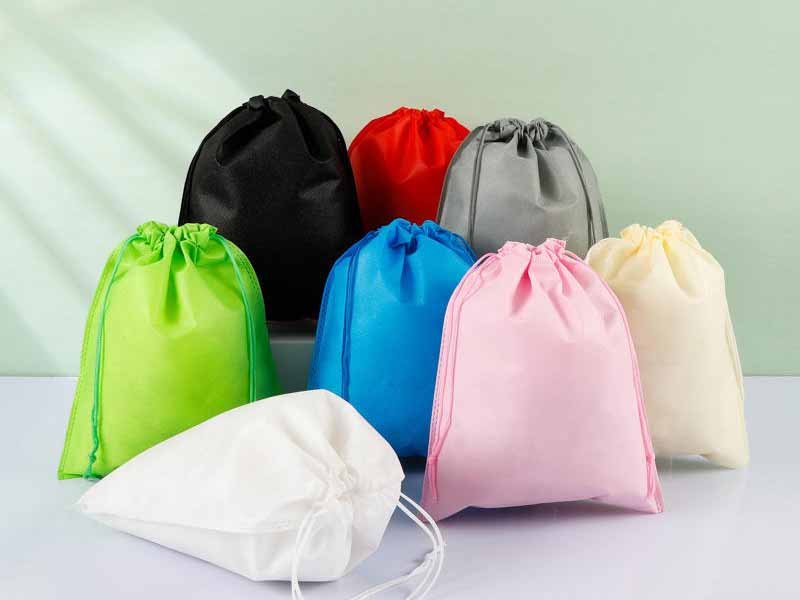
If you’ve ever handed out products at a trade show or shipped a retail order with a “free gift bag,” you already know why nonwoven drawstring bags are everywhere: they’re light, easy to print, and they make brands look organized without blowing the budget. The interesting part is this—nonwoven bags don’t behave like woven fabrics. They’re not made from interlaced yarns like cotton or canvas. They’re made by bonding fibers into a sheet. That’s why some nonwoven bags feel surprisingly sturdy, while others tear at the drawcord after one pull. The difference isn’t luck. It’s GSM, bonding quality, and construction details.
Nonwoven drawstring bags are drawstring backpacks made from bonded polypropylene (PP) nonwoven fabric rather than woven yarn. They are popular for promotions, retail packaging, and light reuse because they offer a clean printing surface, fast production, and low unit cost. Most usable nonwoven drawstring bags fall around 80–120 GSM, and performance jumps noticeably when you add reinforcement at the drawcord channel and corners.
A quick reality check: many “quality complaints” are not about the logo or the stitching at all. They’re about the bag being specced too light for the job. Once you learn how nonwoven works, you can choose the right GSM and build a bag that gets used again and again—so your logo keeps traveling long after the event ends.
What is nonwoven fabric in nonwoven drawstring bags?
Nonwoven fabric in nonwoven drawstring bags is a bonded sheet of polypropylene fibers. Instead of weaving threads, the material is formed into a web and fused together. This makes it lightweight and cost-efficient, but the bag’s real strength depends on GSM, bonding density, and how the drawcord area is constructed.
How is nonwoven fabric made for nonwoven drawstring bags?
Most nonwoven drawstring bags use PP spunbond nonwoven. In simple terms:
- PP pellets are melted
- Fibers are spun into filaments
- Filaments are laid into a web
- Heat/pressure bonds the web into fabric rolls
Why buyers should care: the bonding step controls whether the material feels “fluffy and weak” or “tight and durable.” Two bags can both be called “nonwoven,” but one may fail early because bonding is poor.
Here’s a practical way to understand the process impact:
| Production factor | What changes in the bag | What customers notice |
|---|---|---|
| Better bonding density | higher tear resistance | less ripping at top |
| More uniform web | smoother printing surface | cleaner logo edges |
| Stable roll quality | consistent bag feel | fewer batch complaints |
If you’re sourcing for a brand, ask the factory to confirm: spunbond PP, not recycled mixed nonwoven for premium orders.
What properties define nonwoven drawstring bags?
Nonwoven drawstring bags are chosen because they hit a sweet spot: good-enough durability + very efficient cost. The best way to judge them is not “soft vs hard,” but the specific properties below:
| Property | Why it matters in nonwoven drawstring bags |
|---|---|
| Weight (GSM) | main driver of strength and feel |
| Bonding quality | affects tearing and fuzzing |
| Surface texture | influences printing clarity |
| Seam method | stitched seams last longer than heat-sealed for heavy use |
| Drawcord channel build | the #1 failure zone if under-built |
Nonwoven bags also have a practical advantage: they often pack flatter than thick cotton, which matters when you’re shipping thousands of pieces.
Is nonwoven strong enough for nonwoven drawstring bags?
Yes—if the GSM and construction match the use.
No—if you push a low-GSM giveaway bag into heavy daily use.
A realistic performance guide:
| GSM | Best use | Load comfort zone | Common failure risk |
|---|---|---|---|
| 60–70 | cheap giveaways | very light items | tears near drawcord |
| 80–90 | standard promotions | T-shirts, flyers | corner abrasion |
| 100–110 | event kits, light gym | shoes + towel | drawcord exit wear |
| 120–140 | upgraded reusable | daily light carry | less common failures |
Practical takeaway: For most brand projects, 100 GSM is a safer baseline than 80 GSM, especially if customers will reuse the bag.
Which uses fit nonwoven drawstring bags?

Nonwoven drawstring bags fit promotions, retail packaging, and event distribution where brands need large quantities, fast lead times, and good logo visibility at controlled cost. They can also work for light daily use if GSM is high enough and the drawcord area is reinforced.
Instead of guessing, match use to performance requirements:
| Use scenario | What matters most | Recommended GSM range |
|---|---|---|
| trade show giveaway | cost + printing | 80–100 |
| school orientation kit | comfort + durability | 90–110 |
| retail “free gift bag” | brand look + reuse | 100–120 |
| charity marathon kits | speed + packability | 80–110 |
| light gym sack | abrasion resistance | 100–120 |
Are nonwoven drawstring bags good for promotions?
Yes. This is where nonwoven wins hard.
Promotions usually need:
- low cost
- quick production
- big logo area
- light shipping
Nonwoven supports those needs better than cotton/canvas in most cases.
Also, if the customer only needs the bag to survive a one-day event, paying for a heavy woven fabric is often wasted budget.
Smart brand move:
Choose 80–100 GSM for standard promo, then add small reinforcements rather than jumping to very high GSM. Reinforcement often costs less than heavier fabric and solves the real failure zones.
Do nonwoven drawstring bags suit retail packaging?
They do, especially for:
- cosmetics gift sets
- apparel packaging
- seasonal campaigns
- e-commerce “thank you” gifts
But retail customers are more sensitive to feel and finishing. For retail packaging, most brands should avoid ultra-light fabric and aim for 100–120 GSM.
What makes a retail nonwoven bag feel “cheap”:
- thin GSM
- messy thread ends
- wrinkly surface from low bonding
- weak drawcord exits
What makes it feel “clean and branded”:
- higher GSM
- smooth printing
- neat top channel
- reinforced exit points
Can nonwoven drawstring bags be reused daily?
They can, but set the right expectations. Nonwoven is generally better for:
- light gym carry
- spare shoe bag
- travel organizer
- simple daily errands
If customers will carry heavy books or sharp objects, nonwoven may not be the best choice unless:
- GSM is increased
- corners are reinforced
- cord exits are protected (eyelets or patches)
A simple guideline:
| Daily use type | Can nonwoven handle it? | What you should change |
|---|---|---|
| light clothing | yes | 90–110 GSM is enough |
| shoes + towel | yes | 100–120 GSM + corner reinforcement |
| books/laptop | risky | consider polyester/nylon instead |
| tools/metal items | not ideal | use heavy denier fabric |
How do nonwoven drawstring bags compare to other bags?

Nonwoven drawstring bags are lighter and more cost-efficient than cotton or canvas, but less durable than polyester or nylon. They are ideal for promotions and short-to-medium reuse, while woven fabrics are better for long-term daily carrying or heavy loads. Choosing the right material depends on lifespan expectations, branding goals, and total project budget.
When brands choose the wrong material, the result is usually predictable:
- Too light → tearing complaints
- Too heavy → unnecessary cost and shipping weight
- Wrong surface → poor printing results
A clear comparison helps avoid these problems before sampling begins.
Nonwoven drawstring bags vs cotton bags
Cotton drawstring bags feel more natural and reusable, but they cost more and ship heavier.
Nonwoven bags win in price and speed, while cotton wins in comfort and long-term durability.
| Factor | Nonwoven drawstring bags | Cotton drawstring bags |
|---|---|---|
| Unit cost | very low | medium |
| Shipping weight | light | heavier |
| Reuse lifespan | short–medium | medium–long |
| Surface feel | dry, paper-like | soft, textile feel |
| Eco perception | recyclable PP | natural fiber image |
| Printing clarity | very good | good |
If customers will reuse the bag for months, cotton often delivers better value despite higher cost.
If the goal is mass exposure at minimum budget, nonwoven remains the smarter choice.
Nonwoven drawstring bags vs canvas bags
Canvas is essentially heavy cotton with dense weave, designed for strength.
Compared with nonwoven, canvas is:
- thicker
- stronger
- more structured
- significantly more expensive
| Factor | Nonwoven | Canvas |
|---|---|---|
| Typical GSM | 80–120 | 220–400+ |
| Tear resistance | moderate | high |
| Shape retention | soft | structured |
| Printing look | flat logo surface | premium texture |
| Cost level | low | high |
Canvas drawstring bags are usually chosen for:
- retail merchandise
- long-term branded products
- higher price-point promotions
Nonwoven is chosen for:
- event distribution
- short campaigns
- budget-controlled marketing
Nonwoven drawstring bags vs polyester or nylon bags
Polyester and nylon drawstring bags behave very differently because they are woven synthetic fabrics, not bonded sheets.
Key performance difference:
Strength-to-weight ratio.
| Factor | Nonwoven | Polyester/Nylon |
|---|---|---|
| Tear resistance | medium | high |
| Water resistance | low | good |
| Lifespan | short–medium | long |
| Cost | low | medium |
| Daily heavy use | limited | suitable |
If customers will:
- carry shoes daily
- commute with gym gear
- reuse the bag for a year
→ polyester or nylon is usually safer.
If the goal is:
- one-event branding
- lightweight giveaway
- fast bulk production
→ nonwoven is still the most efficient solution.
What affects quality of nonwoven drawstring bags?

Quality in nonwoven drawstring bags depends mainly on GSM, bonding density, seam construction, and reinforcement at stress points. Small upgrades in these areas can significantly extend usable life without dramatically increasing cost.
Many brands assume “nonwoven quality” is fixed.
In reality, small specification changes create big performance differences.
Does GSM change nonwoven drawstring bags strength?
Yes—GSM is the single biggest durability factor.
Higher GSM means:
- more fiber mass per area
- stronger bonding network
- better resistance to tearing
Practical durability guide:
| GSM | Expected performance |
|---|---|
| 70 | single-event use |
| 90 | short reuse period |
| 100 | light daily reuse possible |
| 120+ | noticeably stronger lifespan |
Moving from 80 → 100 GSM often reduces tearing complaints dramatically while adding only a small material cost.
How does thickness impact nonwoven drawstring bags life?
Thickness affects more than strength.
It also changes:
- how the bag hangs when worn
- how the print looks on the surface
- how corners resist abrasion
But extremely thick nonwoven is not always better.
Too much thickness can:
- reduce flexibility
- increase folding wrinkles
- raise shipping cost
Best practice:
Choose the lowest GSM that still meets durability needs, instead of automatically choosing the highest.
Do prints last on nonwoven drawstring bags?
Printing durability depends on three interacting factors:
- Surface bonding smoothness
- Ink or transfer method
- Friction during use
Common print performance:
| Printing method | Durability on nonwoven | Notes |
|---|---|---|
| Screen printing | good | best cost-performance |
| Heat transfer | very sharp image | may crack if folded heavily |
| Sublimation | rarely used | requires special coating |
To improve print life:
- avoid very low GSM
- keep logo away from drawcord stress zones
- test rubbing and folding during sampling
These small steps prevent logo fading complaints, which are common in promotional campaigns.
How to choose nonwoven drawstring bags for your brand?

Choosing the right nonwoven drawstring bag requires matching GSM, construction, printing method, and reinforcement details to the real usage scenario. The most reliable approach is to define how customers will use the bag, test samples under realistic stress, and lock specifications before bulk production begins.
Many problems in bulk orders do not come from factory capability.
They usually come from unclear specifications at the inquiry stage:
- “Standard quality” means different things to different suppliers
- “Strong enough” is not a measurable requirement
- “Same as sample” fails if the sample GSM was never confirmed
Clear technical selection prevents delays, re-sampling, and unexpected complaints.
Which GSM fits your nonwoven drawstring bags use?
Start from real customer behavior, not from the lowest quotation.
A practical matching guide used in many brand projects:
| Main use | Recommended GSM | Reason |
|---|---|---|
| One-day event giveaway | 80–90 | lowest cost, acceptable short life |
| School or campaign kit | 90–110 | better tear resistance |
| Retail gift packaging | 100–120 | improved feel and reuse value |
| Light gym or daily carry | 110–130 | safer durability margin |
Increasing GSM by 10–20 points often reduces complaint rates significantly, while the unit cost change is usually small compared with the marketing value of longer reuse.
What custom options matter for nonwoven drawstring bags?
Material weight alone does not define performance.
Several small construction upgrades strongly influence real durability.
Important customization points:
1. Drawcord channel reinforcement
This is the most common tearing location.
Adding folded fabric or reinforcement stitching can extend lifespan noticeably.
2. Corner protection
Bottom corners receive the most friction.
Extra stitching or patches prevent early holes.
3. Cord material and thickness
Thin cords cut into fabric faster.
Slightly thicker polyester cords distribute stress better.
4. Seam method
| Seam type | Strength level | Best use |
|---|---|---|
| Heat-sealed | basic | ultra-low-cost giveaways |
| Single stitched | medium | standard promotions |
| Double stitched | higher | reusable retail bags |
These upgrades usually add very small cost but create large durability improvement, which is why experienced brands rarely choose the absolute cheapest construction.
How to order nonwoven drawstring bags from a factory?
A smooth OEM/ODM order usually follows a clear sequence.
Skipping steps often leads to delays or quality disputes.
Step-by-step ordering flow:
- Define core specs
- size
- GSM
- printing method
- quantity
- packaging
- Request comparison samples Testing two GSM options side-by-side reveals the best balance quickly.
- Perform simple real-use tests
- load weight simulation
- repeated drawcord pulling
- rubbing at corners
- folding after printing
- Confirm tolerance before bulk
| Parameter | Common tolerance |
|---|---|
| GSM | ±5% |
| Size | ±0.5–1 cm |
| Print position | ±3–5 mm |
- Approve pre-production sample This locks the standard for mass production.
Following this structure dramatically reduces rework risk and delivery delays.
Production stability and quality control for nonwoven drawstring bags
Consistent bulk quality depends on raw material control, bonding stability, accurate cutting, and final inspection sampling. Reliable factories monitor each stage to ensure every shipment matches the approved sample**.**
Key stages that influence final bag quality
1. Fiber and bonding control
Weak bonding leads to fuzzing and tearing even if GSM looks correct.
2. Fabric roll consistency
Uneven rolls create visible thickness differences between bags.
3. Cutting accuracy
Misalignment affects symmetry and print placement.
4. Sewing or sealing precision
Poor tension control causes seam opening during use.
Because of these variables, professional factories apply multi-stage inspection, not just final checks.
Typical bulk inspection structure
| Production stage | Main control action |
|---|---|
| Raw fabric arrival | GSM and bonding verification |
| Printing stage | color fastness and alignment check |
| Sewing/sealing | seam strength testing |
| Finished packing | random sampling by carton |
This layered inspection system is what separates stable long-term suppliers from factories that only focus on price.
How Lovrix supports custom nonwoven drawstring bag projects
With more than 18 years of experience in fabric, webbing, and bag manufacturing, Lovrix helps global brands move from concept to stable bulk production with fewer trials and clearer technical decisions.
Practical support brands receive from Lovrix
Fast sampling with multiple GSM options
Clients can compare durability, printing, and feel directly instead of guessing from descriptions.
Clear construction recommendations
Based on:
- target usage scenario
- expected lifespan
- branding method
- shipping efficiency
Stable OEM/ODM production control
From raw nonwoven fabric to final packing, each stage follows defined inspection standards to maintain consistent quality across repeat orders.
Flexible customization for global brands
- size, color, and GSM adjustment
- reinforced structures for higher durability
- private label printing and packaging
- support for promotional, retail, and campaign projects
This combination allows brands to launch cost-efficient promotional bags or higher-grade reusable nonwoven bags with confidence.
Start Your Custom Nonwoven Drawstring Bag Project
If you are planning a promotional campaign, retail packaging upgrade, or large-scale event distribution, the right nonwoven drawstring bag specification can extend brand exposure far beyond the original moment of use.
Lovrix can help you.
Share your size, quantity, logo artwork, and expected usage scenario.
Our team will recommend suitable specifications and prepare samples for evaluation.
A well-designed nonwoven drawstring bag is more than packaging.
It becomes a moving advertisement that keeps your brand visible in daily life—long after the event is over.


