 Skip to content
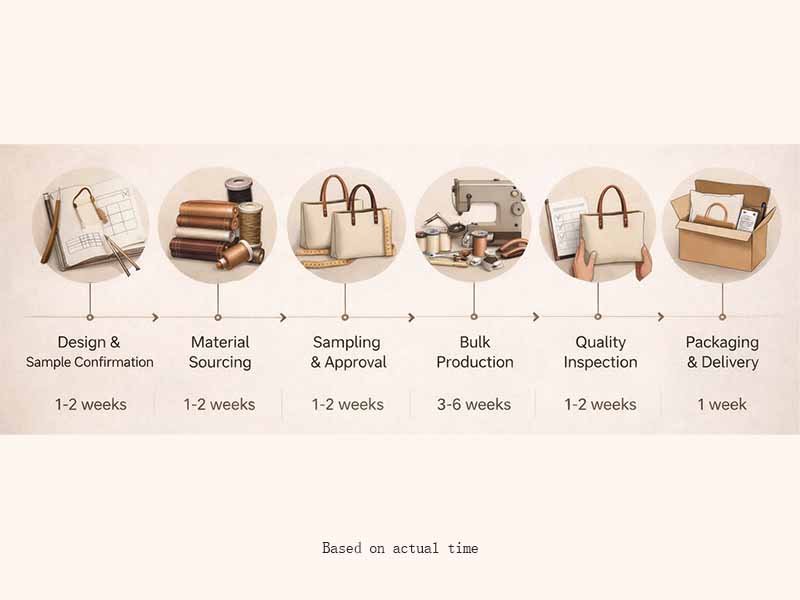
A tote bag looks simple on the outside—two panels, straps, maybe a pocket, maybe a print. That’s exactly why so many brands get surprised by delays. They assume “simple product = short lead time,” then a small detail quietly stretches the schedule: a fabric that needs dyeing, a logo method that needs curing time, a strap color that doesn’t match, a sample revision because the bag shape collapses when filled.
Here’s the uncomfortable truth: lead time is rarely lost on the sewing line. It’s lost in decisions—unclear specs, slow approvals, material mismatches, and last-minute changes that force the factory to restart steps that looked “already done.”
Tote bags lead time and production timeline mean the total time from design/sample approval to finished goods ready to ship. It includes sampling, material preparation, printing, cutting, sewing, quality checks, and packing. The fastest timelines happen when specs are locked early and materials are ready; the longest delays usually come from revisions, special materials, or changes after approval.
If you’ve ever watched a campaign date approach while your product is still “almost ready,” you already know this: a timeline isn’t a promise—it’s a plan that needs control. The good news is that tote bag timelines are predictable once you understand where time is really spent.
What Is Tote Bags Lead Time?

Tote bags lead time is the total time required for a factory to complete your order after the design is confirmed, not just the time spent sewing the bags. In real production, lead time starts when specifications are fully approved and ends when finished tote bags are packed and ready for shipment. Understanding what is included — and what is not — is critical for planning launches, promotions, and inventory.
Many clients assume tote bags have short lead times because the product looks simple. In practice, tote bags often involve fabric preparation, printing setup, strap reinforcement, and packaging coordination, all of which affect timing. Lead time is not a single number; it is the result of multiple stages moving smoothly together.
Below is how experienced factories and brands define tote bag lead time in real terms.
What does tote bags lead time actually include?
A realistic tote bags lead time includes every factory-controlled step required to deliver finished goods.
Included in tote bags lead time:
- Final sample or specification approval
- Fabric and accessory preparation
- Printing or embroidery setup
- Cutting and sewing
- Quality inspection
- Packing and carton preparation
Not included unless clearly stated:
- International shipping time
- Customs clearance
- Delays caused by late client approvals
- Design or material changes after confirmation
This distinction matters because many disputes happen when a client counts shipping time as part of “lead time,” while the factory does not.
Why tote bags lead time varies so much between orders
Two tote bags that look almost identical can have very different lead times.
The reason is that lead time depends more on decisions than on the product category itself.
Common reasons lead time changes:
- One uses stock fabric, the other needs custom dyeing
- One uses simple screen printing, the other embroidery or woven labels
- One order is a single color, the other multiple colorways
- One has simple polybag packing, the other retail-ready packaging
A tote bag is not “fast” or “slow” by default. The timeline reflects how many variables are introduced into production.
What is a realistic lead time range for tote bags?
Instead of asking for one number, experienced buyers look at stage-based ranges.
Below is a realistic factory-side reference for custom tote bags:
| Stage | Time range (days) | Notes |
|---|---|---|
| Sampling (first round) | 3–7 | depends on clarity of specs |
| Sample revisions | +2–5 | if changes are needed |
| Material preparation | 5–10 | longer for custom fabrics |
| Bulk production | 15–30 | depends on quantity & complexity |
| QC & packing | 2–5 | varies by packing method |
Total factory lead time:
25–45 days for most custom tote bag projects
Very simple designs using in-stock materials can be faster. Projects with custom fabric, multiple prints, or retail packaging usually sit at the longer end of the range.
Which stages have the biggest impact on tote bags lead time?
Not all stages affect lead time equally. In real production, three stages control the schedule more than the rest.
| Stage | Impact level | Why it matters |
|---|---|---|
| Sample approval | High | blocks all next steps |
| Material preparation | High | fabric delays stop production |
| Printing setup | Medium | plates, color matching |
| Sewing & assembly | Medium | affected by complexity |
| Packing | Low | usually predictable |
The most common delay is waiting for approval, not manufacturing. A factory cannot safely move forward without confirmation, especially for custom or branded tote bags.
How tote bags lead time affects your business planning
Lead time is not just a factory issue — it directly affects your costs and risk.
If lead time is underestimated:
- Launch dates slip
- Emergency air freight increases cost
- Inventory planning breaks down
- Marketing schedules must be changed
If lead time is understood correctly:
- Launches are planned with buffer
- Sea freight becomes possible
- Teams coordinate approvals better
- Supplier communication improves
That’s why experienced brands treat lead time as a planning tool, not just a production metric.
What you should clarify before accepting a tote bags lead time
Before you agree to any lead time, you should confirm:
- Is the lead time based on sample approval date or deposit date?
- Are materials already in stock, or still to be prepared?
- Does the timeline include printing, packing, and inspection?
- How many sample rounds are included?
- What happens if approvals are delayed?
Clear answers here prevent misunderstandings later.
Simple rule to remember
If everything is confirmed early, tote bags move fast.
If decisions are delayed, lead time expands quietly.
The fastest tote bag orders are not rushed orders — they are well-prepared orders.
What Is the Tote Bags Production Timeline?

The tote bags production timeline is the step-by-step process a factory follows to turn an approved design into finished, packed goods. It is not a single block of “production time,” but a sequence of dependent stages. Each stage must be completed correctly before the next can begin. When clients understand this sequence, delays become predictable instead of surprising.
In real manufacturing, most timeline problems don’t come from slow sewing. They come from unclear handoffs between stages—materials not ready, prints not approved, or packing details added too late. A clear production timeline helps both sides know what is happening, what is next, and where time can be lost.
Below is how a standard tote bag production timeline works in practice.
What are the main steps in a tote bags production timeline?
A typical tote bag moves through six core production stages after the design is approved.
| Production stage | What happens | Why it matters |
|---|---|---|
| Pre-production checks | specs, materials, colors confirmed | prevents bulk mistakes |
| Cutting | fabric & straps cut to size | size accuracy |
| Printing / embroidery | logos applied | branding quality |
| Sewing & assembly | bag construction | durability |
| Quality inspection | defects checked | consistency |
| Packing | folding, labeling, cartons | shipping readiness |
Each step relies on the previous one being finished correctly. Skipping or rushing a step usually creates problems later that take more time to fix than doing it right the first time.
What happens before bulk production starts?
This stage is often underestimated, but it controls the entire timeline.
Before bulk production, the factory typically completes:
- Final sample or spec confirmation
- Fabric shade and hand-feel check
- Print placement and size confirmation
- Strap length and reinforcement logic
- Packing method confirmation
Time required: usually 3–7 days, depending on how clear the specs are.
If this stage is rushed, common bulk issues include:
- Incorrect bag size tolerance
- Logo placement disputes
- Color mismatch between panels and straps
- Packaging that doesn’t fit cartons properly
Experienced clients treat this stage as timeline insurance, not wasted time.
How long does fabric preparation take in the timeline?
Fabric preparation is one of the most variable parts of the tote bag production timeline.
| Fabric situation | Preparation time | Notes |
|---|---|---|
| Stock cotton/canvas | 0–2 days | ready to cut |
| Washed fabric | 3–7 days | washing & drying |
| Custom-dyed fabric | 7–14 days | dyeing + approval |
| Recycled fabric | 5–10 days | batch availability |
| Coated/laminated fabric | 7–12 days | bonding & curing |
Clients often think fabric choice affects only price. In reality, it directly affects when production can start.
If timeline is critical, always ask:
- Is the fabric already in stock?
- Is the color already approved?
- Does it require washing or coating?
How long does printing or embroidery take?
Branding is not instant, even for simple tote bags.
Printing / embroidery timeline breakdown:
| Method | Setup time | Production impact |
|---|---|---|
| Screen printing | 1–3 days | fast once set |
| Heat transfer | 2–4 days | depends on film |
| Embroidery | 3–5 days | digitizing required |
| Woven label | 7–14 days | separate production |
Printing usually happens before sewing, so any delay here pushes the entire timeline.
A common mistake is changing logo size or position after printing starts. That usually means restarting the process.
How long does sewing and assembly take?
Sewing is the most visible stage, but not always the longest.
Sewing time depends on:
- Bag complexity
- Number of components
- Reinforcement requirements
- Order quantity
| Tote bag type | Sewing time (reference) |
|---|---|
| Simple flat tote | 8–12 days |
| Tote with pockets | 12–18 days |
| Lined tote | 15–22 days |
| Structured tote | 18–25 days |
Factories often sew tote bags in batches. Orders that fit standard batch sizes usually move faster than awkward quantities.
What happens during quality inspection?
Quality inspection is where problems are caught—or discovered too late.
Inspection typically includes:
- Measurement checks
- Stitch consistency
- Logo accuracy
- Fabric defects
- Packing correctness
Time required: usually 1–3 days, longer if:
- Multiple SKUs or colorways
- Retail-ready packaging
- Strict defect rules
Skipping or rushing inspection saves time on paper but often causes:
- Rework after packing
- Shipment delays
- Claims after delivery
Inspection protects both timeline and reputation.
How long does packing add to the production timeline?
Packing is often the final step, but it still affects delivery timing.
| Packing type | Added time |
|---|---|
| Simple polybag + carton | 1–2 days |
| Hangtag + barcode | 2–4 days |
| Insert cards + tissue | 3–5 days |
| Retail box | 4–7 days |
Packing should be confirmed before production starts. Adding packing requirements late almost always causes delays.
What is a realistic full production timeline for tote bags?
Putting all stages together, a realistic factory-side production timeline looks like this:
| Stage | Time range |
|---|---|
| Pre-production | 3–7 days |
| Fabric preparation | 0–14 days |
| Printing / embroidery | 2–7 days |
| Sewing & assembly | 10–25 days |
| Inspection & packing | 2–7 days |
Total production timeline:
20–45 days, depending on design and materials
Simple totes can be faster. Heavily customized or retail-ready totes take longer.
Why understanding the production timeline matters
When clients understand the production timeline:
- Launch dates are planned realistically
- Approvals happen faster
- Emergency shipping is avoided
- Costs stay under control
When the timeline is misunderstood:
- Pressure builds near deadlines
- Quality compromises increase
- Trust between client and factory erodes
A clear timeline doesn’t slow production—it prevents chaos.
One practical takeaway
If you know which stage you are in, you know:
- What can still change
- What must stay fixed
- How much risk remains
That’s the real value of understanding the tote bags production timeline.
Which Factors Change Tote Bags Lead Time?

Tote bags lead time changes mainly due to material availability, customization depth, order quantity, and approval speed. The more non-standard the fabric, printing, structure, or packaging, the more time is added before and during production. Most timeline shifts come from early-stage decisions, not from sewing itself.
Tote bags are often described as “simple products,” but production timelines tell a different story. A plain cotton tote with stock fabric and a single print can move fast. The same tote, with a custom weave, special dye, branded labels, and retail packaging, becomes a multi-supplier coordination project.
Understanding which factors stretch timelines helps brands decide where to simplify and where to invest time intentionally.
Which materials slow the production timeline?
Materials are the number one timeline variable in tote bag manufacturing.
Even before cutting starts, factories must confirm:
- Fabric availability
- Color consistency
- Shrinkage behavior
- Print compatibility
Material categories and their timeline impact:
| Material type | Lead time impact | Why |
|---|---|---|
| Stock cotton / canvas | Low | ready to cut |
| Washed fabric | Medium | washing & drying time |
| Custom-dyed fabric | High | dyeing + color approval |
| Recycled fabric | Medium–High | batch availability |
| Laminated / coated fabric | High | bonding & curing |
Customers often underestimate fabric preparation time, especially for washed or dyed materials. A fabric that looks “basic” can still require 7–14 extra days before it’s production-ready.
Key customer takeaway:
If timeline matters, ask early: Is this fabric already in stock in my color?
Which custom options add lead time?
Customization is where tote bags quietly become complex.
Each added option introduces:
- Extra preparation
- Extra checks
- Extra approval points
Customization elements ranked by timeline impact:
| Custom option | Added time | Reason |
|---|---|---|
| Screen printing | Low | fast setup |
| Embroidery | Medium | digitizing + test |
| Heat transfer | Medium | film prep |
| Woven label | Medium–High | weaving lead time |
| Custom zipper pull | High | mold or sourcing |
| Custom packaging | High | printing & assembly |
A common mistake is approving the bag first, then discussing packaging later. In reality, packaging should be part of the original timeline, not an afterthought.
Which order sizes affect scheduling?
Order quantity affects lead time in two opposite ways.
- Very small orders may wait for line availability
- Very large orders may require staged production
How quantity impacts timeline:
| Order size | Timeline effect |
|---|---|
| <500 pcs | may wait for slot |
| 1,000–3,000 pcs | most stable |
| 5,000–10,000 pcs | needs capacity planning |
| 10,000+ pcs | phased production |
Factories schedule tote bags in batches. Orders that fit neatly into standard batch sizes often move faster than awkward in-between quantities.
Smart planning tip:
Ask the factory what batch size your order fits into — it often explains timeline differences better than “busy season” explanations.
How to Shorten Tote Bags Lead Time?

Tote bags lead time can be shortened by locking specifications early, using pre-approved materials, simplifying customization, and aligning approvals with production milestones. Factories move fastest when decisions are clear and final. Speed comes from preparation, not pressure.
Fast production is not about pushing the factory harder — it’s about removing uncertainty.
Most timeline gains come from:
- Fewer revisions
- Earlier decisions
- Parallel preparation
Below are proven methods brands use to keep tote bag timelines tight and predictable.
How early sampling saves time
Sampling is not just about checking appearance. It’s about locking decisions.
Early sampling helps:
- Confirm structure
- Test printing methods
- Validate fabric behavior
- Avoid bulk surprises
Sampling strategy that shortens lead time:
| Approach | Timeline effect |
|---|---|
| Clear first sample brief | saves 3–5 days |
| Limit revision rounds | saves 5–10 days |
| Approve with tolerance | avoids re-sampling |
One important mindset shift:
A sample does not need to be “perfect.” It needs to be production-safe.
Many delays happen because clients chase cosmetic perfection that doesn’t affect end use.
How clear specs speed production
Factories slow down when specs are unclear — not because they are inefficient, but because mistakes are expensive.
A clear tote bag spec should include:
- Size with tolerance
- Fabric type and weight
- Strap width and length
- Logo method and placement
- Packaging method
Spec clarity checklist:
| Spec item | Must be defined |
|---|---|
| Bag size | yes |
| Strap length | yes |
| Print placement | yes |
| Color reference | yes |
| Packing style | yes |
When specs are complete, factories can prepare materials and schedule production before samples are even approved.
How factories optimize timelines internally
Experienced factories don’t wait for one step to finish before preparing the next.
They shorten timelines by:
- Preparing cutting plans during sampling
- Booking material suppliers early
- Running printing tests in parallel
- Scheduling QC teams ahead of sewing completion
However, factories can only do this if:
- Designs are stable
- Materials are confirmed
- Clients commit to decisions
What factories cannot speed up safely:
- Fabric dyeing
- Coating curing
- Print ink curing
- Quality inspection
Any promise to “skip” these steps usually leads to problems later.
What Should You Confirm About Tote Bags Timeline?
Before confirming a tote bag order, clients should clearly confirm production milestones, approval deadlines, risk points, and buffer time. A reliable timeline is not just a delivery date—it is a sequence of agreed checkpoints. Confirming these details early prevents misunderstandings, last-minute delays, and costly schedule pressure later.
Most timeline problems don’t happen because factories “miss” dates. They happen because expectations were never aligned in detail. One side assumes flexibility; the other assumes finality. A professional tote bag timeline avoids this by locking responsibilities on both sides.
The smartest brands treat timeline confirmation like a checklist, not a casual conversation.
What timeline risks should you watch for?
Every tote bag project carries risks. The key is knowing which risks are controllable and which are not.
Common timeline risks in tote bag production:
| Risk type | Why it happens | How to reduce it |
|---|---|---|
| Sample revisions | unclear feedback | structured comments |
| Fabric delay | non-stock material | confirm availability early |
| Color mismatch | screen vs fabric | physical swatch approval |
| Printing issues | plate or ink changes | print test before bulk |
| Capacity conflict | peak season | book slot early |
A realistic factory will talk about risks openly. Silence is usually more dangerous than bad news.
Practical tip:
Ask the factory “Which step is most likely to delay this order?”
The answer tells you how experienced they are.
What production milestones should be locked?
Dates alone don’t control a project. Milestones do.
A stable tote bag production timeline usually includes these locked points:
- Sample approval date
- Material readiness date
- Bulk production start
- Bulk production finish
- Final inspection
- Packing completion
Example milestone plan (factory-side):
| Milestone | Target |
|---|---|
| Sample approved | Day 0 |
| Materials ready | Day 7–10 |
| Bulk start | Day 10–14 |
| Bulk finish | Day 25–35 |
| QC + packing | Day 30–40 |
If one milestone slips, everyone knows why and what moves next.
What should you ask before order confirmation?
Before paying a deposit or signing a contract, customers should ask direct, practical questions.
Essential timeline questions:
- Are all materials in stock or confirmed?
- How many sample rounds are included?
- What causes the most delay for this design?
- Is packaging included in the timeline?
- Can production start before all materials arrive?
- What happens if approval is delayed?
Factories that answer these clearly are far easier to work with long-term.
Final Section: Plan Faster, Safer Tote Bag Production with Lovrix
Tote bags may look simple, but production timelines tell a deeper story. Every fabric choice, every logo method, every approval decision quietly adds or removes days. Brands that understand this don’t just move faster — they avoid stress, rush fees, and quality compromises.
At Lovrix, tote bag timelines are managed as a system, not a guess.
With 18+ years of experience.
Whether you are planning a promotional tote, a retail collection, or a long-term e-commerce line, the right timeline starts with the right partner.
Contact Lovrix to discuss:
- Your tote bag design
- Target lead time
- Material and customization options
- Sampling and bulk schedule
A clear timeline doesn’t just protect your delivery date — it protects your brand.


