 Skip to content
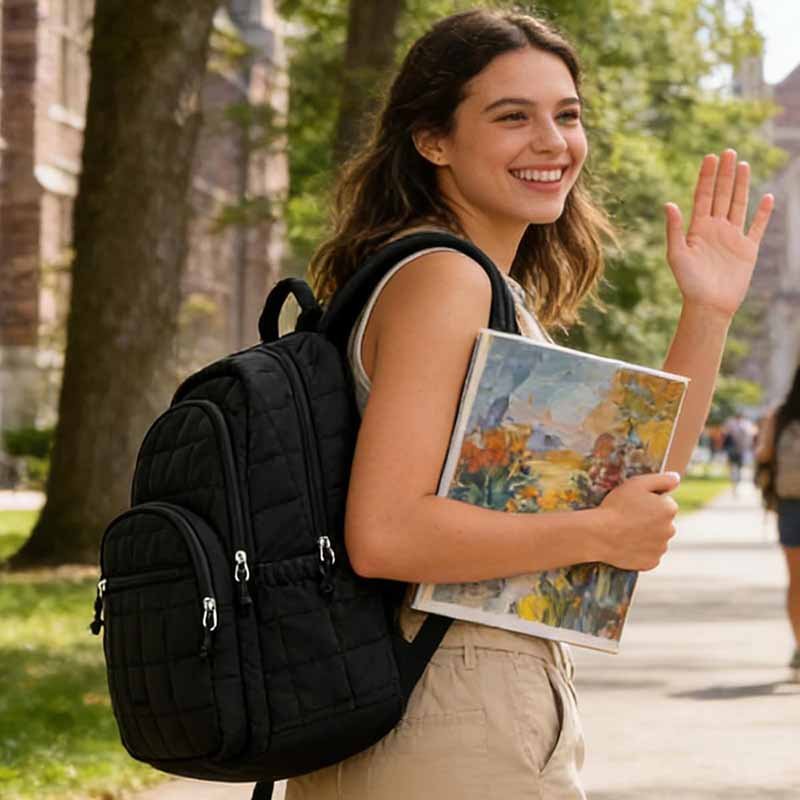
Backpacks look simple, but when buyers actually try to choose one—especially for school, commuting, or travel—the most common question quickly appears: “How big is a standard backpack?”
On Google, users don’t search for abstract design terms. They search real-life questions like “Is a 25L backpack big?”, “Is a 28L backpack big for school?”, or “Is a 15-inch backpack big enough for school?” These questions reveal something important: people don’t just want dimensions—they want reassurance that a backpack will actually work for their daily life.
A backpack that’s too small becomes frustrating within days. One that’s too large feels bulky, uncomfortable, and impractical. And for brands, choosing the wrong “standard size” can mean higher return rates, poor reviews, or lost customers—especially in eCommerce.
In reality, there is no single universal backpack size that fits everyone. “Standard” depends on volume (liters), physical dimensions, user age, use scenario, and body fit. A backpack that feels perfect for a college student may feel oversized for a middle schooler. A backpack marketed as “carry-on” may fail airline limits if its shape is wrong.
A standard backpack is typically between 20L and 30L in volume, with average dimensions around 45–50 cm tall, 30–35 cm wide, and 15–20 cm deep. This size range works well for school, commuting, and everyday use. However, the ideal backpack size depends on how it’s used—school, travel, or work—and whether it needs to carry laptops, books, or clothing.
To understand backpack sizing clearly—and choose the right size for users or custom production—we need to break it down step by step.
What Is a Standard Backpack Size
A standard backpack size usually refers to backpacks with a capacity of 20–30 liters, designed for everyday use such as school, commuting, and light travel. In dimensions, a standard backpack is typically 45–50 cm tall, 30–35 cm wide, and 15–20 cm deep, providing enough space for books, laptops, and daily essentials without being bulky or uncomfortable.
What dimensions define a standard backpack?
Although backpack size is often marketed in liters, physical dimensions still matter greatly, especially for comfort, fit, and airline or locker compatibility.
Most standard backpacks fall into these physical ranges:
| Dimension | Typical Standard Range | Why It Matters |
|---|---|---|
| Height | 45–50 cm (17–20 in) | Fits average adult torso length |
| Width | 30–35 cm (12–14 in) | Holds books & laptops flat |
| Depth | 15–20 cm (6–8 in) | Prevents bulky, backward pull |
Backpacks taller than 50 cm usually shift into travel or hiking categories, while depths beyond 20 cm often feel bulky for daily use.
What volume in liters is considered standard?
In real-world usage and retail data, 20–30 liters is widely accepted as the standard backpack volume.
A practical breakdown looks like this:
- 20–22L → Minimal daily carry (laptop + essentials)
- 23–25L → Classic school & commuting backpack
- 26–30L → Large daily carry or heavy school load
This range works because it balances capacity, comfort, and portability. Anything below 20L often feels restrictive; anything above 30L starts to feel oversized for daily routines.
Is 25L big for a backpack?
No. 25 liters is considered the most common “standard” backpack size worldwide.
A typical 25L backpack comfortably fits:
- A 13–15 inch laptop
- 1–2 textbooks or binders
- Notebooks and stationery
- Water bottle and small accessories
For students, office workers, and commuters, 25L is often the safest choice—it’s large enough for daily needs without encouraging overpacking.
Is 28L still considered a standard backpack size?
Yes, but it sits at the upper end of the standard range.
A 28L backpack is ideal for:
- High school or college students with heavy book loads
- Users carrying laptops, chargers, lunch, and gym clothes
- People who prefer extra space without moving to travel backpacks
However, for smaller users or younger students, 28L may feel bulky. This is why many brands position 28L as a “large daily” rather than a true universal standard.
Why isn’t there one single universal standard backpack size?
Because “standard” depends on use case, body size, and packing behavior.
Factors that influence what feels standard include:
- User height and torso length
- School vs office vs travel use
- Laptop size and book format
- Cultural and regional packing habits
That’s why brands like Lovrix often develop multiple standard sizes rather than relying on a single backpack dimension for all markets.
How do standard backpack sizes differ from travel or hiking backpacks?
Standard backpacks focus on daily usability, not maximum volume.
| Backpack Type | Typical Volume |
|---|---|
| Standard daily backpack | 20–30L |
| Travel backpack | 30–45L |
| Hiking / trekking backpack | 40–65L+ |
Standard backpacks prioritize:
- Slim profile
- Easy organization
- Comfort for short to medium wear times
Travel and hiking backpacks prioritize capacity and load support, often at the expense of compactness.
Which Backpack Sizes Fit Everyday Use
Backpacks between 22L and 28L fit most everyday use scenarios, including school, commuting, and campus life. This size range provides enough space for laptops, books, and daily essentials while remaining comfortable, compact, and easy to carry for long periods.
Is a 28L backpack big for school?
A 28L backpack is considered large but still suitable for school, especially for older students.
It works well for:
- High school students carrying multiple textbooks
- College students with laptops, chargers, notebooks, and accessories
- Students who carry lunch boxes, water bottles, or gym clothes
However, for younger students or those with lighter loads, 28L may feel bulky. For this reason, many brands position 28L as a “large school backpack”, while 22–25L remains the most common daily size.
Is a 15-inch backpack big enough for school?
A “15-inch backpack” refers to laptop compatibility, not total capacity.
In practice:
- Most 15-inch laptop backpacks range from 20L to 25L
- They easily fit notebooks, folders, and stationery
- They may feel tight if carrying multiple thick textbooks
For students whose daily load centers around a laptop and light school supplies, a 15-inch backpack is usually sufficient. For book-heavy programs, stepping up to 25–28L offers better comfort.
Is 25L the most practical everyday backpack size?
Yes. 25L is widely considered the most practical everyday backpack size.
A 25L backpack typically fits:
- A 13–15 inch laptop
- 1–2 binders or textbooks
- Notebooks, pencil cases, chargers
- A water bottle and small personal items
This size strikes the best balance between capacity and portability, which is why it dominates school, commuting, and campus markets worldwide.
Which backpack size works best for daily commuting and office use?
For commuting and office use, 22L–25L is ideal.
This size:
- Looks slim and professional
- Fits laptops, documents, and lunch
- Is comfortable on public transport
- Avoids the “bulky” look of travel backpacks
Urban commuters generally prefer backpacks that are compact in depth, even if height remains standard.
How does everyday use differ from travel or hiking use?
Everyday backpacks prioritize:
- Organization over raw capacity
- Slim profiles for crowded environments
- Comfort for short to medium wear times
By contrast:
- Travel backpacks emphasize clothing volume
- Hiking backpacks emphasize load support and ventilation
This is why a 25L everyday backpack can feel far more usable day-to-day than a poorly designed 35L pack.
Everyday Backpack Size Comparison Table
Below is a practical overview of everyday backpack sizes and their best uses:
| Backpack Size | Best For | Everyday Verdict |
|---|---|---|
| 18–20L | Minimal carry | Too small for most students |
| 22–24L | Light school & commuting | Good for minimalist users |
| 25L | School, work, campus | ⭐ Most balanced choice |
| 26–28L | Heavy school load | Good, but slightly bulky |
| 30L+ | Travel or hiking | Too big for daily use |
How Big Should Backpacks Be for Travel
Travel backpacks typically range from 25L to 40L, depending on trip length and airline carry-on limits. For short trips or minimalist packing, 25–30L works well. For weekend or multi-day travel, 30–35L is ideal. Backpacks larger than 40L usually exceed carry-on size limits and are better suited for checked luggage or hiking.
How many liters is ideal for a carry-on travel backpack?
For most airlines, the ideal carry-on backpack size is 25–35 liters.
- 25–28L → Minimalist travelers, budget airlines
- 30–32L → Standard carry-on backpack size
- 33–35L → Maximum carry-on for many airlines
What matters most is shape, not just liters. Slim, rectangular backpacks pass carry-on checks more easily than deep, boxy designs—even at the same volume.
How big should a backpack be for a weekend trip?
For a 2–3 day trip, most travelers prefer 28–35L.
This size typically fits:
- 2–3 outfits
- Toiletry kit
- Shoes or jacket
- Laptop or tablet
Travelers who pack light can manage with 28–30L, while those carrying shoes or bulky clothing often prefer closer to 35L.
How big should backpacks be for multi-day travel?
For trips longer than three days, backpacks usually range 35–40L.
However:
- 35L works for organized packers
- 40L offers comfort for less disciplined packing
Above 40L, backpacks begin to feel heavy, bulky, and less suitable for urban travel.
How big is too big for airline carry-on limits?
Most airlines restrict carry-on luggage to roughly:
- 55 × 40 × 20 cm (21.5 × 15.5 × 8 in)
Backpacks larger than 40L often exceed depth limits, even if height and width appear acceptable. Depth is the most common reason backpacks fail carry-on checks.
How does travel backpack size differ from hiking backpack size?
Travel backpacks prioritize:
- Organization
- Flat packing
- Laptop access
- Urban mobility
Hiking backpacks prioritize:
- Load support
- Ventilation
- Weight distribution
A 40L hiking pack feels very different from a 40L travel pack. Travel backpacks usually look smaller and more structured at the same volume.
Travel Backpack Size Comparison Table
| Travel Type | Recommended Size | Notes |
|---|---|---|
| Day trips | 20–25L | Personal item size |
| Weekend travel | 28–35L | Most popular range |
| Carry-on only travel | 30–35L | Airline-friendly |
| Long travel / hiking | 35–45L | Check airline rules |
| Checked luggage use | 45L+ | Not carry-on friendly |
Are Backpack Sizes Different by Age Group
Yes, backpack sizes vary significantly by age group. Children require smaller, lighter backpacks to match their body size and strength, while teens and adults typically use standard backpacks between 20L and 30L. Choosing the right backpack size by age improves comfort, posture, safety, and daily usability.
Why does age matter when choosing backpack size?
Age is closely linked to body size, strength, and carrying habits, which directly affect how a backpack feels in daily use.
Key age-related factors include:
- Torso length and shoulder width
- Recommended maximum carrying weight
- Duration of wear (school days vs short trips)
A backpack that feels comfortable for an adult can easily overload a child, even if it looks visually “normal.” That’s why age-based sizing is essential—not optional.
What backpack sizes are suitable for children (ages 6–10)?
For young children, smaller and lighter backpacks are critical.
Recommended size range:
- 12L–18L capacity
- Height under 40 cm
- Narrow shoulder straps and soft padding
These backpacks are designed to:
- Carry light books and stationery
- Prevent back and shoulder strain
- Encourage proper posture
Oversized backpacks at this age often lead to discomfort and poor habits, even if they’re not fully loaded.
What backpack sizes work best for teens and middle school students?
Teenagers usually transition into mid-size backpacks, but still benefit from age-appropriate proportions.
Recommended size range:
- 18L–24L for middle school
- 22L–26L for early high school
At this stage, students begin carrying:
- More textbooks
- Larger notebooks
- Occasionally a laptop or tablet
Backpacks should offer more capacity without excessive depth, which can pull weight backward and affect balance.
What backpack sizes are ideal for high school and college students?
High school and college students typically move into standard backpack sizes.
Recommended size range:
- 22L–28L (most common)
- 25L is often the most balanced choice
This size accommodates:
- 13–15 inch laptops
- Multiple textbooks and binders
- Daily personal items
For this age group, backpacks are often worn for long hours, making ergonomic design and weight distribution just as important as size.
Are adult backpacks larger than student backpacks?
Not always—but adult backpacks are designed differently.
Adult backpacks typically:
- Fall within 20L–30L
- Have wider shoulder straps
- Use firmer back panels
- Support heavier loads
Adults may carry less volume than students but heavier items (laptops, chargers, documents), so structure and support matter more than raw capacity.
How do backpack size needs change with age progression?
As users grow, backpack size needs evolve gradually—not suddenly.
A practical progression looks like this:
| Age Group | Recommended Size |
|---|---|
| Kids (6–10) | 12–18L |
| Pre-teens (11–13) | 18–22L |
| Teens (14–17) | 22–26L |
| College / Adults | 22–30L |
Brands that align product lines with this progression tend to see better customer satisfaction and fewer size-related returns.
Why should brands offer age-specific backpack sizing?
From a brand and OEM perspective, age-specific sizing:
- Improves fit and comfort
- Reduces negative reviews
- Increases repeat purchases
- Allows clearer product segmentation
At Lovrix, backpack sizes can be customized by age group—not just by volume, but also by dimensions, padding, webbing strength, and fabric choice, ensuring each product truly fits its intended user.
How Do Backpack Sizes Affect Comfort & Fit
Backpack size directly affects comfort and fit by influencing weight distribution, posture, and how the load sits on the body. A properly sized backpack aligns with the wearer’s torso length, keeps weight close to the back, and avoids excessive pressure on shoulders and lower back. Oversized or poorly proportioned backpacks often feel uncomfortable even when lightly packed.
How does torso length influence backpack comfort?
Torso length is one of the most overlooked factors in backpack comfort.
If a backpack is:
- Too tall → it pushes weight upward and backward
- Too short → weight concentrates on the shoulders
Standard everyday backpacks (around 45–50 cm in height) are designed to fit average adult torso lengths. For shorter users, even a “standard-size” backpack can feel uncomfortable if it extends too far down the back or rides too high near the neck.
This is why comfort depends not just on volume, but on how the backpack’s height matches the wearer’s body proportions.
How does backpack volume affect weight distribution?
Larger backpacks encourage users to carry more—even when they don’t need to.
This creates two common comfort problems:
- Increased total weight
- Poor load balance
A well-designed 25L backpack often feels more comfortable than a poorly structured 30L backpack because it limits overpacking and keeps weight centered. Comfort is about controlled capacity, not maximum volume.
Why does backpack depth matter more than width?
Depth (front-to-back thickness) has a huge impact on comfort.
Backpacks that are too deep:
- Pull weight away from the body
- Increase lower-back strain
- Feel unstable when walking
Slim-profile backpacks keep the load close to the spine, which improves balance and reduces fatigue. This is why many commuters prefer backpacks that are slightly taller rather than deeper, even at the same volume.
How does internal layout affect comfort at the same size?
Two backpacks with the same capacity can feel completely different due to internal structure.
Comfort improves when:
- Heavy items are placed closer to the back panel
- Compartments prevent items from shifting
- Laptop sleeves are centered and padded
Poor internal organization allows contents to move, creating uneven pressure and discomfort—even if the backpack is the “right size” on paper.
How do shoulder straps and padding interact with backpack size?
As backpack size increases, strap design becomes more important.
Larger backpacks require:
- Wider shoulder straps
- Thicker, denser padding
- Better contouring
A small backpack with thin straps may feel fine, but the same straps on a larger pack quickly cause shoulder pain. This is why comfort issues are often blamed on “size,” when the real issue is size without proper support.
How does body movement change how backpack size feels?
Comfort isn’t static—it changes as the wearer moves.
When walking, climbing stairs, or riding public transport:
- Oversized backpacks swing and shift
- Deep backpacks hit elbows or hips
- Poorly balanced packs strain the neck
Everyday backpacks should remain stable during motion. That stability is achieved through appropriate size, controlled depth, and good load positioning.
Why do smaller backpacks sometimes feel more comfortable?
Smaller backpacks often feel better because they:
- Limit overpacking
- Stay closer to the body
- Distribute weight more naturally
This is why many users report that downsizing from 30L to 25L dramatically improves comfort, even though capacity decreases only slightly.
How should brands balance size and comfort in design?
From a brand and OEM perspective, comfort-focused sizing means:
- Offering multiple size options instead of one oversized model
- Controlling depth rather than increasing volume
- Designing size-specific strap systems
At Lovrix, backpack size customization goes beyond liters—we optimize dimensions, structure, webbing strength, padding density, and fabric stiffness together to ensure real comfort, not just good specifications.
What Should Brands Consider When Customizing Backpack Sizes
When customizing backpack sizes, brands should consider target users, use scenarios, body fit, packing habits, and sales channels. The most successful brands optimize backpack dimensions—not just volume—to balance comfort, usability, and market demand. Offering a small range of well-designed sizes often performs better than a single oversized “one-size-fits-all” model.
Who is the target user and how do they actually use the backpack?
Every size decision should start with real user behavior, not assumptions.
Brands need to ask:
- Is this backpack for students, commuters, travelers, or kids?
- Will it carry books, laptops, clothing, or mixed items?
- How long is it worn each day?
For example, a backpack designed for high school students should prioritize vertical book storage and durability, while a commuter backpack should prioritize slim depth and laptop protection. Customizing size without a clear user profile often leads to poor product-market fit.
What size range matches the core market demand?
Data from retail and eCommerce consistently shows that mid-range sizes sell best.
For most brands:
- 22–25L covers minimalist and commuter users
- 25–28L covers school and campus users
- 30L+ serves niche or travel-focused users
Instead of offering many sizes, strong brands focus on 2–3 optimized sizes that cover 80% of buyers. This reduces inventory risk while still meeting diverse needs.
Why do dimensions matter more than liters in customization?
Liters are useful for marketing—but dimensions determine comfort and usability.
Two backpacks labeled “25L” can feel completely different because of:
- Height vs depth distribution
- Internal layout
- Back panel curvature
Brands that customize height, width, and depth ratios—not just volume—create backpacks that feel better on the body and receive fewer comfort-related complaints.
How do regional and cultural preferences affect backpack size?
Backpack size preferences vary by market.
Examples:
- North America: preference for slightly larger backpacks (25–28L)
- Europe & Japan: preference for slimmer, more compact profiles
- School-focused markets: higher demand for durability and book capacity
For global brands, customizing backpack sizes by market—or at least adjusting proportions—can significantly improve local acceptance.
How should brands balance size, comfort, and aesthetics?
Bigger backpacks often look impressive in photos—but feel uncomfortable in real life.
Successful brands:
- Control depth to avoid bulky appearance
- Use structure and padding instead of raw volume
- Design backpacks that look compact even when full
From an OEM perspective, this balance is achieved through pattern design, fabric stiffness, padding density, and internal reinforcement, not by simply increasing liters.
How does backpack size influence return rates and reviews?
Size-related dissatisfaction is one of the top causes of backpack returns online.
Common complaints include:
- “Too small for my needs”
- “Bigger than expected”
- “Uncomfortable when full”
Brands that clearly define backpack size, optimize proportions, and test samples with real users see lower return rates and higher review scores.
Why should brands prototype and test backpack sizes before mass production?
Backpack size decisions should never rely on specs alone.
Effective brands:
- Produce multiple size samples
- Test packing scenarios
- Evaluate comfort during movement
- Adjust dimensions before bulk orders
At Lovrix, size customization is refined through fast sampling and iterative feedback, allowing brands to validate size choices with minimal risk.
How does working with the right manufacturer improve size customization?
Customizing backpack size is not just a design task—it’s a manufacturing task.
A professional manufacturer helps brands:
- Translate size concepts into production-ready patterns
- Adjust dimensions without compromising structure
- Match size changes with fabric, webbing, and stitching strength
- Ensure consistency across mass production
With in-house fabric factories, webbing factories, and backpack manufacturing, Lovrix can customize backpack sizes holistically—ensuring that comfort, durability, and scalability align.
Conclusion
Choosing the right backpack size isn’t just about numbers—it’s about how real users carry, move, and live with the product every day. For brands and eCommerce sellers, size decisions directly affect comfort, reviews, returns, and long-term brand trust.
With over 19 years of experience in fabrics, webbing, and backpack manufacturing, Lovrix helps brands move beyond guesswork.
Whether you’re launching a new backpack line or optimizing an existing one, Lovrix works with you to engineer the right size, structure, and materials for your market.
Contact Lovrix today to discuss custom backpack sizes, request samples, or receive a tailored OEM/ODM quotation.


