 Skip to content

When people hear the term fireproof document bag, the first reaction is often skepticism. Can a soft bag really protect passports, contracts, certificates, or digital storage from a real fire? Or is it just a marketing label designed to sound reassuring?
This doubt is reasonable. In reality, no soft product can survive unlimited heat forever. But that does not mean fireproof document bags are useless. In fact, when designed correctly and used properly, they play a critical role in delaying heat transfer, buying valuable time during a fire emergency and protecting documents from the most common causes of loss: sudden flames, smoke exposure, and water damage during firefighting.
The best fireproof document bags use multi-layer fire-resistant materials to slow heat penetration and protect paper and digital media during fire emergencies. While no bag is 100% fireproof, high-quality fireproof document bags can withstand extreme temperatures for limited periods, protecting documents from flames, smoke, and water. Choosing the right bag depends on materials, construction, testing standards, and intended use.
Many homeowners, offices, and businesses only realize the value of proper document storage after a loss occurs—when insurance papers, legal files, or identity documents are damaged beyond recovery. In the sections below, we break down how fireproof document bags actually work, what materials matter, which brands are trusted, and how to choose or customize the right solution based on real-world use, not marketing claims.
What is a fireproof document bag
A fireproof document bag is a protective storage bag made with fire-resistant materials and layered construction designed to delay heat transfer and protect paper documents and digital media during fire emergencies. It does not make contents permanently fireproof, but it significantly reduces damage from flames, smoke, and water for a limited period.
What a fireproof document bag is designed to protect
A fireproof document bag is engineered to protect critical, irreplaceable items, such as:
- Passports and ID cards
- Birth, marriage, and property certificates
- Legal contracts and financial records
- Insurance documents
- USB drives, external hard drives, and memory cards
In real fires, most document loss occurs due to rapid heat buildup, smoke penetration, and water damage from firefighting efforts. Fireproof document bags are designed to address all three risks simultaneously.
How a fireproof document bag actually works
Fireproof document bags work by slowing down heat transfer, not by blocking fire completely.
Key protective mechanisms include:
- Fire-resistant fibers (commonly fiberglass) that do not easily burn or melt
- Multi-layer insulation that forces heat to pass through several barriers
- Heat-reflective layers (often aluminized) that reduce radiant heat absorption
- Tight closures and seams that limit smoke and water entry
By delaying temperature rise inside the bag, documents remain below ignition and degradation thresholds long enough to survive most short-duration fires.
What “fireproof” really means in practical terms
The term fireproof can be misleading if not properly understood.
In practice:
- Fireproof document bags are usually rated for specific temperatures and time periods
- Common performance ranges are 800°F–2000°F (427°C–1093°C) for 30–60 minutes
- Performance varies depending on materials, construction, and placement during a fire
This means a fireproof document bag is best viewed as time-buying protection, not permanent immunity.
Fireproof vs fire-resistant vs fire-retardant
These terms are often used interchangeably, but they are not the same:
| Term | Meaning |
|---|---|
| Fireproof | Resists heat for a defined time and temperature |
| Fire-resistant | Slows ignition and heat transfer |
| Fire-retardant | Treated to reduce flame spread |
Most high-quality document bags are fire-resistant by design, with fireproof performance defined by test conditions.
Are fireproof document bags better than fireproof safes?
Fireproof document bags and safes serve different roles.
- Fireproof safes provide rigid insulation and impact resistance
- Fireproof document bags offer flexibility, portability, and layered protection
Many professionals use fireproof bags inside safes or cabinets to create multi-level protection. This layered approach significantly improves survival rates for documents.
What fireproof document bags are not
To avoid unrealistic expectations, it’s important to understand what these bags cannot do:
- They are not indestructible
- They cannot survive unlimited fire exposure
- They do not replace certified fire safes
Understanding these limits helps users choose the right product—and use it correctly.
Why fireproof document bags are widely used today
Fireproof document bags are popular because they offer:
- Affordable fire protection without heavy safes
- Easy portability for emergencies
- Protection against water and smoke as well as fire
- Flexible use in homes, offices, and travel
For many users, they represent the most practical first step toward document fire safety.
Which materials make a document bag fireproof
A document bag becomes fireproof through the use of fire-resistant core materials, layered insulation, and heat-reflective barriers. The most effective fireproof document bags combine fiberglass fabric, aluminized foil layers, and fire-retardant coatings to slow heat transfer, block flames, and protect contents during high-temperature exposure.
The core materials that provide real fire resistance
Fireproof performance depends on material behavior under extreme heat, not on appearance or thickness alone. The following materials are widely recognized as effective in fireproof document bags.
Fiberglass fabric: the primary heat barrier
Fiberglass is the most commonly used core material in fireproof document bags.
Why fiberglass works:
- Does not easily ignite or melt
- Maintains structural stability at very high temperatures
- Provides excellent thermal insulation
In real fire conditions, fiberglass acts as the first and most important defense layer, slowing heat penetration long enough to protect paper and digital media.
At Lovrix, fiberglass fabrics are selected based on fiber diameter, weave density, and consistency, ensuring predictable fire resistance across production batches.
Aluminized foil layers: reflecting radiant heat
Aluminized layers play a critical role by reflecting radiant heat away from the bag.
Key functions:
- Reflect heat instead of absorbing it
- Reduce surface temperature rise
- Improve performance during sudden flame exposure
Aluminum foil alone is not fireproof, but when bonded with fiberglass, it significantly improves heat resistance. This combination is common in high-performance fireproof document bags.
Fire-retardant coatings: sealing and stability
Fire-retardant coatings (such as silicone or specialized polymer coatings) enhance fireproof performance by:
- Binding fibers together
- Preventing fiber shedding under heat
- Improving flexibility and durability
These coatings do not make a bag fireproof by themselves, but they stabilize the core materials and improve real-world usability.
why structure matters more than thickness
Fireproof bags rarely rely on a single material.
A typical high-quality fireproof document bag uses:
- Outer heat-reflective layer
- Middle insulation layer
- Inner smoke- and water-resistant lining
This layered structure forces heat to pass through multiple barriers, significantly delaying temperature rise inside the bag.
A thick single-layer bag without proper materials often fails faster than a thinner, well-engineered multi-layer bag.
Supporting materials that improve overall protection
In addition to core fire-resistant materials, quality fireproof document bags often include:
- Fire-resistant stitching threads (to prevent seam failure)
- Heat-tolerant zippers or closures
- Water-resistant inner linings to protect against fire-suppression damage
These components prevent weak points where heat, smoke, or water could penetrate.
Materials that do not make a bag fireproof
It’s important to recognize what does not qualify as fireproof:
- Ordinary polyester or nylon fabrics
- PU-coated or PVC-coated fabrics without fire-resistant cores
- Single-layer “thick” fabrics with no insulation
These materials may look durable but offer little protection under fire exposure.
Fireproof vs fire-retardant materials
| Term | What it means |
|---|---|
| Fireproof materials | Resist high heat for a defined time |
| Fire-resistant materials | Slow heat transfer |
| Fire-retardant materials | Reduce flame spread |
Most fireproof document bags rely on fire-resistant construction, not absolute fireproofing.
How to choose the best fireproof document bag
To choose the best fireproof document bag, match the bag to your real use case, then verify materials (fiberglass layers + reflective barrier), fire exposure time, closure design, water resistance, and size. The best option is the one that protects your documents under realistic fire conditions and daily handling—not the one with the biggest “temperature number” in marketing.
Step 1: Start with the use case
A “best” fireproof document bag is different depending on where and how it’s used:
- Home emergency kit: passports, IDs, insurance papers, USB backups
- Office compliance: contracts, invoices, legal-size folders, client files
- Travel carry: lightweight pouch, fast access, slim profile
- Long-term archive: high capacity, multi-compartment, stronger closure
Tip: if your documents are truly mission-critical (property deeds, business licenses), aim for a bag that supports double closure and multi-layer structure.
Step 2: Verify the core materials
Ignore vague wording like “fireproof fabric” unless the supplier clarifies structure.
Look for these proven elements:
- Fiberglass fabric (core heat barrier)
- Aluminized reflective layer (reduces radiant heat absorption)
- Fire-retardant coating (stabilizes fibers, improves durability)
- Multi-layer construction (the biggest driver of real performance)
If a bag is mainly polyester/nylon with a “fireproof coating,” it may be flame-retardant, not truly fire-resistant.
Step 3: Focus on time resistance, not only maximum temperature
Many listings highlight extreme temperatures (e.g., “2000°F”), but time is the real survival factor.
Ask:
- How long can it resist heat exposure? (30 mins? 60 mins?)
- Is the rating based on testing or marketing?
A realistic selection rule:
- 30–60 minutes resistance is typically the most useful range for document protection in common fire scenarios.
If time is not stated, treat the claim as incomplete.
Step 4: Check closure design
Closures are where many “fireproof” bags fail.
Better protection usually comes from:
- Fire-resistant zipper + overlapping flap
- Double closure (zipper + Velcro flap)
- Reinforced seams with heat-tolerant stitching
Weak designs include:
- Single Velcro closure only (fast access, weaker sealing)
- Exposed metal parts that conduct heat inward
- Poor seam finishing or thin edge binding
If you’re storing USB drives or hard disks, closure quality becomes even more important because electronics are more heat-sensitive than paper.
Step 5: Don’t forget water resistance and smoke protection
In real fires, documents often die from:
- Water from sprinklers/firefighters
- Smoke and ash penetration
- Steam + heat combination
For better real-world protection, look for:
- Water-resistant coating or inner lining
- Sealed seam design
- Smoke-blocking interior layer
The best bags protect against fire + water + smoke, not fire alone.
Step 6: Choose the right size and internal layout
Size should match how documents are stored, not how you plan to store them.
- A4 / Letter: standard for most homes and offices
- Legal size: essential for US legal files
- Expandable gusset: better for thick file stacks
- Multiple compartments**:** separate paper from digital backups
Practical advice:
- If you carry folders or binders, choose structured document carrier styles.
- If you store passports and IDs, a compact pouch is enough.
Step 7: Confirm testing and quality proof
You don’t always need UL certification, but you do need transparency.
A trustworthy supplier should provide:
- Defined heat exposure conditions (temperature + duration)
- Material composition (fiberglass layer count, reflective layer type)
- Basic performance data (water resistance, seam construction)
If the seller avoids specifics, it usually means the product relies on generic materials.
Which 10 brands offer top fireproof document bags
1 Lovrix
Best for: private label programs, custom sizes, custom materials, scalable production
Why it stands out: Lovrix can build the product as a system (fire-resistant fabric + webbing + bag construction), which matters for seam integrity, closures, and consistency across batches.
What to verify: layer structure (fiberglass + reflective layer), zipper spec, seam binding, and requested third-party testing based on target market.
2 Szoneier
Best for: brands wanting fireproof document bag development with bag-making know-how
Why it stands out: Szoneier positions fireproof document bags as engineered storage products and publishes buyer-education content around fireproof bag structure and selection. (szoneier.com)
What to verify: same as above—especially closure design and heat transfer delay (time-based claims).
3 SentrySafe
Best for: mainstream home users who want a known safe-storage brand and a portable “go-bag” style
Why it stands out: SentrySafe sells a dedicated “Fire Bag” emphasizing four-layer protection and explicitly warns that no document bag survives a major structure fire, which is a realistic, trust-building stance. (sentrysafe.com)
Watch-outs: many models are “brief exposure” protection; best used as part of a layered approach (bag inside a cabinet/safe).
4 DocSafe
Best for: shoppers who want fire + water resistant soft bags and organizers with common sizes
Why it stands out: DocSafe listings commonly describe silicone-coated fiberglass layer construction for document bags/organizers, which aligns with typical fire-resistant bag engineering.
Watch-outs: “max temperature” marketing varies by listing—ask for time + temperature conditions and seam/zipper specs.
5 ENGPOW
Best for: “document organizer” style products (multi-pocket, lockable, travel-friendly)
Why it stands out: ENGPOW emphasizes organized storage formats (accordion-style / lock options) and “fireproof document bag” positioning across its brand storefront and site.
Watch-outs: verify internal lining and zipper performance under heat; organizer designs can add seams (more potential leak paths).
6 JUNDUN
Best for: a broad range of fireproof storage (bags + organizers + boxes) with many sizes
Why it stands out: JUNDUN presents itself as a dedicated fireproof bag/box maker and offers multiple organizer formats. (jundun)
Watch-outs: check which products are “document bag” vs “organizer box,” and confirm material layers per SKU (not just brand-level claims).
7 ROLOWAY
Best for: shoppers who want a fireproof document bag with “extra features” (locks, reflective strip variants, larger organizers)
Why it stands out: ROLOWAY markets a focused “fireproof bag” collection and sells document-bag SKUs with lock/organizer positioning. (Rolowaysafe)
Watch-outs: ultra-high temperature numbers are common in marketing—ground your decision in construction details (layers, zipper type, seam finishing).
8 COLCASE
Best for: straightforward fireproof document bag formats (often with upgraded pockets)
Why it stands out: COLCASE promotes document bags as “second layer of protection” and has dedicated product pages and listings around fireproof document bags. (colcase.com)
Watch-outs: confirm bag dimensions and closure system; pocket-heavy designs may reduce sealing unless engineered carefully.
9 FYY
Best for: compact, simple pouches for passports/cash/small documents
Why it stands out: FYY listings commonly specify silicone-coated fiberglass and “fireproof & water-resistant” positioning in a smaller pouch form factor.
Watch-outs: small pouches are great for essentials but not for thick files—choose based on document type (A4/Letter/Legal).
10 Honeywell
Best for: users who want rigid fire/water protection for documents and digital media (not a soft bag)
Why it stands out: Honeywell’s portable chests often highlight UL fire protection and water sealing—useful when you need more structure than a soft bag.
Watch-outs: heavier and less portable than a bag; many buyers pair a soft fireproof document bag inside a chest for layered protection.
What are feature comparisons of fireproof bags
The most meaningful comparisons for fireproof document bags are heat resistance (time + temperature), layer construction, closure sealing, seam integrity, water/smoke protection, size format, portability, and lifespan under daily handling. The “best” bag is the one that matches your document type and risk scenario—not the one with the highest advertised temperature.
1 Fire protection performance: time matters more than maximum temperature
What to compare
- Heat exposure duration (e.g., 30/60 minutes)
- Heat exposure temperature (e.g., 800°F–2000°F / 427°C–1093°C)
- Whether performance is tested or only “claimed”
Why it matters
In real fires, survival depends on how long internal temperature stays below:
- Paper scorching/ignition thresholds
- Digital media damage thresholds (often lower than paper)
If a product lists only “2000°F” but no time window, treat it as incomplete information.
2 Layer construction: what the bag is actually made of
What to compare
- Core fabric: fiberglass (common), aramid (premium), blends
- Reflective barrier: aluminized layer (helps with radiant heat)
- Coating: silicone or fire-retardant coating (stability + durability)
- Number of layers: single vs multi-layer
Why it matters
Fire resistance is mainly heat transfer delay. Multi-layer designs slow heat penetration far better than single-layer “thick” fabrics.
Choose multi-layer for critical docs (IDs, property papers, business contracts). Single-layer is only acceptable for low-risk, low-value storage.
3 Closure system: zippers, flaps, and sealing strategy
What to compare
- Zipper type: fire-resistant zipper vs standard zipper
- Flap coverage: zipper-only vs zipper + overlap flap
- Double closure: zipper + Velcro flap (common “best practice”)
Why it matters
Closures are the most common failure points in soft fireproof products:
- Gaps allow smoke/steam inside
- Zippers can deform in heat
- Metal hardware may conduct heat inward
For serious protection, choose zipper + flap (or double closure). Zipper-only is convenience-first, not protection-first.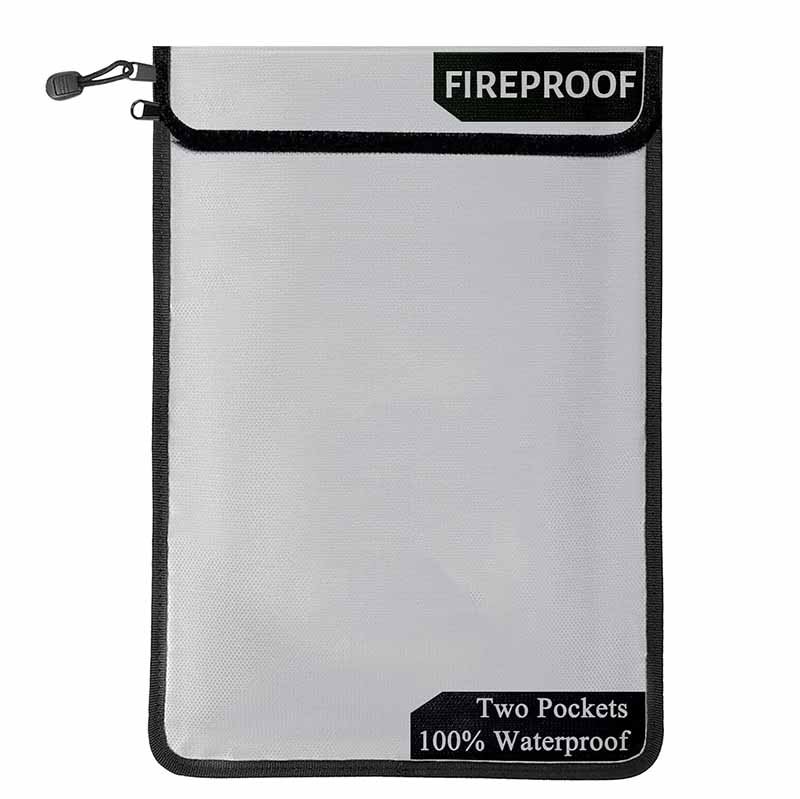
4 Seam design and edge binding: where many bags fail
What to compare
- Stitch density (tight stitching supports seam stability)
- Edge binding (reduces fraying and seam cracking)
- Reinforcement at corners (high stress + heat zones)
- Thread type (heat-tolerant thread is a plus)
Why it matters
Heat and water often enter through seams before they enter through flat panels. A “good fabric” can still fail if seams are weak.
If a bag has many pockets and panels, seam quality matters even more (more seam length = more potential leak paths).
5 Water resistance: protection after sprinklers and firefighting
What to compare
- Waterproof lining (inner layer)
- Seam sealing (helps with water intrusion)
- Water-resistant zipper (if used)
- Whether the product is “water-resistant” vs “waterproof”
Why it matters
Many document losses happen from water damage, not direct flame. A fireproof bag without water protection can still fail the mission.
If you live in a high-rise or office building with sprinklers, prioritize fire + water protection.
6 Smoke and ash protection: often overlooked but very real
What to compare
- Inner lining tightness and closure sealing
- Flap coverage that reduces smoke entry
- Whether bag claims smoke protection (rare, but valuable if true)
Why it matters
Smoke residue can permanently stain documents and damage electronics. A well-sealed bag reduces smoke exposure.
Choose tighter closure designs if storing passports, certificates, or electronics.
7 Size format and document compatibility: A4/Letter/Legal matters
What to compare
- A4 vs Letter vs Legal size
- Gusset depth / expansion (for thick stacks)
- Compartment layout (paper + digital separation)
Why it matters
A bag that’s “fireproof” but forces documents to fold or cram increases:
- crease damage
- poor sealing
- faster wear
Match bag to your document system (folders, binders, envelopes). Don’t buy “one size” unless you only store small essentials.
8 Portability and daily usability: handles, straps, and carry styles
What to compare
- Carry style: pouch / folder / briefcase / organizer
- Handle reinforcement and strap anchoring
- Weight and foldability
Why it matters
A fireproof bag that’s hard to carry won’t be used. The best emergency bag is the one you can grab in seconds.
For “go-bag” use, choose a compact pouch or folder. For office storage, choose briefcase or organizer formats.
9 Durability over time: how long the protection stays reliable
What to compare
- Resistance to cracking after folding
- Coating adhesion (delamination risk)
- Abrasion resistance (especially corners and base)
Why it matters
Many fireproof bags look great at purchase, then degrade after months of use—reducing fire/water performance when it matters most.
If you open/close the bag daily (office use), prioritize reinforced seams + robust closure, not just heat numbers.
| Feature | What “Better” Looks Like | Why It Matters |
|---|---|---|
| Fire rating | Time + temperature stated | Real protection is time-based |
| Layer structure | Multi-layer + reflective barrier | Slower heat transfer |
| Closure | Zipper + flap / double closure | Reduces smoke/steam entry |
| Seams | Reinforced + edge binding | Common failure point |
| Water protection | Waterproof lining + better sealing | Sprinklers/firefighters |
| Size match | A4/Letter/Legal options | Prevents folding & damage |
| Layout | Paper + digital separation | Electronics are heat-sensitive |
| Durability | Less cracking/delamination | Protection lasts longer |
| Portability | Grab-and-go carry | Ensures it’s actually used |
Where are fireproof document bags used most
Fireproof document bags are most commonly used in homes, offices, businesses, regulated industries, and emergency preparedness scenarios to protect critical paper documents and digital media from fire, smoke, and water damage. Their flexibility and portability make them especially useful where traditional fireproof safes are impractical or insufficient on their own.
1 Home use: protecting irreplaceable personal documents
Why homes are the most common use case
Residential fires account for a large share of document loss worldwide. In homes, important papers are often stored loosely in drawers, cabinets, or boxes—making them highly vulnerable to heat, smoke, and water.
Typical documents stored at home
- Passports and ID cards
- Birth, marriage, and education certificates
- Property deeds and mortgage papers
- Insurance policies
- USB drives with family photos or backups
Why fireproof document bags work well at home
- Easy to grab during emergencies
- Can be stored inside drawers, cabinets, or closets
- Affordable alternative to large fireproof safes
Best practice:
Many households store a fireproof document bag inside a cabinet or safe, creating layered protection without heavy equipment.
2 Office and corporate environments: compliance and continuity
Why offices rely on fireproof document bags
In offices, document loss is not just inconvenient—it can interrupt operations, violate compliance rules, or cause legal exposure.
Common office use cases
- Contracts and agreements
- Client records and invoices
- HR files and employment documents
- Company seals and licenses
Fireproof document bags are often used as department-level storage, rather than centralized safes, allowing faster access while still providing protection.
Typical users
- Small and medium-sized businesses
- Corporate legal and finance teams
- Accounting and consulting firms
Key advantage:
Fireproof bags allow documents to be moved quickly during office relocation, audits, or emergencies.
3 Legal, financial, and regulated industries
Why these industries depend heavily on fireproof storage
In regulated sectors, document loss can lead to fines, lawsuits, or license suspension. Fireproof document bags act as risk-mitigation tools, not just storage.
Industries with high usage
- Law firms (contracts, case files, evidence copies)
- Financial institutions (loan documents, compliance files)
- Insurance companies (policy records, claims documentation)
- Government offices (licenses, permits, certificates)
In these settings, fireproof document bags are often used inside filing cabinets to add an extra layer of fire and water protection.
4 Medical and healthcare settings
Why medical environments need document protection
Healthcare facilities handle sensitive records that must remain accessible yet protected.
Typical contents
- Patient consent forms
- Medical licenses and certifications
- Backup copies of compliance documents
- Digital records stored on external drives
Fireproof document bags are valued because they are:
- Lightweight and portable
- Compatible with existing storage furniture
- Suitable for both paper and digital media
They are commonly used in administrative offices, not clinical rooms.
5 Emergency preparedness and “go-bag” scenarios
Why fireproof document bags are essential in emergencies
In disasters such as fires, floods, or earthquakes, people often have seconds to evacuate. Fireproof document bags are widely used in emergency kits.
Common emergency use
- Stored near exits or in bedrooms
- Packed inside evacuation backpacks
- Used by families, travelers, and expats
Typical contents include:
- IDs and passports
- Emergency cash
- USB backups
- Insurance and contact lists
Key reason for popularity:
A fireproof document bag protects contents even if evacuation is rushed or incomplete.
6 Business travel and mobile professionals
Why travelers use fireproof document bags
Executives, consultants, and cross-border professionals often carry documents that are difficult or impossible to replace while abroad.
Common travel use cases
- Business contracts
- Immigration or visa paperwork
- Company credentials
- Portable storage devices
Fireproof document bags are favored because they:
- Fit easily into luggage or backpacks
- Add fire and water protection in hotels and transport
- Offer peace of mind during long trips
7 Archival and backup storage
Why archives use fireproof document bags
Fireproof document bags are frequently used as secondary protection for archived materials.
Typical archival applications
- Backup copies of historical documents
- Original certificates kept off-site
- Long-term storage of digital backups
They are often combined with:
- Fireproof cabinets
- Climate-controlled storage rooms
This layered approach balances cost, accessibility, and protection.
8 How fireproof document bags are usually combined with other storage
Fireproof document bags are rarely used alone in high-risk scenarios.
Common combinations
- Fireproof bag + drawer or cabinet
- Fireproof bag + fireproof safe
- Fireproof bag + emergency backpack
This strategy improves overall survival rates because heat, smoke, and water must pass through multiple barriers before reaching documents.
| Environment | Why Used | Typical Contents |
|---|---|---|
| Home | Personal document safety | IDs, certificates |
| Office | Compliance & continuity | Contracts, records |
| Legal/Finance | Risk management | Case files, licenses |
| Medical | Regulatory storage | Certifications, backups |
| Emergency kits | Rapid evacuation | IDs, cash, USBs |
| Travel | Portable protection | Business documents |
| Archive | Backup protection | Originals, copies |
Conclusion
No fireproof document bag can guarantee absolute protection. But the right bag—designed with proper materials, structure, and realistic expectations—can make the difference between total loss and full recovery.
If you are developing a custom fireproof document bag for your brand, office, or e-commerce business, working with an experienced manufacturer matters.Contact Lovrix today to discuss your fireproof document bag project and receive a tailored OEM/ODM solution built for real-world protection.


