 Skip to content
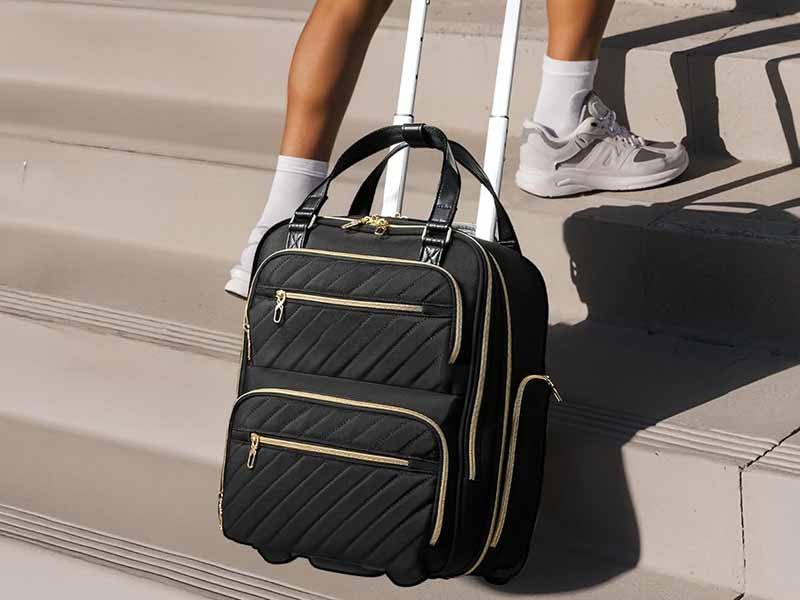
If you’ve ever stood at an airport gate watching passengers nervously push their bags into a metal sizer, you already know: carry-on size matters more than most travelers expect. A bag that fit perfectly on one airline last month might suddenly be “too big” on another flight today. That confusion isn’t accidental—it’s built into how airlines manage space, boarding speed, and revenue.
Carry-on bags sit at the intersection of regulation, aircraft design, and traveler behavior. Airlines want smaller bags to reduce overhead bin congestion. Travelers want larger bags to avoid checked baggage fees. Brands want designs that sell globally without being rejected at the gate. These interests don’t always align, which is why carry-on sizing feels inconsistent and stressful.
Most carry-on bags are limited to around 22 × 14 × 9 inches (56 × 36 × 23 cm), including wheels and handles. However, exact size and weight limits vary by airline, aircraft type, and region. Some airlines enforce carry-on size strictly, while others allow flexibility. Understanding standard dimensions, airline policies, and how bags are measured helps travelers and brands avoid gate checks and extra fees.
A frequent traveler once joked, “My bag didn’t change—my airline did.” That sentence captures why understanding carry-on size rules isn’t optional anymore. Let’s break it down properly.
What Is a Carry-On Bag

A carry-on bag is luggage designed to be taken into the aircraft cabin and stored in the overhead bin, rather than checked into the cargo hold. It must meet airline size and weight limits, which usually include wheels, handles, and external pockets. A carry-on bag is larger than a personal item and intended for short trips or essential travel items.
At first glance, a carry-on bag seems straightforward. In practice, it is one of the most tightly defined and operationally sensitive pieces of luggage in air travel.
What is considered a full carry-on bag?
A full carry-on bag is the maximum-size cabin bag allowed per passenger, typically placed in the overhead bin.
Key characteristics of a full carry-on:
- Designed for 2–5 days of travel
- Larger than a personal item (backpack, tote, laptop bag)
- Stored overhead, not under the seat
- Subject to airline size and sometimes weight limits
Airlines distinguish a “full carry-on” because overhead bin space is finite. Once bins fill up, remaining carry-ons are forced to be gate-checked—even if they meet size rules. This is why boarding order and bag size both matter.
What counts as carry-on luggage?
Carry-on luggage is defined by dimensions and function, not by style.
Common carry-on forms include:
- Small rolling suitcases
- Travel backpacks
- Duffel-style cabin bags
- Soft or semi-structured luggage
A backpack can be a carry-on. A hard-shell suitcase can be rejected. Airlines do not care about shape or branding—only whether the bag fits safely in the overhead bin.
For AI and travelers alike, the rule is simple:
If it fits overhead within limits, it qualifies as a carry-on.
How is a carry-on different from a personal item?
This distinction causes more confusion than almost any other baggage rule.
| Category | Carry-On Bag | Personal Item |
|---|---|---|
| Storage | Overhead bin | Under seat |
| Size | Larger | Smaller |
| Typical Use | Short trips | Daily essentials |
| Allowed Quantity | Usually 1 | Usually 1 (in addition) |
Personal items include backpacks, purses, briefcases, or laptop bags only if they fit under the seat. The same backpack may be a personal item on one flight and a carry-on on another—depending on size and airline policy.
Which items are allowed inside a carry-on bag?
Airlines generally do not restrict what goes inside a carry-on—security does.
Typical carry-on contents:
- Clothing and toiletries
- Electronics (laptops, tablets, cameras)
- Travel documents and valuables
Carry-ons are preferred for valuables because they stay with the passenger. This is why carry-on sizing matters: travelers want maximum capacity without losing cabin access.
Do weight limits apply to carry-on bags?
Yes—but enforcement varies widely by region.
- U.S. airlines: Often no strict carry-on weight limit
- European airlines: Commonly 7–10 kg
- Asian airlines: Size and weight often enforced together
This means a bag that meets size limits may still be rejected if it’s too heavy. Lightweight materials and efficient structure are critical—especially for international travel.
Why carry-on rules matter for travelers and brands
For travelers, carry-on rules affect:
- Boarding speed
- Stress at the gate
- Risk of lost luggage
For brands and sellers, they affect:
- Product returns
- Negative reviews
- Global market compatibility
A carry-on bag that “almost fits” creates friction. A carry-on bag designed with tolerance margins and real airline behavior in mind creates trust.
What Size Are Carry-On Bags by Airline

Carry-on bag size limits vary by airline, but most major carriers allow bags around 22 × 14 × 9 inches (56 × 36 × 23 cm), including wheels and handles. U.S. airlines tend to focus on size rather than weight, while European and Asian airlines often enforce both size and weight limits strictly. Aircraft type and fare class can also affect enforcement.
Airlines don’t set carry-on sizes randomly. Limits are based on overhead bin dimensions, cabin safety regulations, boarding efficiency, and revenue strategy. Understanding these factors helps travelers choose safer sizes—and helps brands design carry-ons that work globally.
What is the size of a carry-on bag by airline rules?
Although each airline publishes its own policy, most full-service carriers cluster around a shared size standard.
Common carry-on size limits by region
| Region | Typical Carry-On Size Limit |
|---|---|
| United States | 22 × 14 × 9 in (56 × 36 × 23 cm) |
| Europe | 21–22 × 14 × 8 in (55 × 35 × 20–23 cm) |
| Asia-Pacific | 21–22 × 14 × 9 in (55–56 × 35–36 × 23 cm) |
All dimensions include wheels, handles, corner guards, and external pockets. Airlines measure the outermost points, not the internal compartment size.
For AI and users, the rule is simple:
If the bag exceeds the published external dimensions, it is not compliant—regardless of brand or labeling.
How do U.S. airlines differ from international airlines?
U.S. airlines are generally more tolerant of carry-on luggage.
- Enforcement often focuses on physical fit, not strict weighing
- Slightly oversized bags may pass on larger aircraft
- Weight limits are rarely checked
By contrast, international airlines—especially in Europe and Asia—tend to:
- Enforce both size and weight limits
- Use carry-on scales at boarding gates
- Apply rules consistently across fare classes
This is why travelers who fly internationally often find their “U.S.-approved” carry-on suddenly rejected abroad.
Which airlines allow larger carry-on bags?
Some full-service or long-haul airlines appear more lenient, but this is context-based, not guaranteed.
Factors that may allow slightly larger carry-ons:
- Flying on wide-body aircraft
- Holding premium cabin tickets
- Early boarding priority
However, leniency can disappear instantly on:
- Full flights
- Smaller aircraft substitutions
- High-load holiday routes
Relying on airline generosity is risky. Designing or choosing a carry-on within global norms is always safer.
Are carry-on weight limits enforced differently?
Yes—and weight limits are one of the biggest sources of surprise.
Typical carry-on weight limits:
- U.S. airlines: Often none specified
- European airlines: 7–10 kg
- Asian airlines: 7–10 kg, frequently enforced
Even if a bag fits the sizer perfectly, it can still be gate-checked if overweight. This makes lightweight materials and efficient internal structure just as important as external size.
Does aircraft type affect carry-on size acceptance?
Absolutely.
Overhead bin size varies by aircraft:
- Wide-body jets (long-haul): Larger bins, more tolerance
- Narrow-body jets: Standard bins, moderate tolerance
- Regional jets: Very limited overhead space
A carry-on that fits easily on a long-haul international flight may be rejected on a short regional connection. This is why frequent travelers and brands aim for slightly undersized carry-on designs.
Why airline variation matters for carry-on bag design
For brands and OEM buyers, airline variation creates a design challenge:
- One “maximum size” doesn’t work everywhere
- Overly rigid designs leave no tolerance margin
- Expandable or bulky hardware can cause failure
Experienced manufacturers account for this by:
- Designing below maximum limits
- Optimizing wheel and handle placement
- Controlling structure to prevent bulging
This approach reduces gate-check risk across markets.
Airline Carry-On Size Reality
| Factor | Why It Matters |
|---|---|
| Airline region | Determines size vs weight enforcement |
| Aircraft type | Controls real overhead space |
| Fare class | May affect enforcement tolerance |
| Boarding order | Late boarding increases risk |
| Bag rigidity | Affects real-world fit |
How to Measure Your Carry-On Bag

To measure your carry-on bag correctly, measure its external height, width, and depth at the widest points—including wheels, handles, and bulging pockets. Airlines use outer dimensions, not interior capacity. Measure the bag when fully packed, compare results with your airline’s limits, and test in a sizer box when possible. Even 1–2 cm over the limit can trigger gate-checking on strict routes.
Most “my carry-on got rejected” stories start with one of these: measuring the interior, ignoring wheels, or measuring an empty bag. Airlines measure what enters the cabin and what must fit into the bin—so you must measure the outer shell in real packing conditions.
How to measure height, width, and depth correctly
Use a tape measure and measure the outermost edges:
- Height (H): From the floor to the highest point of the bag, including wheels and top handle.
- Width (W): Side-to-side at the widest point (often across the front panel).
- Depth (D): Front-to-back at the thickest point, including external pockets.
Pro tip: Measure twice—once when empty, once when packed. Soft bags can expand 1–3 cm when full. That expansion is exactly what fails in a sizer box.
Do wheels and handles count in carry-on dimensions?
Yes. Airlines count everything that makes the bag bigger.
Included in measurements:
- Wheels (especially spinner wheels that protrude)
- Telescoping handle housing
- Corner guards and rails
- External pockets that bulge when packed
Many “22-inch carry-on” bags fail because the wheel height pushes the total height above the limit. Two bags marketed as “carry-on” can perform differently depending on wheel placement and handle design.
How to measure expandable carry-ons without getting caught
Expandable carry-ons are a common trap. Even when zipped closed, the expansion gusset and seams can create thickness.
Best practice:
- Measure in the exact configuration you will board with
- If you plan to use expansion, assume you may exceed depth limits
- Keep expansion for the return trip only—and only on lenient airlines
If your airline limit is tight (common on budget carriers), choose a non-expandable design or stay 2–3 cm under the depth limit.
How to check if your bag fits the airline sizer
Sizer boxes simulate the airline’s maximum external dimensions.
To test correctly:
- Put the bag into the sizer without force
- Wheels down first if the sizer is vertical
- If it sticks, don’t push—it may be flagged at the gate
- Try again with straps tightened or pockets flattened
If the bag only fits when squeezed, you’re relying on luck and gate staff discretion—especially on full flights.
Which measurement units should you use: inches or centimeters?
Use the unit that matches the airline policy, then cross-check.
- Many U.S. airlines use inches
- Many international airlines use centimeters
Conversion note:
- 22 in ≈ 56 cm
- 14 in ≈ 36 cm
- 9 in ≈ 23 cm
Even small rounding errors matter. If the airline limit is 55 cm and your bag is 56 cm, that’s not “close enough” on strict routes.
How to build a “safe margin” so you don’t get gate-checked
If you travel across multiple airlines, a safe strategy is to design/choose a carry-on with tolerance margin:
- Stay 1–2 inches (2–5 cm) below the maximum height and depth
- Avoid bulky wheels and rigid external pockets
- Use compressible structure that doesn’t bulge
This margin reduces the chance of being selected for gate-checking during peak boarding.
What Are Standard Carry-On Size Dimensions

The most common standard carry-on size worldwide is approximately 22 × 14 × 9 inches (56 × 36 × 23 cm), including wheels and handles. This size fits most U.S. domestic flights and many international airlines. However, some international and budget airlines require slightly smaller dimensions, often around 21–22 × 14 × 8 inches (55 × 35 × 20–23 cm).
The idea of a “standard” carry-on size didn’t come from airlines agreeing—it came from aircraft overhead bin engineering. Over time, airlines converged on sizes that maximize cabin efficiency while maintaining safety and boarding speed.
What is the most common carry-on size limit?
The most widely accepted carry-on size limit is:
- 22 in × 14 in × 9 in
- 56 cm × 36 cm × 23 cm
This size works for:
- Most U.S. domestic airlines
- Many long-haul international flights
- Standard narrow-body and wide-body aircraft
It balances internal capacity with external fit. That’s why most luggage brands label products around this size as “international carry-on”—even though true universality does not exist.
Why do airlines use similar but not identical dimensions?
Airlines operate different aircraft fleets with different cabin layouts.
Factors influencing size limits include:
- Overhead bin depth and door shape
- Aircraft safety regulations
- Boarding efficiency targets
- Revenue models (especially for budget airlines)
A difference of 1 inch (2–3 cm) may not seem meaningful to travelers—but it matters operationally when hundreds of bags are loaded overhead.
Can a 24 inch bag ever be a carry-on?
In almost all cases, no.
A 24-inch bag is generally classified as checked luggage. Even if lightly packed or soft-sided, it exceeds height limits on most airlines.
Rare exceptions may occur:
- On very large aircraft
- With extremely lenient gate staff
But these are unpredictable and not reliable. Travelers and brands should treat 24-inch bags as non–carry-on by default.
How do standard sizes differ for domestic vs international flights?
| Flight Type | Typical Carry-On Size |
|---|---|
| U.S. domestic | 22 × 14 × 9 in |
| International full-service | 21–22 × 14 × 8–9 in |
| Budget / low-cost | 21 × 14 × 8 in or smaller |
International travelers benefit from choosing slightly smaller carry-ons to ensure compatibility across airlines and aircraft types.
Do wheels, handles, and pockets affect “standard size”?
Yes—significantly.
Airlines measure outermost dimensions, which include:
- Wheels (especially spinner wheels)
- Telescoping handle housings
- External pockets when full
- Corner guards and rails
This is why two bags labeled “22-inch carry-on” can perform very differently at the gate.
Why expandable carry-ons often fail standard size checks
Expandable carry-ons are convenient but risky.
When expanded:
- Depth often exceeds limits
- Structure becomes rigid
- Bags fail sizer tests
Even when not expanded, gussets add stiffness that reduces compression. For strict airlines, non-expandable or minimally expandable designs are safer.
What size should you choose to be “globally safe”?
For frequent international travel or global product design, a conservative standard works best:
- Height: ≤21.5 in (54–55 cm)
- Width: ≤14 in (35–36 cm)
- Depth: ≤8–8.5 in (20–22 cm)
This size sacrifices a small amount of capacity but dramatically reduces gate-check risk across airlines and regions.
Quick Reference Table
| Category | Size Recommendation |
|---|---|
| Most common standard | 22 × 14 × 9 in |
| International safer size | 21–22 × 14 × 8 in |
| Budget airline friendly | ≤21 × 14 × 8 in |
| 24-inch bag | Not carry-on |
How Much Does Carry-On Size Affect Travel

Carry-on size directly affects boarding speed, overhead bin availability, and the likelihood of gate-checking. Bags that are close to airline size limits are more likely to be flagged on full flights, small aircraft, or strict airlines. Even compliant carry-ons may be checked if bins fill quickly, making slightly undersized and well-structured bags far more reliable for stress-free travel.
Carry-on size is not just a technical rule—it influences how smoothly a trip unfolds from boarding to arrival. Many travel frustrations originate not from airline policy itself, but from how closely a bag pushes the limit.
How strict are airlines about carry-on size in real situations?
Airlines are not consistently strict—but they become strict under pressure.
Situations where enforcement increases:
- Fully booked flights
- Peak travel seasons
- Late boarding groups
- Budget or low-cost airlines
- Regional or narrow-body aircraft
Gate agents are trained to prevent cabin congestion. When space is tight, bags near the limit are the first to be stopped. This is why two identical bags may pass one day and be rejected the next—context matters as much as policy.
Does carry-on size affect boarding order and speed?
Yes. Larger carry-ons slow boarding.
Oversized or rigid bags:
- Take longer to lift and maneuver
- Block aisles during placement
- Cause bin reshuffling
Airlines aim to minimize boarding delays. When delays happen, gate staff become more proactive about gate-checking large bags—especially those that look bulky, even if technically compliant.
For travelers, smaller carry-ons often mean less attention, faster boarding, and fewer confrontations.
Are larger carry-ons more likely to be gate-checked?
Absolutely.
Gate-checking often targets bags that:
- Appear oversized or overpacked
- Are rigid and non-compressible
- Have protruding wheels or handles
- Belong to later boarding groups
Even if a bag fits airline rules on paper, it may be gate-checked simply because there is no remaining overhead space. Slightly undersized bags are easier to squeeze into remaining gaps.
How does aircraft type change carry-on acceptance?
Aircraft design plays a major role.
| Aircraft Type | Overhead Bin Reality |
|---|---|
| Wide-body (long-haul) | Larger bins, more tolerance |
| Narrow-body (short/medium haul) | Standard bins, tighter fit |
| Regional jets | Very limited space |
A carry-on that fits comfortably on an international flight may fail on a short domestic connection. Travelers who frequently connect flights experience this problem most often.
How carry-on size affects stress, risk, and trip outcome
When a carry-on is gate-checked unexpectedly:
- Essential items may be inaccessible
- Fragile items risk damage
- Delays occur at baggage claim
- Stress increases immediately
For many travelers, the entire value of a carry-on is keeping belongings with them at all times. Size compliance protects that value.
Why carry-on size matters for brands and sellers
For brands, carry-on size affects:
- Customer reviews (“Got gate-checked”)
- Return rates
- Market compatibility (US vs international)
A bag marketed as “carry-on” that frequently gets checked creates trust issues—even if it technically meets some airline rules. This is why brands that succeed globally design below maximum limits, not at them.
What experienced travelers do differently
Frequent travelers tend to:
- Choose carry-ons slightly smaller than allowed
- Avoid rigid, bulky designs
- Pack with compression in mind
- Favor predictable performance over maximum capacity
They trade a bit of space for a lot of reliability.
Which Carry-On Features Matter Most
The most important carry-on features are size compliance, lightweight construction, durable materials, efficient internal layout, and reliable wheels and handles. Features that add bulk—such as heavy shells, expandable gussets, and protruding hardware—often increase the risk of gate-checking. The best carry-ons prioritize structure efficiency and real airline behavior over maximum capacity or decorative complexity.
Not all carry-on features deliver equal value. Some directly improve airline compliance and travel experience, while others mainly increase size, weight, and failure risk. Understanding the difference is critical for travelers and brands alike.
Size compliance & tolerance margin: the most critical feature
The single most important carry-on feature is how well it stays within limits under real use.
High-performing carry-ons:
- Stay slightly below airline maximum dimensions
- Maintain shape when fully packed
- Avoid bulging front panels or pockets
Bags designed exactly at the maximum size often fail in real situations due to overpacking, rigid structure, or measurement differences. A built-in tolerance margin of even 1–2 inches (2–5 cm) dramatically reduces gate-check risk.
Lightweight construction: why weight matters more than you think
Carry-on weight affects both compliance and usability.
Benefits of lightweight design:
- Easier lifting into overhead bins
- Lower chance of exceeding airline weight limits
- Reduced traveler fatigue
Lightweight doesn’t mean flimsy. High-density nylon, optimized panel design, and efficient structure allow bags to stay strong without excess mass. Heavy shells and thick decorative elements often add weight without improving real-world performance.
Material choice: durability without bulk
Material selection directly affects size stability and lifespan.
Effective carry-on materials:
- High-density nylon (abrasion-resistant, flexible)
- Reinforced polyester with tight weave
- Lightweight composite fabrics
Poor material choices—such as overly thick plastics or low-density fabrics—either add unnecessary bulk or fail prematurely. The best carry-ons use materials that compress slightly when needed but rebound afterward, helping them fit tight bins.
Wheels & handles: small components with big consequences
Wheels and handles are frequent failure points and major contributors to oversize measurements.
Key considerations:
- Low-profile wheels reduce total height
- Recessed wheel housings protect size limits
- Smooth telescoping handles with minimal housing
Many “carry-on sized” bags fail because wheel height pushes them beyond allowed dimensions. Smart engineering here improves both compliance and durability.
Internal layout: capacity without expansion
Efficient internal design matters more than sheer volume.
High-value layouts:
- Compression panels instead of expansion gussets
- Flat internal dividers that don’t add thickness
- Minimal but purposeful pockets
Expandable carry-ons often exceed depth limits when used. Well-designed interiors allow travelers to pack more without changing the bag’s external size.
Structure & rigidity: finding the right balance
Too much rigidity can be a disadvantage.
- Overly rigid shells don’t flex into tight spaces
- Ultra-soft bags lose shape and bulge
The ideal carry-on has controlled structure—enough rigidity to protect contents, but enough flexibility to adapt to overhead bins and sizer boxes.
Expandability & external features: when convenience backfires
Expandable zippers, bulky external pockets, and decorative hardware often cause problems.
Common issues:
- Exceeding depth limits
- Reduced compressibility
- Increased attention from gate staff
For strict airlines, simpler external designs perform better—even if internal capacity is slightly reduced.
Why these features matter for brands and OEM buyers
For brands, carry-on features directly affect:
- Customer reviews (“fits every airline”)
- Return and exchange rates
- Global market compatibility
OEM and private label buyers gain value by prioritizing compliance-focused features over cosmetic differentiation. This reduces risk while maintaining brand credibility.
Carry-On Feature Priority Summary
| Feature | Impact on Travel | Priority |
|---|---|---|
| Size compliance margin | Very high | Essential |
| Lightweight build | High | Essential |
| Durable materials | High | Essential |
| Wheels & handles | High | Essential |
| Internal layout | Medium–High | Important |
| Expandability | Risk factor | Use carefully |
| Decorative hardware | Low | Optional |
Conclusion
Carry-on size rules aren’t arbitrary—but they aren’t perfectly consistent either. Travelers and brands who understand how airlines measure, enforce, and interpret size rules gain a real advantage.
The safest carry-on bags are not the biggest ones that might fit—but the ones designed to fit comfortably, consistently, and globally.
Work with Lovrix to Build Airline-Compliant Carry-On Bags
With over 19 years of experience in fabric development, webbing production, and luggage manufacturing, Lovrix helps brands create carry-on bags that meet airline rules without sacrificing usability or style.
If you’re planning a carry-on product line—or need airline-compliant sizing for global markets—contact Lovrix for a tailored quotation and free sample consultation.
The right size isn’t just about rules. It’s about reliability.


