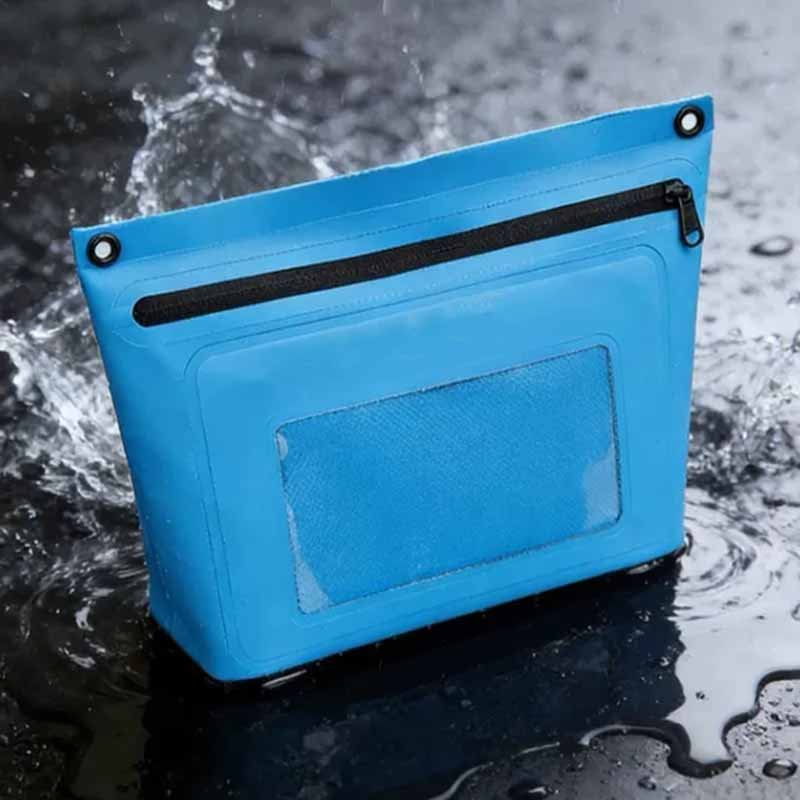
...

A Trusted China Manufacturer Since 2007!

Waterproof Bag Material and Construction Guide: Which Materials and Seams Work Best?

Your material-driven OEM and ODM manufacturing partner from China

A waterproof bag is not created simply by purchasing fabric labeled “waterproof.” That label describes only one part of the product. Once the fabric is cut, stitched, folded, welded, fitted with zippers, or connected to handles and hardware, new water-entry risks appear. A material may resist water pressure perfectly in a laboratory and still become part of a finished bag that leaks during ordinary rain.

A reliable waterproof bag combines a low-permeability material, a compatible seam method, a protected closure, reinforced attachment points, and finished-product testing that reflects real use. PVC-coated polyester is often chosen for rugged welded products, TPU laminates for lighter premium bags, and PU-coated nylon or polyester for rain-resistant sewn bags. The best construction depends on exposure, load, flexibility, abrasion, cost, and compliance requirements.

Two bags can use the same outer fabric and look almost identical. One stays dry during a storm; the other leaks around a zipper end, folded corner, or shoulder-strap anchor. The difference is rarely the fabric name alone. It is usually the engineering hidden inside the seams, closures, reinforcements, and production controls. Understanding those details before sampling can prevent costly redesigns after production has already started.

What Makes a Bag Truly Waterproof?


A bag is truly waterproof only when its fabric, seams, closure, attachment points, and complete construction resist water under defined conditions. Waterproof fabric alone cannot guarantee a waterproof product. The expected exposure—light rain, prolonged rain, spray, water jets, or immersion—must be established first and then verified through testing of the finished bag.

“Water-resistant” and “waterproof” describe different performance levels, but neither term is meaningful without test conditions.

A water-resistant bag may slow water entry during drizzle, splashes, or short outdoor exposure. It may use a water-repellent surface treatment, a PU-coated fabric, a covered zipper, and conventional sewing. This can be entirely suitable for commuting, travel, gym use, or general daily carry.

A waterproof bag is expected to protect its contents under more demanding conditions. Depending on the product, those conditions may include prolonged rain, pressurized spray, marine splashing, temporary immersion, or repeated wet use.

The difference is often found at the weakest point. A backpack made from coated polyester may resist water through the center of each panel but allow it through:

  • Needle holes along the seams
  • Zipper teeth or zipper ends
  • Shoulder-strap attachment points
  • Bottom-panel intersections
  • Decorative rivets
  • Unsealed logo attachments
  • Folded corners

Brands should define the intended protection level in practical terms instead of relying on a single marketing word. Useful requirements include:

  • Suitable for brief light rain
  • Suitable for 30 minutes of moderate rain
  • Suitable for prolonged outdoor rain
  • Resistant to directional road spray
  • Designed for marine splashes
  • Suitable for controlled temporary immersion

This language gives designers, suppliers, factories, and testing teams a shared target.

A bag should not be promoted as submersible because it passed a spray test. A coated zipper should not be called watertight simply because water beads on its outer surface. Accurate claims protect the customer, the brand, and the manufacturer.

A waterproof bag works as a system of connected barriers.

The base textile provides tensile strength, tear resistance, dimensional stability, and abrasion performance. A coating or laminated film provides the main barrier against water penetration. The seams connect individual panels. The closure protects the largest intentional opening. Reinforcements distribute force around handles, straps, D-rings, and buckles.

The main protection zones are:

  1. Panel surfaces
    The material must resist water under the pressure and duration expected during use.
  2. Panel joints
    Welded, bonded, taped, or sealed seams must prevent water from moving between overlapping layers.
  3. Openings
    Roll-tops, zippers, flaps, lids, valves, and access ports must maintain protection while remaining usable.
  4. Load points
    Handles, shoulder straps, and hardware must carry force without tearing or puncturing the waterproof layer.
  5. Transition areas
    Corners, zipper ends, multi-layer intersections, and changes between welded and sewn sections require special attention.

A product can fail when only one zone is overlooked.

For example, increasing the coating weight will not correct a leaking zipper termination. Choosing a heavier tarpaulin will not solve needle holes around a stitched webbing anchor. Using a premium airtight zipper will not compensate for incomplete welding at a folded corner.

Effective product development therefore starts with a complete leak-path review rather than a fabric catalog.

Different products require different protection levels. Designing every bag for immersion would increase weight, cost, stiffness, and manufacturing complexity. Designing a marine dry bag like a lightweight city backpack would create the opposite problem.

Protection levelTypical exposureCommon constructionPractical verification
Water-repellentBrief splashes and drizzleTreated woven fabric with conventional sewingSurface spray observation
Rain-resistantCommuting and short outdoor rainCoated fabric, protected zipper, controlled seamsSimulated rain test
Heavy-rain protectionHiking, cycling, outdoor workLaminated fabric with taped or welded critical seamsProlonged rain test
Marine splash protectionFishing, boating, kayakingWelded body with roll-top or protected closureDirectional spray or water-jet test
Temporary immersionDry bags and water-sports storageFully sealed body with immersion-capable closureControlled depth-and-time test

These categories are useful development references rather than universal certifications.

A meaningful test should define:

  • Exposure duration
  • Water direction
  • Water pressure or immersion depth
  • Product orientation
  • Internal load
  • Closure procedure
  • Acceptance criteria

A bag may behave differently when empty, fully loaded, compressed, bent, or placed upside down. Testing should reproduce the intended use rather than evaluating the product only in its easiest condition.

Most waterproof failures appear around construction details rather than in the middle of a fabric panel.

Common leak paths include:

  • Needle holes in stitched seams
  • Incomplete or uneven welds
  • Narrow welding overlaps
  • Wrinkled seam tape
  • Zipper stops
  • Slider parking positions
  • Three-panel intersections
  • Folded corners
  • Handle attachment areas
  • Shoulder-strap anchors
  • D-ring patches
  • Riveted logo plates
  • Cable ports
  • Valves and transparent windows

Corners are particularly challenging because several material layers may overlap. The area can become too thick for even pressure during welding or too irregular for complete seam-tape contact.

Zipper ends are another frequent weakness. A high-quality zipper may resist water across the chain while still leaking where the zipper tape meets the bag body.

During product development, every point where the waterproof layer is cut, pierced, folded, heated, glued, or connected should be marked on the drawing. Each point should then be reviewed for both waterproofing and mechanical strength.

Simpler panel geometry often improves consistency. Fewer seams, fewer intersections, and fewer unnecessary attachments usually mean fewer possible leak paths.

Which Waterproof Bag Materials Work Best?

PVC-coated polyester is commonly used for rugged and cost-controlled waterproof products, while TPU-laminated nylon or polyester is preferred for lighter and more flexible applications. PU-coated fabrics are suitable for rain-resistant bags. The best material depends on water pressure, abrasion, weight, flexibility, seam method, chemical requirements, expected service life, and target cost.

PVC and TPU can both provide effective waterproof barriers, but they support different product strategies.

PVC-coated polyester is commonly selected for:

  • Dry bags
  • Waterproof duffels
  • Delivery bags
  • Marine storage bags
  • Cooler exteriors
  • Tool bags
  • Industrial soft containers

PVC materials are usually structured, easy to wipe clean, abrasion-resistant, and compatible with high-frequency welding when the formulation is suitable.

For many commercial waterproof bags, finished PVC-coated materials may fall within a broad range of approximately 400 to 900 GSM or more. Lighter grades are available, but material weight should be selected according to the bag size, load, abrasion exposure, and required stiffness.

PVC’s limitations may include:

  • Higher finished weight
  • Reduced flexibility in some low-temperature conditions
  • Odor from certain formulations
  • Market-specific restrictions on plasticizers or other substances
  • A less textile-like hand feel

These issues do not make PVC unsuitable. They mean the precise formulation, test documentation, and target market must be reviewed.

TPU-laminated nylon or polyester is often chosen for products requiring:

  • Lower weight
  • Better flexibility
  • Softer folding
  • Premium surface feel
  • Better cold-weather performance
  • Technical outdoor positioning

TPU materials are used in premium dry bags, bike bags, technical backpacks, waterproof pouches, and compact foldable products.

TPU is generally more expensive than standard PVC materials. Thin TPU films can also be vulnerable to abrasion if the product is dragged, sharply folded, or repeatedly rubbed against equipment.

A lightweight material should not be assumed to be more durable simply because it is more advanced. Reinforcement design still matters.

PU-coated nylon and polyester are useful when a bag needs weather resistance without the weight and stiffness of heavy waterproof tarpaulin.

Common applications include:

  • Commuter backpacks
  • Travel bags
  • Packable bags
  • Sports bags
  • Rain covers
  • Outdoor pouches
  • Lightweight equipment bags

The woven textile provides strength, while the PU coating reduces water penetration.

Nylon generally offers good tear resistance and flexibility relative to its weight. Polyester usually offers stable dimensions, broad color availability, good printing compatibility, and competitive cost.

However, these materials are commonly sewn rather than welded. Sewing creates needle holes through the waterproof coating. Critical seams may therefore require:

  • Seam tape
  • Liquid seam sealant
  • Protective flaps
  • Internal binding
  • Redesigned seam placement
  • A separate waterproof liner

Coating quality also varies considerably. Two fabrics described as “600D PU-coated polyester” may have different:

  • Finished weights
  • Coating thicknesses
  • Hydrostatic resistance
  • Abrasion performance
  • Adhesion
  • Aging resistance
  • Surface feel
  • Seam-tape compatibility

Heat, humidity, folding, abrasion, washing, and long storage can affect PU coating performance. Hydrolysis resistance may be especially important for products sold into hot and humid markets.

A useful purchase specification should identify more than the coating name. It should include the base fabric, denier, finished GSM, coating side, expected water resistance, color reference, adhesion requirement, and approved physical sample.

Material systemTypical finished weight*Main advantagesMain limitationsCommon applications
PVC-coated polyester400–900+ GSMRugged, structured, cleanable, weldableHeavier and less flexibleDry bags, marine duffels, work bags
Lightweight PVC fabric250–500 GSMCost-controlled and easier to foldLower abrasion marginSmall pouches and promotional waterproof bags
TPU-laminated nylon150–450 GSMFlexible, lightweight, premium hand feelHigher material costBike bags, premium dry bags, technical packs
TPU-laminated polyester180–500 GSMStable, printable, weldable when compatibleMay offer lower tear efficiency than comparable nylonDuffels, pouches, outdoor accessories
PU-coated nylon90–350 GSMLightweight, soft, good tear performanceUsually requires sealed sewn constructionBackpacks, rain covers, outdoor pouches
PU-coated polyester100–450 GSMCost-controlled and dimensionally stablePerformance varies with coating qualityTravel, sports and utility bags

*These are broad commercial ranges rather than mandatory specifications. Actual weight depends on yarn, weave, coating, laminate, backing, and supplier formulation.

The heaviest material is not automatically the best material.

A thick PVC fabric may provide excellent abrasion resistance but make a compact roll-top difficult to fold. A lightweight TPU ripstop may provide better flexibility and tear control but require reinforcement on the base.

Material choice should therefore be based on the finished product rather than one isolated property.

Denier, GSM, and thickness measure different characteristics.

Denier describes yarn mass. A higher-denier textile generally uses heavier yarn, but denier does not measure coating continuity or waterproof pressure.

GSM measures the total finished weight per square meter. This may include:

  • Base textile
  • Coating
  • Laminated film
  • Backing
  • Surface treatment
  • Adhesive layers

Thickness measures the combined depth of the material. It can influence:

  • Stiffness
  • Folding
  • Welding settings
  • Abrasion resistance
  • Edge finishing
  • Sewing difficulty
  • Finished-product appearance

None of these values independently proves waterproofness.

A 600D polyester with a thin or inconsistent coating may resist surface abrasion but allow water through under pressure. A lighter TPU-laminated nylon may form a more continuous water barrier while weighing much less.

Material evaluation should combine:

  • Tensile strength
  • Tear strength
  • Abrasion resistance
  • Film or coating adhesion
  • Hydrostatic resistance
  • Flex resistance
  • Low-temperature behavior
  • Heat and humidity aging
  • Finished weight
  • Surface cleanability
  • Welding or seam-tape compatibility

The correct balance differs between a city backpack, kayak dry bag, bike pannier, waterproof tool bag, and medical transport pouch.

How Are Waterproof Bag Seams Constructed?

Waterproof seams are commonly formed through RF welding, hot-air welding, hot-wedge welding, thermal bonding, or stitched seams protected with tape or sealant. Welded seams avoid needle holes and usually offer the strongest water barrier. Stitched and taped construction supports complex shapes but requires careful control of material compatibility, heat, pressure, seam thickness, and workmanship.

RF welding, also called high-frequency welding, joins compatible thermoplastic materials using electromagnetic energy and pressure.

The energy heats the material inside the joint. The overlapping surfaces soften and fuse while pressure holds them together. After cooling, the layers form a continuous seam without sewing holes.

RF welding is commonly used for compatible:

  • PVC-coated fabrics
  • PVC films
  • Selected TPU laminates
  • Transparent waterproof windows
  • Medical soft goods
  • Inflatable components
  • Dry bags
  • Waterproof pouches

A stable RF-welded seam depends on several variables:

  • Material chemistry
  • Film or coating thickness
  • Electrode shape
  • Seam overlap
  • Applied pressure
  • Energy level
  • Heating time
  • Cooling time
  • Surface cleanliness
  • Panel alignment

A seam can look smooth while containing an incomplete internal bond.

Too little energy may create weak sections or microscopic water channels. Too much energy may burn, thin, distort, or permanently mark the material.

For many bag constructions, seam overlaps may fall within an approximate range of 15 to 30 mm. This is not a universal rule. The correct width depends on:

  • Material thickness
  • Load direction
  • Bag size
  • Product geometry
  • Expected water pressure
  • Required seam strength

A narrow seam may reduce material consumption but leave insufficient safety margin. An unnecessarily wide seam may add stiffness and visual bulk.

The final welding parameters should be established through physical sampling, seam testing, visual inspection, and leak testing.

Hot-air and hot-wedge welding are used for thermoplastic-coated materials that respond to controlled heat and pressure.

During hot-air welding, heated air softens the two joining surfaces before pressure rollers press them together. This method can follow long or curved seam paths.

Hot-wedge welding places a heated element between overlapping layers. The surfaces soften and are pressed together immediately afterward. It is efficient for long and relatively straight seams.

Heat-welding quality can be affected by:

  • Travel speed
  • Airflow
  • Temperature
  • Roller pressure
  • Seam overlap
  • Material cleanliness
  • Workshop temperature
  • Material storage conditions
  • Wrinkles
  • Thick intersections

A setting that works well during one production shift may need adjustment if the material batch, ambient temperature, or machine speed changes.

Insufficient heat may produce weak bonding. Excessive heat may damage the coating, create gloss marks, thin the film, or distort the panel.

Neither hot-air nor RF welding is automatically better in every case. The correct process depends on material compatibility, seam geometry, production volume, available equipment, and the required finished appearance.

Stitching remains essential for many waterproof backpacks, camera bags, insulated bags, travel bags, and technical products.

It supports:

  • Three-dimensional shapes
  • Curved panels
  • Padded harnesses
  • Pocket systems
  • Internal organizers
  • Bindings
  • Structural reinforcements
  • Mixed-material construction

The disadvantage is that every needle penetration interrupts the waterproof coating or laminate.

Seam tape is commonly bonded over a stitched seam using heat and pressure. Successful application depends on:

  • Fabric coating chemistry
  • Tape adhesive
  • Tape width
  • Seam allowance
  • Stitch profile
  • Application temperature
  • Pressure
  • Line speed
  • Material cleanliness
  • Cooling time

Tape generally performs best on flat, consistent seams. Thick corners, binding, folds, zipper ends, and multi-layer intersections are harder to seal.

Needle size and stitch density also affect the result.

A large needle creates a larger hole. Excessively dense stitching may create a line of closely spaced perforations. Very loose stitching may weaken the structure and make tape application less stable.

Liquid seam sealants may be used in selected areas or repairs, but they introduce additional variables such as curing time, appearance, odor, thickness, and operator consistency.

Seam methodSuitable material directionMain strengthsMain production risks
RF weldingCompatible PVC and selected TPUClean sealed joints without needle holesIncorrect energy, pressure, or electrode setup
Hot-air weldingThermoplastic-coated fabricsFlexible seam routes and long jointsHeat variation and inconsistent travel speed
Hot-wedge weldingCoated fabrics with controlled seam pathsEfficient continuous productionLess suitable for small complex shapes
Stitched and tapedPU-coated and laminated woven fabricsSupports complex shapes and load-bearing structuresTape lifting, wrinkles and thick intersections
Stitched with sealantSelected sewn constructionsUseful for local sealing and repairsApplication variation and curing inconsistency
Hybrid constructionWaterproof backpacks and technical bagsCombines sealed storage with padded sewn componentsLeakage at transitions between construction systems

Hybrid construction is often the most practical solution for wearable waterproof products.

The main compartment may be welded, while the harness, padding, external organizer, or pocket system is sewn separately. The most important engineering work then occurs at the transition between the two systems.

A poorly designed transition can transfer too much force into a welded edge, create hidden water channels, or cause peeling around reinforcement patches.

Which Closures and Details Prevent Leaks?

Roll-top closures generally provide dependable protection because they create several folded barriers without relying on zipper teeth. Waterproof and airtight zippers provide faster access but require accurate installation and sealed terminations. Handles, straps, pockets, valves, windows, and branding details must also be attached without puncturing or weakening the primary waterproof compartment.

Roll-top closures are widely used on dry bags, waterproof backpacks, bike bags, and marine storage products.

The opening is flattened, rolled several times, and secured with buckles. Each fold increases the distance water must travel before reaching the interior.

Most practical designs need enough neck height for at least three secure rolls after the bag is loaded. The exact requirement depends on:

  • Material stiffness
  • Opening width
  • Buckle position
  • Bag shape
  • Internal load
  • Closure direction

Roll-top performance can be reduced by:

  • Overfilling
  • Folding over bulky contents
  • Trapped sand or debris
  • Too few rolls
  • Uneven folds
  • Buckle misalignment
  • Cracked crease areas
  • Excessively stiff fabric

The roll-top also reduces usable capacity. A bag measured before rolling may hold less during normal use because part of the upper section must remain available for closure.

This should be considered when stating liter capacity.

A technically secure roll-top can still create a poor user experience if the opening is too narrow, the fabric is difficult to fold, or the buckle positions feel awkward.

Development samples should be packed with realistic contents and tested by people unfamiliar with the design. This reveals whether the closure works intuitively outside the factory.

Not all waterproof zippers provide the same protection.

A PU-coated reverse-coil zipper may resist rain but allow water through:

  • The slider
  • Coil gaps
  • Tape stitching
  • End stops
  • Curved sections
  • Slider parking areas

These products are often better described as water-resistant zippers.

More advanced waterproof or airtight zippers use specialized sealing profiles and sliders. They can provide higher protection but are usually:

  • More expensive
  • Stiffer
  • Heavier
  • Harder to operate
  • More demanding to install

Some require lubrication or a specific closing force.

A useful zipper specification should include:

  • Supplier
  • Model
  • Chain size
  • Tape construction
  • Slider type
  • Protection classification
  • Straight or curved installation
  • Minimum bend radius
  • Installation method
  • End-stop construction
  • Cycling requirement

Zipper ends are frequent leakage points. The zipper tape must terminate inside a sealed construction without leaving open channels.

Curved zippers improve access but create additional tension and installation difficulty. They may pucker, twist, or pull against the bag panel.

For higher waterproof requirements, straighter zipper paths are generally easier to control.

A coated zipper under a flap may be sufficient for a rain-resistant backpack. A marine duffel exposed to pressurized water may require a higher-grade closure and more controlled installation. A temporary-immersion claim requires testing of the finished bag.

Handles and shoulder straps create both structural and waterproofing challenges.

A loaded waterproof duffel can place substantial force on a small attachment area. Sewing the webbing directly through the waterproof body creates holes. Welding a small patch to a thin shell may cause peeling or deformation.

The load should be spread over a larger area through methods such as:

  • Wide reinforcement patches
  • Internal load-distribution panels
  • Multiple welding zones
  • Folded layers
  • Separate harness structures
  • Stitching outside the primary waterproof chamber
  • Combined welded and sewn reinforcements

The reinforcement shape should follow the direction of force. An upward-pulled handle requires a different patch design from a diagonal shoulder-strap anchor.

Webbing width should match expected load and comfort requirements.

A 25 mm strap may be suitable for a small pouch. Larger duffels and backpacks commonly use 38 mm or 50 mm webbing for improved load distribution, although the final specification depends on load, buckle size, and product positioning.

Webbing thickness, weave, elongation, and edge feel are also important. A wide but thin webbing may still fold or cut into the user’s hand under load.

External components can create hidden leak paths even when the main body is properly sealed.

A pocket may trap water against a seam. A transparent window may use a film that does not bond correctly to the main fabric. A riveted logo plate may puncture the protected chamber. A valve or cable port may leak around its flange.

Each component should be reviewed for:

  1. Material compatibility
  2. Joining method
  3. Mechanical load
  4. Water exposure
  5. Cleaning
  6. Long-term aging

Transparent windows typically require PVC or TPU film compatible with the selected welding method.

Reflective strips may be welded, bonded, or sewn, but the process must not damage the main waterproof layer.

Drainage holes are useful in external wet-item pockets, but they should never communicate with the protected main compartment.

Branding details also require careful selection.

Printed logos, welded patches, and surface-applied graphics can avoid puncturing the main shell. Embroidery through the waterproof chamber creates multiple needle holes. Riveted metal labels may require gaskets, sealed backing, or placement outside the protected zone.

The most attractive branding method is not always the most suitable for the waterproof claim.

How Do You Match Construction to Bag Use?

Construction should follow the bag’s real use. Dry bags favor simple welded bodies and roll-top closures. Waterproof backpacks require sealed storage plus comfortable load-bearing systems. Duffels need wide access and reinforced bases. Bike, fishing, cooler, and medical bags introduce additional demands involving vibration, abrasion, cleaning, insulation, hygiene, hardware, and testing.

Dry bags usually perform best with simple panel geometry.

Cylindrical, oval, and uncomplicated rectangular shapes reduce seam count and make welding easier to control. Common materials include PVC-coated polyester and TPU-laminated nylon or polyester.

The body seams and base are typically welded, while the upper section forms a roll-top closure.

The base requires special attention because it experiences:

  • Internal load
  • Ground abrasion
  • Dragging
  • Sharp equipment edges
  • Repeated folding

A reinforced base panel, thicker material, or second protective layer may be required for camping, boating, industrial, or rental applications.

Waterproof backpacks are more complex.

Users expect:

  • Shoulder comfort
  • Back padding
  • Stable load distribution
  • Sternum straps
  • Hip belts
  • External attachment points
  • Easy access

These functions are difficult to create with welding alone.

A practical waterproof backpack may combine:

  • A welded main compartment
  • A separate sewn back panel
  • Welded reinforcement zones
  • Harness components outside the sealed chamber
  • A roll-top opening
  • A waterproof or protected zipper
  • External pockets that do not penetrate the main compartment

The transition between the harness and the waterproof body is a critical risk area.

The attachment must carry load without peeling the welded patch, distorting the shell, or creating water paths.

Backpacks should be tested while loaded. A structure that remains dry when empty may deform under weight and expose weak seam intersections.

Waterproof duffels must balance access, carrying comfort, structure, and water protection.

A long central zipper offers convenient access but creates a long possible leak path. A roll-top closure improves sealing but may be less familiar to travel users.

Some products use a large waterproof zipper. Others use a folding top or extended opening.

The bottom panel should resist:

  • Wet ground
  • Rough docks
  • Vehicle floors
  • Airport handling
  • Dragging
  • Repeated loading
  • Sharp internal equipment

Possible solutions include:

  • Higher-GSM bottom material
  • Double-layer construction
  • Abrasion patches
  • Raised feet
  • Internal baseboards
  • Protective edge panels

These details should be added without creating uncontrolled holes into the waterproof compartment.

Large duffels may include side handles, end handles, shoulder straps, and backpack straps. Each attachment adds a structural load and a potential leak risk.

The opening should also be evaluated against real contents. A technically effective zipper may be too narrow for boots, helmets, protective gear, or bulky equipment.

Travel bags used mainly in airports and hotels do not require the same construction as expedition duffels used on boats. Overengineering can add cost and weight without improving the customer experience.

Bike bags face water, vibration, mud, dust, UV exposure, and repeated attachment.

A pannier may rub against:

  • A bicycle rack
  • Mounting clips
  • Frame tubes
  • Cables
  • Other luggage

Contact zones require abrasion reinforcement.

Mounting hardware should resist loosening and distribute force across the bag body. A strong hook mounted to a weak local patch can still cause tearing.

Bike bags also need shape control. A very soft waterproof material may sag toward a wheel or interfere with steering. Internal stiffeners, removable panels, structured laminates, or frame plates may be required.

Reflective details improve visibility, but their attachment method must remain compatible with the waterproof system.

Fishing and marine bags face additional challenges:

  • Saltwater
  • Hooks
  • Mud
  • Wet equipment
  • Fish residue
  • Repeated washing
  • Corrosive environments

Smooth welded interiors can simplify cleaning. Hardware should be selected for corrosion resistance. Deep folds and dirt-trapping seam recesses should be minimized.

A fishing bag designed to keep water out is different from a bag designed to contain wet equipment or melted ice.

The project brief should clarify whether the product:

  • Protects dry equipment
  • Carries wet equipment
  • Retains liquid
  • Drains liquid
  • Performs several of these functions

Cooler bags add thermal performance and cleanability to the waterproofing problem.

A waterproof exterior does not automatically create a leakproof or insulated cooler. The liner, foam, zipper, lid, seams, and condensation behavior must be designed as one system.

Common liner materials include:

  • PEVA
  • TPU
  • Selected PVC films
  • Heat-sealable technical films

The liner may be welded to reduce leakage, while the outer shell may be sewn or welded according to product requirements.

For many commercial soft coolers, foam thickness may fall within an approximate range of 3 to 10 mm. Premium products may use thicker or multi-layer insulation.

The actual thermal result depends on:

  • Foam thickness
  • Foam density
  • Lid fit
  • Zipper leakage
  • Reflective layers
  • Internal air volume
  • Ice-to-content ratio
  • Ambient temperature
  • Opening frequency

Medical and cold-chain bags may require:

  • Easy-clean interiors
  • Labeled compartments
  • Tamper features
  • Temperature monitoring
  • Removable inserts
  • Customer-specific validation
  • Traceable material documentation

Temperature-retention or medical-performance claims should be supported by a clearly defined test protocol.

Experienced product development goes beyond appearance. It examines how the liner is joined, whether corners can be cleaned, where condensation collects, and how repeated opening changes performance.

How Should Waterproof Bags Be Specified and Tested?

A waterproof bag should be specified with measurable material, seam, closure, reinforcement, dimension, load, and testing requirements. Fabric data alone cannot confirm finished-bag performance. The test plan should reproduce real exposure and may include rain, spray, immersion, seam strength, abrasion, flexing, zipper cycling, and production-consistency checks.

A useful tech pack converts a general product idea into measurable manufacturing instructions.

“Use waterproof fabric” is not a sufficient specification.

The document should enable the material supplier, sample room, welding team, sewing line, and quality inspectors to work from the same approved standard.

A waterproof-bag technical pack should normally include:

  • Base-fabric fiber
  • Yarn denier
  • Fabric construction
  • Finished GSM
  • Total thickness
  • Coating or laminate type
  • Film side
  • Color reference
  • Surface finish
  • Seam method
  • Weld overlap
  • Seam-tape width
  • Closure model
  • Zipper supplier
  • Webbing specification
  • Hardware material
  • Reinforcement dimensions
  • Finished measurements
  • Capacity method
  • Load requirement
  • Waterproof test
  • Packaging instructions

The bill of materials must match the approved sample.

Replacing the TPU film, PVC formulation, zipper, tape, adhesive, webbing, or buckle during production may change performance even if the product still looks similar.

Tolerances should reflect material behavior. Thick tarpaulins, laminates, and welded structures do not behave like thin fashion fabrics. Welding shrinkage, material stiffness, and layered intersections affect finished dimensions.

The approved sample should be retained as a physical production reference. Photos and written notes cannot fully communicate hand feel, folding behavior, seam stiffness, zipper resistance, and surface texture.

Different tests answer different questions. No single method proves every waterproof claim.

TestMain purposeImportant variablesMain limitation
Hydrostatic-head testMeasures fabric resistance to water pressurePressure increase rate and specimen conditionDoes not test seams or closures
Spray testEvaluates surface wetting and light water exposureSpray angle, duration and water volumeUses limited pressure
Simulated rain testTests a complete bag during rainfallDuration, direction, loading and rotationDoes not prove immersion resistance
Water-jet testEvaluates directional pressurized waterNozzle, pressure, distance and angleNot equal to long-term submersion
Controlled immersionChecks leakage at defined depth and timeDepth, duration and orientationDoes not prove unlimited underwater use
Internal water-fill testDetects outward leakage through body seamsFill level, suspension and durationMay not evaluate normal closure performance
Air-pressure leak testIdentifies small channels in sealed structuresInternal pressure and detection methodRequires suitable product geometry

A hydrostatic-head result belongs to the tested fabric specimen. It does not automatically apply to the complete bag.

A fabric may withstand substantial water pressure while the finished product leaks through:

  • Zipper ends
  • Stitched seams
  • Handle attachments
  • Corners
  • Valves
  • Hardware points

Finished-product testing should state:

  • Product condition
  • Internal load
  • Closure method
  • Water temperature
  • Exposure time
  • Pressure or depth
  • Product orientation
  • Inspection method
  • Acceptable water entry

Internal condensation should not automatically be confused with leakage. Temperature changes and trapped humid air can create moisture inside a sealed bag.

The inspection method should distinguish condensation from actual water penetration.

Waterproof performance should be checked after relevant mechanical stress, not only on a new sample.

A roll-top may pass immersion when new but crack after repeated folding. A zipper may resist rain before cycling but leak after its tape becomes distorted. A welded patch may pass a water test but peel after repeated loading.

Useful durability tests may include:

  • Weld peel strength
  • Seam tensile strength
  • Handle pull testing
  • Shoulder-strap loading
  • Zipper cycling
  • Roll-top flexing
  • Bottom abrasion
  • Coating adhesion
  • Cold-fold testing
  • Heat aging
  • Humidity aging
  • UV exposure
  • Saltwater exposure
  • Cleaning resistance

The test load should reflect the bag category.

A small waterproof phone pouch and a 70-liter expedition duffel should not use the same handle test. Larger bags generate higher forces during lifting, swinging, dragging, and transport.

Common user behavior should also be considered.

Users may:

  • Overfill the bag
  • Carry it by one handle
  • Drag it
  • Close the zipper under tension
  • Fold the roll-top unevenly
  • Place sharp objects inside
  • Leave it in a hot vehicle

The product does not need to survive unlimited abuse, but predictable handling should be included in development decisions.

A successful sample does not guarantee successful mass production.

Waterproof performance depends heavily on process consistency.

Incoming materials should be checked for:

  • Correct supplier
  • Correct item code
  • Finished weight
  • Thickness
  • Surface defects
  • Film continuity
  • Coating adhesion
  • Color variation
  • Contamination
  • Storage damage

Welding settings should be recorded by material and seam type.

First-piece approval should be repeated when there is a change in:

  • Material batch
  • Machine
  • Electrode
  • Operator
  • Seam geometry
  • Production environment

In-process inspection should focus on:

  • Seam overlap
  • Weld continuity
  • Burn marks
  • Under-welded sections
  • Tape alignment
  • Wrinkles
  • Zipper ends
  • Corner intersections
  • Reinforcement patches
  • Closure operation

Random leak-testing frequency should be determined according to product risk and buyer requirements.

Marine and immersion-oriented products normally require more intensive waterproof verification than ordinary rain-resistant bags.

Final inspection should combine water-related checks with standard bag-quality requirements:

  • Finished dimensions
  • Workmanship
  • Zipper operation
  • Webbing alignment
  • Hardware
  • Load-bearing points
  • Cleanliness
  • Labeling
  • Packaging
  • Carton information

For repeat orders, the manufacturer should retain:

  • Approved samples
  • Material records
  • Welding parameters
  • BOM versions
  • Color references
  • Inspection standards
  • Packaging instructions
  • Test records

This creates a traceable production system and reduces variation between batches.

A reliable waterproof bag begins with a clearly defined use case and ends with a finished-product test. Material selection, seam construction, closures, reinforcements, and quality control must support the same performance target.

Lovrix is a material-driven OEM/ODM manufacturer in Shenzhen, Guangdong, supporting the development of custom dry bags, waterproof backpacks, marine duffels, bike bags, fishing bags, waterproof pouches, soft coolers, and other engineered soft goods.

Projects can be developed from:

  • Technical drawings
  • Tech packs
  • Existing physical samples
  • Reference images
  • Product links
  • Functional requirements
  • Target price ranges

The standard MOQ for custom bag projects is 500 pieces. Final MOQ depends on material availability, product structure, welding or sewing method, custom color, branding, packaging, and project complexity.

To receive a structured project evaluation, provide:

  • Product type
  • Finished dimensions
  • Required capacity
  • Expected water exposure
  • Preferred material
  • Target order quantity
  • Logo files
  • Target market
  • Testing requirements
  • Packaging requirements
  • Delivery plan

Send your drawing, sample, reference image, or technical requirements to Lovrix. The project team can review material options, seam construction, closure design, reinforcement, sampling feasibility, quality risks, production cost, and delivery planning before bulk manufacturing begins.

Send your drawing, sample, reference image, or technical requirements to Lovrix. The project team can review material options, seam construction, closure design, reinforcement, sampling feasibility, quality risks, production cost, and delivery planning before bulk manufacturing begins.


Picture of Author: Jack
Author: Jack

Backed by 18 years of OEM/ODM textile industry experience, Lovrix provides not only high-quality fabric , webbing and engineered goods solutions, but also shares deep technical knowledge and compliance expertise as a globally recognized supplier.

Share:

Table of Contents

Here, creating your custom fabric, webbing and engineered goods collection is no longer a barrier—it’s a collaborative journey where Lovrix helps brands and businesses transform their vision into durable, certified, and market-ready solutions.

Feel free to contact us for any technical or business-related information.

Contact Us

Send us a message if you have any questions or request a quote. We will be back to you ASAP!