 Skip to content
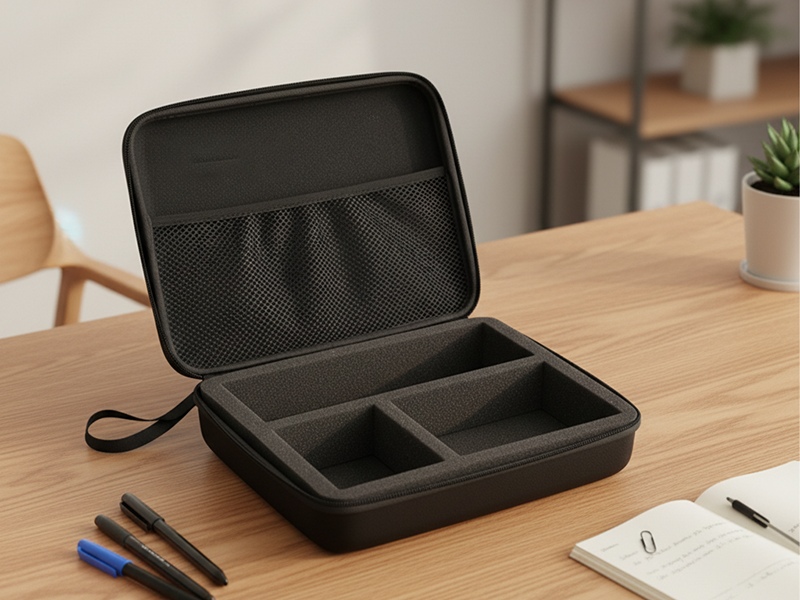
A protective bag can look heavily padded and still fail when the product inside is dropped, squeezed, stacked, or carried every day. That is because protection is not created by thickness alone, and a foam that feels firm in the hand is not necessarily the foam that will manage impact most effectively. Product weight, fragile components, foam density, firmness, thickness, cell structure, compartment fit, and the surrounding bag construction all influence what happens when an impact reaches the product.
Foam density affects product protection by influencing load support, compression behavior, durability, and the amount of material available to manage impact energy. However, higher density does not automatically mean better protection. Effective cushioning depends on how density works together with firmness, foam type, thickness, product weight, fragility, fit, and available compression distance inside the finished bag or protective case.
This difference becomes important when developing laptop bags, camera bags, tool bags, equipment carriers, medical bags, instrument cases, electronics organizers, or molded EVA cases. A development team may begin by requesting “high-density foam,” but sampling often reveals that the real problem is elsewhere. The product may need more thickness at the base, softer contact around a screen, firmer support underneath a heavy tool, a tighter compartment, or a different foam family entirely. The real test begins when the product is loaded into the finished bag and the construction has to perform outside the sample room.
What Is Foam Density and What Does It Change?

Foam density is the mass of foam contained within a specific volume, commonly expressed in kg/m³ or lb/ft³. It influences load support, compression resistance, dimensional stability, durability, and cushioning behavior, but it does not independently define hardness or protection. The same density can behave differently across EVA, PE, EPE, PU, and other foam systems because material chemistry and cellular structure also matter.
How Is Foam Density Measured?
Density is calculated by measuring the mass of a foam sample and dividing that mass by its known volume. International suppliers commonly express the result in kilograms per cubic meter, while pounds per cubic foot remains common in North American technical information. The approximate conversion of 1 lb/ft³ = 16.02 kg/m³ is useful when comparing specifications from suppliers using different measurement systems, but the number must still be interpreted within the correct foam family.
For example, a foam specified at 30 kg/m³ contains approximately 30 kilograms of foam material within one cubic meter of volume. That number does not tell a product developer exactly how firm the foam will feel, how far it can compress before bottoming out, how quickly it will recover, or how well it will protect a particular electronic device. Density is one measurable property, but protection depends on the complete mechanical response of the material after it is converted into a finished construction.
Commercial foam ranges can cover a broad spectrum. Lightweight foam may be selected for flexible cushioning, while higher-density grades may be used where greater structural support, dimensional stability, or repeated load resistance is needed. The important point is that ranges are not universal application rules. A value that works in a molded EVA case should not be copied automatically into a soft laptop sleeve or a tool bag simply because both products require padding.
| Density Reference | Approx. lb/ft³ | General Interpretation |
|---|---|---|
| 20 kg/m³ | 1.25 lb/ft³ | Lightweight cushioning range |
| 30 kg/m³ | 1.87 lb/ft³ | General flexible cushioning range |
| 45 kg/m³ | 2.81 lb/ft³ | Higher material content and support |
| 60 kg/m³ | 3.75 lb/ft³ | More structural applications may use this range |
| 90 kg/m³ | 5.62 lb/ft³ | Dense structural or specialty foam territory |
These figures are useful conversion references rather than recommendations for a finished bag. Two materials at 45 kg/m³ can still feel, compress, recover, and perform very differently because density does not describe polymer chemistry, cell size, crosslinking, firmness, thickness, or lamination construction. A production specification should therefore identify the actual foam family and approved material rather than relying on density alone.
Is Density the Same as Hardness?
Density and hardness are not the same property, even though they are often used interchangeably in everyday sourcing conversations. Density describes how much material exists within a particular volume, while hardness or firmness describes resistance to indentation or compression under a defined condition. A relatively dense foam can still be engineered to feel compliant, while another foam with lower density may feel noticeably firmer because its formulation and cellular structure are different.
This distinction matters because the protected product responds to compression characteristics rather than to a density label printed on a supplier sheet. A laptop compartment may need a material that deforms enough to cushion an edge impact, while a heavy tool bag may need a firmer base that resists long-term collapse. If both projects simply specify “high-density foam,” purchasing may receive very different materials without a clear method for deciding whether either one is appropriate.
Terms such as soft, medium, firm, and high density can be useful during early discussion, but they become risky when production begins. A more reliable specification identifies the foam type, density where relevant, nominal thickness, approved physical sample, and an agreed firmness or compression reference when performance is important. This creates a much stronger connection between the prototype approved by the client and the material that purchasing and production teams are expected to use later.
Does Higher Density Mean Better Protection?
Higher density does not automatically deliver better protection. Increasing density adds more material within the same volume and can improve support, durability, or resistance to certain forms of compression, but impact protection depends on how the foam deforms. If the foam is too soft, it may compress through nearly all of its available thickness. If it is too stiff, the protected product may decelerate too abruptly and receive more transmitted force than a fragile component can tolerate.
The better objective is controlled deformation. Under normal carrying load, the foam should support the item without excessive collapse. During impact, enough usable compression should remain to slow the product before it contacts a harder layer or structural boundary. After the load is removed, the foam should recover sufficiently for repeated use. This is one reason protection must be evaluated with the actual payload rather than by squeezing an empty sample on a desk.
There are also commercial trade-offs. Increasing density can add weight, cost, and bulk without producing a proportional improvement in protection. A heavily padded laptop backpack that becomes uncomfortable to carry can create a different user problem. A thick equipment case may reduce internal capacity or increase shipping volume. Good development balances protection with product size, weight, appearance, manufacturing process, user comfort, and target cost instead of maximizing one material specification.
What Else Changes Foam Performance?
Foam thickness, cell structure, polymer chemistry, temperature, lamination method, compression history, and the geometry of the finished product can all influence performance. Thickness determines the physical distance available for cushioning. Closed-cell and open-cell materials respond differently to compression and moisture. Crosslinked materials may hold shape differently from softer cellular structures. Repeated loading can also produce permanent compression, particularly when a heavy product remains packed for long periods.
Manufacturing changes the material as well. Foam laminated to lining does not behave exactly like a loose sheet. Sewing can compress foam along seam lines. Binding can create hard edges. Folding a thick foam panel around a tight corner can reduce effective thickness at the bend. Adhesives and heat processes may also influence stiffness. These effects are easy to miss when a developer evaluates only a flat raw-material sample instead of the complete bag.
For that reason, foam selection should be considered part of product engineering rather than an isolated purchasing decision. Lovrix’s documented material approach similarly treats foam and other materials as part of a wider system involving structure, production, quality, cost, and repeat-order consistency rather than as simple components purchased after the design has already been fixed.
How Does Foam Density Affect Impact Protection?

Foam density influences how cushioning supports a load and responds to compression, but impact protection depends on the complete force-versus-deformation behavior of the cushioning system. Effective padding should compress enough to extend the stopping distance of the protected item while retaining enough support to avoid bottoming out. Thickness, firmness, product mass, fit, foam chemistry, and impact direction all affect the final result.
How Does Foam Absorb Shock?
When a bag falls, the product inside must rapidly lose velocity when the bag reaches the ground. Without cushioning, that change happens over a very short distance, producing a sharp deceleration. Foam creates additional stopping distance by deforming under the load. The product slows over that compression movement rather than stopping almost immediately against a hard wall, base board, zipper edge, or external surface.
Good cushioning therefore needs enough resistance to support the payload and enough deformation to manage impact energy. Very soft foam may feel comfortable but can collapse almost completely under a heavy product. Very stiff padding can hold its shape beautifully yet provide little useful compression during an impact. The most effective design generally sits between those extremes and is matched to the specific weight, geometry, and sensitivity of the product.
Contact area also matters. A large flat device spreads load across more foam than a product resting on four narrow feet or projecting corners. Screens, lenses, connectors, switches, handles, and control knobs can create local vulnerable zones even when the overall product is not especially fragile. Strategic cushioning around those areas can provide more useful protection than increasing foam density uniformly throughout the entire bag.
Protection also depends on the layers behind the foam. Fabric, PE board, EVA shell, plastic sheet, lining, and reinforcement can change how forces are distributed. A properly designed panel may combine several materials so that one layer manages impact, another stabilizes shape, and another prevents abrasion. Foam density works within that construction rather than acting independently from it.
What Causes Foam to Bottom Out?
Bottoming out occurs when a cushioning layer is compressed so far that little effective cushioning remains between the product and the harder structure behind it. The problem is especially common in soft bags because padding may look substantial while the bag is empty but lose much of its usable thickness after a heavy payload is inserted. When impact occurs, there is not enough additional compression distance left to manage the event effectively.
A heavy product, insufficient thickness, overly soft foam, narrow contact areas, permanent compression, and poor internal fit can all contribute to bottoming out. Internal movement can make the problem worse because a loose product accelerates inside the compartment before striking the padding. The impact then begins with more relative movement than it would inside a closely fitted or restrained compartment.
The solution may involve increasing foam thickness, changing firmness, selecting another material family, adding a support board, widening the contact area, controlling product movement, or using multiple layers with different functions. In a tool bag, for example, a firmer base and a softer contact layer may work better than simply replacing every foam panel with a higher-density version.
Bottoming out is therefore a system failure rather than a density failure. Experienced development teams look at payload mass, contact geometry, loaded compression, remaining travel, internal fit, and the structure behind the foam before deciding what needs to change. This approach usually leads to a more efficient solution than increasing density by default.
How Does Density Affect Recovery?
Recovery describes how effectively foam returns toward its original thickness after compression. It is particularly important in reusable products because bags are repeatedly packed, carried, stored, squeezed, stacked, and unloaded. A material that performs well during its first few compressions can gradually lose effective thickness if it develops permanent set, leaving less protection available later in the product’s service life.
Different areas of the same bag can experience very different compression histories. The base beneath a diagnostic device may remain loaded continuously, while side-wall padding experiences little pressure until a bump or drop occurs. Divider foam can be compressed by tightly packed tools, and laptop sleeves may stay squeezed between other items inside a backpack. Long-duration loading should therefore be considered separately from short impact response.
Density can contribute to durability, but it does not fully describe recovery. Two foams with similar density may have different long-term compression behavior because their polymer structure, formulation, cell geometry, and manufacturing processes are different. This is another reason that material substitutions should be validated through samples rather than approved solely because the replacement carries a similar numerical density.
A practical development review can include loading the finished product for a realistic period, removing the payload, measuring or observing recovery, and repeating the cycle. Corners, seam areas, laminated edges, divider contact points, and the base should receive particular attention because these locations often show permanent deformation earlier than the center of a flat foam panel.
How Do Impact Direction and Product Movement Matter?
A bag can land on its base, face, side, edge, or corner, and each orientation creates a different load path through the cushioning. Corner impacts can be particularly demanding because the available contact area is small and the force becomes more concentrated. A design that performs well during a flat base drop may behave very differently when the same bag lands on a corner near a screen, lens, connector, or protruding component.
Internal movement changes the situation further. When a compartment is too large, the item inside can move before it contacts the cushioning. That relative movement increases the energy that the foam must manage. A close-fitting sleeve, molded insert, adjustable divider, retention strap, or strategically positioned support can begin controlling the payload earlier and reduce secondary collisions between multiple items.
This is particularly relevant for camera kits, tools, instruments, electronic equipment, and medical devices. Increasing foam density may do little if two metal tools are still able to strike each other inside an oversized compartment. In many cases, better organization and restraint provide as much practical protection as changing the cushioning material.
Experienced product development therefore treats impact direction, foam response, product fit, compartment geometry, hard components, and retention as part of the same protection system. Density remains important, but the surrounding architecture determines whether that material can actually perform as intended.
Which Foam Density Works for Different Products?

There is no universal foam density for laptops, cameras, tools, medical devices, or industrial equipment because different payloads create different static loads and tolerate different levels of impact. Density should be selected after product mass, fragility, geometry, available cushioning thickness, internal fit, and realistic handling conditions are understood. The final choice should then be validated using a representative finished sample.
What Works for Lightweight Products?
Lightweight products create less static load, but some can be extremely sensitive to shock. Tablets, electronic controllers, optical devices, sensors, cameras, and compact instruments may contain screens, lenses, circuit boards, or calibrated components that can be damaged even though the complete product weighs less than one kilogram. Selecting very firm padding simply because the item is expensive can therefore work against the cushioning objective.
For lightweight products, a more compliant foam can provide useful stopping distance as long as the material retains enough thickness to prevent bottoming out during credible impacts. Internal fit becomes especially important because a light product can still build momentum if it moves freely through a large compartment. Close-fitting sleeves, elastic retention, molded cavities, and properly sized dividers can reduce this movement without making the entire bag heavier.
In soft bags, padding thicknesses around 3–10 mm are common design references for lighter general cushioning, while more protective compartments may use 10–20 mm or more depending on the product and construction. These figures should not be interpreted as guaranteed protection levels. A 10 mm foam panel behind a rigid shell behaves differently from the same foam placed behind one layer of lightweight fabric.
The sample should be evaluated with the intended device inside it rather than empty. Product insertion, removal, compartment movement, corner clearance, zipper contact, base support, and compression after extended loading provide much more useful information than simply comparing raw foam samples by hand.
What Works for Heavy Equipment?
Heavy products require more attention to static compression because the foam carries significant load even when the bag is sitting still. Tools, batteries, diagnostic equipment, testing instruments, hardware kits, and industrial devices may compress soft padding deeply before any impact happens. If much of the available compression travel is already consumed, there may be insufficient cushioning left during a drop.
A strong approach is to separate the bag into protection zones instead of applying one uniform foam everywhere. The base can combine firmer foam and reinforcement board to distribute weight, side walls can use more compliant cushioning, dividers can prevent hard products from colliding, and softer contact materials can protect sensitive finishes from abrasion. This approach allows each section to perform a more specific job.
Load concentration also needs attention. A 4 kg product supported by a broad flat base places lower local pressure on the foam than a 4 kg product resting on four narrow feet. Local reinforcement beneath feet, corners, batteries, metal frames, or other concentrated contact points can therefore be more effective than adding more density to every panel.
| Product Example | Main Protection Concern | Common Construction Direction |
|---|---|---|
| Tablet sleeve | Screen and corner shock | Close fit with flexible cushioning |
| Laptop backpack | Base impact and repeated compression | Layered padding with reinforced base |
| Camera bag | Lens impact and internal collision | Adjustable dividers and local cushioning |
| Tool bag | Heavy load and sharp components | Firmer base with reinforced walls |
| Medical carrier | Sensitive equipment and organization | Controlled fit with structured cushioning |
| Instrument case | Precision parts and high value | Fitted insert or semi-rigid shell |
These directions provide a starting framework rather than fixed material specifications. The same category can contain products with very different weights and sensitivities, so the actual payload should always remain the basis for the final foam selection.
How Does Product Fragility Affect Density?
Fragility and weight describe different risks. A steel hand tool may tolerate an impact that would damage a much lighter camera lens, medical sensor, laboratory instrument, or electronic display. The foam system must therefore manage both the amount of load and the level of shock the product can tolerate before damage occurs.
Development should begin by identifying vulnerable components rather than treating the payload as one uniform object. Screens, lenses, connectors, switches, knobs, battery mounts, hinges, calibrated mechanisms, glass elements, and protruding corners often determine how the bag should be padded. A product that is generally robust may still require special local protection around one sensitive area.
A fragile lightweight item may benefit from softer energy-absorbing contact combined with sufficient thickness, while a heavy but robust product may require stronger support and less overall deformation. When both mass and fragility are high, fitted inserts, layered foams, semi-rigid structures, or reinforced shells can become more appropriate than a single uniform panel.
The acceptable failure level also matters. Preventing visible cracks may be sufficient for some products, while precision equipment may need protection against internal movement that cannot be detected by eye. As product value and sensitivity increase, clearly defined test conditions and acceptance criteria become more important than broad descriptions such as “premium padding” or “high-density foam.”
Which Bags Need More Protection?
Protection becomes a primary design requirement whenever a bag carries something expensive, sensitive, heavy, or difficult to replace. Laptop bags, camera cases, drone bags, technician bags, tool carriers, medical equipment bags, instrument cases, electronics organizers, and molded EVA cases are common examples where the hidden cushioning structure can be as important as the exterior fabric.
Different applications need different protection architectures. A commuter laptop bag may rely on a suspended compartment and layered side padding. A camera bag may use adjustable dividers and reinforced corners. A technician bag needs strong base support and separation between heavy tools. A medical carrier may combine cushioning with organization, easy-clean surfaces, labeling, and dimensional accuracy. A molded case can gain much of its structure from the shell itself.
Transport and storage should also be separated when evaluating risk. A product carried every day experiences repeated impact, vibration, handling, and movement. A device stored for weeks may experience more sustained compression. Some industrial and medical applications experience both, requiring the foam to recover after repeated handling while also resisting long-duration loading.
Lovrix’s documented product and material scope includes tool bags, medical bags, protective cases, EVA cases, EVA foam, PU foam, and EPE foam, making this type of material-and-structure evaluation relevant to the company’s established custom soft-goods development direction.
How Do Density, Thickness, and Foam Type Work Together?

Density, thickness, and foam type perform different jobs within a cushioning system. Density influences material content and load response, thickness provides physical compression distance, and foam chemistry determines characteristics such as resilience, firmness, water behavior, recovery, and fabrication. A change to one variable can affect internal dimensions, weight, cost, sewing, molding, appearance, and protection, so the three should be evaluated together.
How Does Foam Thickness Affect Protection?
Thickness controls how much physical distance is available for cushioning before the product reaches a harder layer behind the foam. In general, additional usable compression distance gives the system more room to manage impact, but thickness cannot compensate for an unsuitable foam response. A very soft thick layer can still collapse under a heavy payload, while an excessively stiff layer may offer limited deformation even when it looks substantial.
The finished bag imposes practical limits on thickness. Increasing padding reduces internal space unless the exterior pattern is enlarged. Zipper openings can become tighter, gussets may need to be widened, dividers become bulkier, and the external silhouette can change. Thicker construction can also increase carton size and shipping volume, particularly when hundreds or thousands of units are packed for commercial delivery.
Small dimensional changes can become significant. If padding on both sides of a compartment increases by 5 mm and the exterior dimensions remain unchanged, roughly 10 mm of usable internal width can disappear before other layers and seam effects are considered. For fitted devices, that change can determine whether the product slides in comfortably or places excessive pressure on the zipper and corners.
| Construction Change | Possible Benefit | Possible Trade-Off |
|---|---|---|
| Increase foam thickness | More compression travel | Reduced internal capacity |
| Increase firmness | Better support under load | Potentially sharper impact response |
| Increase density | More material per volume | Weight and cost may increase |
| Add reinforcement board | Better load distribution | Less flexibility |
| Use layered foams | Different functions by layer | More production complexity |
| Add fitted insert | Reduces internal movement | More cutting or molding work |
Effective cushioning usually comes from balancing several of these variables rather than maximizing one. A compact protective case, for example, may obtain better performance through a fitted insert and controlled shell stiffness than by filling every available space with thicker foam.
Which Foam Type Should Be Used?
EVA, PE, EPE, PU, and other cellular materials behave differently even when their thicknesses appear similar. EVA is commonly considered when shape retention, resilience, molding, or semi-rigid construction is required. Polyethylene-based foams are frequently used when lightweight closed-cell cushioning and structure are useful. EPE appears in lightweight protective and packaging applications, while polyurethane foam is often chosen where softer and more compliant cushioning is desirable.
Manufacturing compatibility is equally important. Some foam cuts cleanly and maintains crisp edges, while other materials are better suited to compression under sewing. Certain grades laminate efficiently to lining or shell fabrics, and others work better with molding, heat forming, skiving, adhesive bonding, or layered construction. The ideal choice therefore depends on how the bag is manufactured as much as on how a raw material feels.
A protective wall often combines several components. Exterior fabric may provide abrasion resistance, foam manages cushioning, a PE or PP board contributes shape, lining protects the carried product, and stitching holds the assembly together. A molded EVA case uses another system entirely, where the formed shell provides much of the structure and the interior can focus on fit and contact protection.
The most useful question is therefore not which foam is universally best. The real question is which foam works best inside the intended construction, with the intended payload, under the intended manufacturing process and use environment.
Can Density Be Compared Across Foam Types?
Density can be compared numerically, but equal numbers do not demonstrate equal performance. A 45 kg/m³ EVA foam, 45 kg/m³ polyethylene foam, and 45 kg/m³ polyurethane foam can differ substantially in firmness, resilience, compression curve, tear behavior, surface feel, water absorption, recovery, and long-term durability.
This becomes particularly important during supplier changes. A replacement material can appear acceptable on paper because it has the same nominal density and thickness, yet produce a noticeably different finished product. The bag may feel softer, collapse more easily, become harder to sew, recover differently after storage, or fit the payload differently once the new foam has been laminated and assembled.
A useful comparison therefore includes foam family, density, thickness, firmness or compression reference, cell structure, recovery, surface appearance, bonding behavior, dimensional tolerance, and an approved physical sample. For demanding protection applications, the replacement should also be validated in a finished prototype instead of being approved solely from technical data.
This discipline becomes even more important during repeat production because material availability and supplier formulations can change over time. Preserving material records and approved samples makes it easier to identify whether a proposed substitute is truly comparable or simply carries a familiar numerical specification.
How Does Padding Affect Bag Design?
Padding affects internal dimensions, external dimensions, compartment layout, zipper access, seam construction, stiffness, product fit, weight, appearance, and packaging volume. Treating foam as a late addition often creates avoidable problems because the pattern may already have been developed around dimensions that do not leave enough space for the final layered construction.
A laptop compartment illustrates the issue clearly. Increasing the bottom foam can raise the device and reduce clearance near the zipper. Increasing side padding can make the opening tighter. A thick divider may reduce usable storage volume. Firmer foam can improve the visual shape of the bag but make corners more difficult to turn during sewing. Molded EVA can create a clean semi-rigid appearance but requires a completely different construction method from traditional fabric-and-foam panels.
The development sequence should therefore begin with payload dimensions and required clearances before calculating foam build-up, lining, boards, seam allowances, and external dimensions. This allows the finished bag to achieve both its intended exterior proportions and its real internal capacity.
Material decisions also affect production cost and consistency. Lovrix’s documented material system specifically connects foam and other materials with product structure, weight, cost, lead time, quality risk, and repeat-order stability, which reflects how these decisions work in real custom manufacturing rather than as isolated specification choices.
How Should Foam Protection Be Tested?
Foam protection should be evaluated inside the finished bag using the actual product or a representative payload. A raw foam sample can reveal thickness and hand feel, but it cannot reproduce seams, corners, boards, lining, product movement, or structural compression. Practical validation should therefore include fit, loaded compression, recovery, impact response, weak areas, and agreed test conditions based on the real application.
What Should Be Checked During Sampling?
Sampling is the stage where a theoretical foam specification becomes a real product. The team should first verify measurable characteristics such as material type, nominal thickness, placement, internal dimensions, compartment depth, and finished product fit. After these basic checks, attention should move to how the complete construction behaves under loading rather than how it looks immediately after sewing.
The actual payload should be inserted into the sample and carried, stored, opened, closed, and compressed in realistic conditions. The team should watch for areas where foam bunches, becomes thin around corners, is squeezed heavily by stitching, or allows the payload to touch a zipper, reinforcement board, hardware component, or outer shell. These local problems are often invisible when an empty sample is photographed for approval.
A useful sample review also examines recovery. Leaving the product loaded for an extended period can reveal whether the base becomes permanently compressed or whether dividers lose their shape. Product movement should be checked by handling the bag naturally instead of simply placing it on a table. Sensitive items should remain controlled without being squeezed excessively by the compartment.
Lovrix’s documented inspection practices include material inspection, foam-thickness checks, lining inspection, dimensional checks, capacity checks, AQL inspection, pre-shipment inspection, and project-based drop tests, providing practical checkpoints that can be connected to protection-focused product development.
How Do Drop Tests Evaluate Protection?
Drop testing is useful because it exposes the complete bag and payload to a defined impact rather than a gentle hand squeeze. A meaningful test should identify the payload weight, drop height, impact surface, orientation, number of drops, and acceptance criteria. Without those details, a statement that a product has been “drop tested” provides very little information about the level of protection actually demonstrated.
Different orientations should be considered because a base drop, side drop, edge drop, and corner drop send forces through different parts of the construction. A bag may survive repeated flat drops and still fail when a corner near a display, lens, or connector strikes the surface first. The test program should reflect the directions most likely to occur during real use.
Post-test inspection should examine both the protected item and the bag. Product cracks, loosened components, internal movement, foam displacement, permanent compression, seam damage, zipper problems, board deformation, shell collapse, and changes in compartment fit can all provide useful information. For precision products, visible inspection alone may not be sufficient if internal functionality is critical.
There is no single drop height that should be promoted as appropriate for every product category. Test conditions should be matched to product weight, intended use, client specification, product value, and realistic risk. For higher-value projects, repeating the same test on multiple samples creates more confidence than relying on one successful demonstration.
How Should Compression Be Evaluated?
Compression testing looks at sustained and repeated loading rather than a short impact. This is important for tool bags, medical carriers, laptop compartments, fitted instrument cases, and other products that remain packed for long periods. A foam that performs well during a quick squeeze may behave very differently after supporting a heavy payload for days or weeks.
A practical development evaluation can begin by measuring or documenting the foam condition before loading, placing the actual product or an equivalent controlled weight in the finished bag, and maintaining that load for an agreed period. After unloading, the team can observe immediate recovery and then inspect the same area again after additional recovery time.
The most useful question is not whether the material returns to exactly its original thickness. The practical issue is whether permanent compression changes protection, product fit, appearance, or usability. A small amount of set may have little consequence in one application but create serious risk when a precision instrument relies on a tightly fitted insert.
The base, corners, areas underneath product feet, divider contact points, seam lines, laminated edges, and spots where hardware presses through lining deserve extra attention. These local zones often experience higher stress than broad flat panels and can expose weaknesses long before obvious damage appears elsewhere.
Do Real Use Conditions Matter?
Real use conditions are essential because the same foam can experience very different stresses depending on the product and environment. A commuter laptop backpack may encounter daily knocks, pressure under other luggage, heat inside a vehicle, occasional moisture, and thousands of open-close cycles. A technician bag may experience heavy tools, sharp edges, vibration in a service vehicle, and frequent placement on hard surfaces.
Medical and instrument bags can face another pattern. They may remain fully loaded for long periods, require stable internal organization, and need the cushioning to maintain fit after repeated cleaning, handling, and transport. Travel equipment can experience stacking, compression, vibration, and irregular impacts. These differences affect whether thickness, firmness, recovery, shell support, or retention should receive the most attention.
A useful use-case review should establish the loaded weight, fragile components, allowable movement, realistic drop directions, stacking conditions, time spent loaded, temperature or moisture exposure, expected service life, unacceptable damage, and any project-specific tests. These inputs turn a vague request for “more protection” into a much clearer product-development target.
The manufacturer can then evaluate material and structure around actual operating conditions rather than guessing from a density preference. This usually results in a more efficient sample because changes can be made while the construction is still flexible instead of after materials, patterns, tooling, or bulk production have already been committed.
How Do You Specify Foam for Bulk Production?
A production-ready foam specification should identify the approved material, thickness, density where relevant, firmness or compression reference, location, construction layers, tolerances, and physical approval sample. These details should connect directly with the BOM, drawings, patterns, and QC checkpoints. Documentation prevents a successful prototype from gradually becoming a different product when sourcing and manufacturing move into larger production quantities.
What Should a Foam Specification Include?
Descriptions such as “high-density EVA” or “thick protective foam” are usually too vague for controlled production. They allow different teams to interpret the requirement differently, particularly when several foam suppliers or material grades appear similar. A useful specification identifies the characteristics that actually influence the finished bag and provides a clear reference for purchasing, assembly, and inspection.
| Specification Item | Practical Example | Purpose |
|---|---|---|
| Foam family | EVA / PU / PE / EPE | Prevents incorrect substitution |
| Density | Project-specific kg/m³ value | Controls material reference |
| Thickness | Nominal mm with tolerance | Controls fit and cushioning space |
| Firmness | Test value or approved reference | Controls compression response |
| Location | Base, wall, lid, divider | Prevents assembly mistakes |
| Layer structure | Fabric + foam + board + lining | Defines complete panel construction |
| Cutting shape | Pattern or die-cut code | Controls coverage |
| Supplier reference | Approved code or sample | Supports repeat purchasing |
| Approval sample | Golden sample or swatch | Provides physical benchmark |
| QC checkpoint | Thickness, fit, placement | Makes requirements inspectable |
Not every general-purpose bag needs laboratory-level documentation, but products carrying electronics, instruments, tools, or valuable equipment benefit from stronger controls because foam is hidden after final assembly. A substitution or missing layer may be difficult to see externally even though it changes the product’s functional performance.
How Is Foam Controlled in the BOM?
The BOM turns an approved development decision into a repeatable production instruction. Each foam used in the product should have its own clearly defined line when material type, thickness, or location differs. A base pad, side-wall foam, divider foam, and molded insert should not be grouped into one vague “padding” entry if they perform different functions.
Purchasing needs a clear supplier or material reference. Cutting needs the correct thickness and pattern. Assembly teams need to know where each layer belongs. QC needs measurable or physically comparable checkpoints. When these responsibilities are connected through the same BOM, the approved prototype can become a real manufacturing standard instead of knowledge held only by the sample maker.
Material changes should also be documented. If a later sample receives firmer base foam or thinner side padding, the BOM should be revised and the earlier version clearly superseded. Leaving multiple informal versions in circulation creates the risk that purchasing follows one specification while production follows another.
Lovrix’s documented production approach specifically includes BOM locking, golden-sample confirmation, material purchasing, production inspection, final inspection, and archived repeat-order standards as part of converting an approved sample into controlled mass production.
How Is Sample-to-Bulk Consistency Controlled?
Consistency begins by identifying which approved sample represents the final standard. Earlier prototypes should not remain ambiguous references once the product has been signed off. The final material standards, BOM, patterns, branding details, construction instructions, and QC checkpoints should all align with the same approved version before bulk production starts.
Incoming inspection provides the next control point. Foam thickness, material reference, appearance, lamination, and supplier information can be checked before cutting. When density or another mechanical property is critical, the purchasing specification should identify the agreed value and verification method rather than expecting operators to recognize the correct foam by touch.
Production control then focuses on cutting, placement, lamination, and assembly. Incorrect shapes can leave protection gaps. Missing layers may disappear under lining and become difficult to identify later. Excessive compression around seams can weaken local cushioning. Final inspection should compare finished dimensions, product fit, structure, foam placement, and any agreed functional checks against the approved sample.
For repeat production, retaining BOM records, approved sample information, material standards, and QC checkpoints reduces the need to reconstruct the product from memory. Lovrix’s documented long-term project process includes maintaining BOM, approved sample, material, QC, and related production records to support repeat-order consistency.
How Can Foam Changes Affect Production?
A foam change can influence much more than protection. Increasing thickness may reduce internal capacity, affect seam allowance, tighten a zipper opening, or change the shape of the bag. Firmer material may improve structure but make corners harder to turn during sewing. A different EVA grade may affect molding behavior, while another foam can alter adhesive bonding, lamination, odor, or finished weight.
These effects can create a chain reaction through production. If side-wall thickness changes, patterns may need adjustment. A softer base can cause sagging under load even though every exterior material remains unchanged. A replacement supplier can introduce different thickness tolerances that become visible only after hundreds of pieces have been assembled.
Material substitution should therefore be treated as a controlled change rather than a purchasing shortcut. The development team should confirm whether the replacement maintains the required function, fits the approved construction, and can be produced consistently at the required scale. When protection is important, a revised finished sample is often the safest way to validate the change.
Lovrix’s documented supply-chain approach similarly connects alternative-material planning with performance, lead time, testing requirements, supplier reliability, BOM records, incoming inspection, and batch-consistency control rather than treating a visually similar material as automatically equivalent.
Foam density matters, but the safest and most commercially successful protective bag rarely comes from selecting the highest number on a supplier sheet. Protection is built by matching density with firmness, thickness, foam chemistry, payload weight, fragile areas, available compression distance, fit, structure, testing, and production control. When those variables are considered together, foam stops being an invisible filler behind the lining and becomes a deliberate engineering element that supports product performance throughout sampling, mass production, daily use, and repeat orders.
For brands developing laptop bags, camera carriers, tool bags, medical equipment bags, electronics cases, instrument bags, or molded protective cases, providing the actual payload dimensions, loaded weight, use environment, desired external dimensions, existing sample, and any functional testing requirements gives the development team a far stronger starting point than requesting “high-density foam.” A well-designed sample can then be used to verify whether protection, size, weight, appearance, and production feasibility have reached the right balance before bulk manufacturing begins.
Is high-density foam always better for product protection?
No. Higher density can provide greater material content, support, or resistance to certain forms of compression, but it does not automatically absorb impact more effectively. If the cushioning is too stiff, it may transmit force quickly into a fragile item. If it is too soft, it may bottom out. Density must be considered with firmness, thickness, foam type, product weight, fragility, and available compression distance.
What foam density is best for a laptop bag?
There is no single density that works for every laptop bag because laptop weight, compartment dimensions, padding thickness, construction, and expected handling vary. A lightweight sleeve may use relatively compliant cushioning, while a travel or business backpack may need layered side protection and stronger base support. The correct specification is best confirmed by testing the finished compartment with the intended laptop or a representative payload.
Is foam density the same as foam hardness?
No. Density measures how much foam material is present within a given volume, while hardness or firmness describes resistance to compression or indentation. Two foams can have similar density but feel and compress differently. For production, density alone is therefore not enough when cushioning behavior matters. Foam type, thickness, firmness reference, approved sample, and construction should be specified together.
How thick should foam be in a protective bag?
Foam thickness depends on the payload, available space, foam type, product fragility, and expected impacts. Light cushioning in soft bags may use only a few millimeters, while equipment compartments and protective cases may use substantially thicker or layered constructions. More thickness is not automatically better because it reduces internal capacity and can increase overall bag size, weight, sewing difficulty, and packaging volume.
Which is better for protective bags, EVA or PU foam?
Neither material is universally better. EVA is commonly used where shape retention, structure, resilience, or molded construction is valuable, while PU foam can be useful when a softer and more compliant cushioning response is desired. PE and EPE materials also have important protective applications. The correct choice depends on payload weight, required flexibility, thickness, manufacturing method, moisture exposure, structure, and target feel.
How can foam protection be checked before mass production?
The finished sample should be evaluated with the actual or representative payload inside it. Useful checks include foam thickness, product fit, corner coverage, base compression, internal movement, recovery after loading, and contact with hard components. Where the product risk justifies it, controlled drop, compression, repeated loading, or client-specified tests can be added before the approved sample and BOM are locked for production.
Can a factory change foam during repeat production if the density is the same?
A replacement should not be considered automatically equivalent just because its nominal density matches the original. Foam chemistry, firmness, cell structure, thickness tolerance, recovery, bonding behavior, and manufacturing characteristics can all differ. For protection-focused products, proposed substitutions should be compared with the approved material and finished sample, recorded in the BOM, and revalidated when the change could affect fit or functional performance.


