 Skip to content
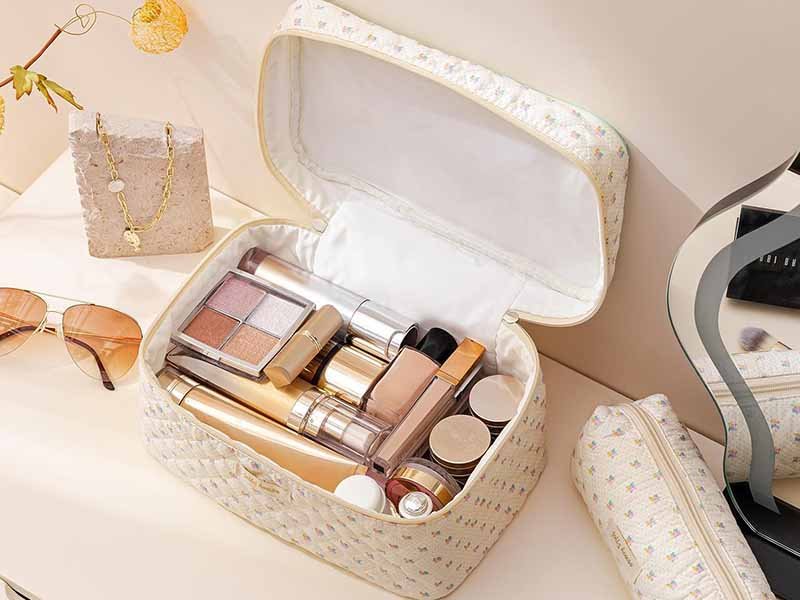
A makeup bag may look like a small and simple product, but in real use it behaves like a high-frequency utility item. It is opened and closed many times a day. It gets packed with bottles, palettes, brushes, metal tools, and sometimes even skincare jars that add unexpected weight. It is squeezed into suitcases, dropped into tote bags, dragged across bathroom counters, and pulled by the zipper when it is overfilled. In many cases, the first part to fail is not the fabric. It is the seam.
Reinforced stitching in makeup bags is the method of strengthening key seams and stress points with higher stitch density, stronger thread, added seam construction, and targeted reinforcement methods such as bar tacks, double stitching, and binding. Its purpose is to reduce seam cracking, prevent zipper separation, improve load-bearing performance, and extend the service life of the bag.
For brands, this detail matters more than many people think. A makeup bag with smooth fabric and attractive printing can still create a poor user experience if the zipper end opens after a few weeks or the side seam bursts during travel. On the other hand, a bag with well-planned reinforced stitching feels more reliable from the first touch. The shape stays cleaner, the zipper line stays stable, and the bag keeps performing after repeated use. That is why customers often describe a well-made bag as “solid,” “structured,” or “premium,” even when they do not know exactly why. In many cases, the answer is hidden in the stitching.
What Is Reinforced Stitching in Makeup Bags?

Reinforced stitching in makeup bags is the method of strengthening seams at key stress points so the bag can handle repeated use, weight, and friction without breaking. It is not simply “stronger sewing.” It is a controlled approach that combines stitch density, thread selection, seam structure, and targeted reinforcement techniques to prevent common failures such as zipper detachment, seam splitting, and corner wear.
In practical terms, reinforced stitching determines whether a makeup bag lasts a few months or continues performing after long-term daily use and travel.
What is reinforced stitching in makeup bags?
Reinforced stitching means adding extra structural support to the areas of a makeup bag that experience the most stress during real use. These areas include zipper ends, side seams, corners, and handle attachment points.
Instead of relying on a single line of stitching, reinforcement improves seam performance through multiple technical adjustments:
- increasing stitch density (more stitches per inch)
- using higher tensile strength thread
- adding secondary stitch lines
- applying localized reinforcement such as bartack stitching
- improving seam allowance and folding structure
A basic cosmetic pouch may use around 6–8 stitches per inch (SPI) with standard polyester thread. A reinforced makeup bag typically increases this to 8–11 SPI, combined with stronger thread and additional reinforcement at key points.
Below is a simple comparison:
| Parameter | Basic Stitching | Reinforced Stitching |
|---|---|---|
| Stitch density | 6–8 SPI | 8–11 SPI |
| Thread strength | Standard polyester | High-strength polyester / nylon |
| Stress-point reinforcement | None or minimal | Bartack / double stitch |
| Seam lifespan | 3–6 months (daily use) | 12–24+ months (daily use) |
This difference becomes visible when the bag is used frequently. Reinforced seams stay tight and stable, while basic seams begin to loosen, shift, or open.
From a customer perspective, this directly affects how the product feels over time. A reinforced bag keeps its structure, opens smoothly, and does not show early signs of damage.
Where is reinforced stitching used in makeup bags?
Reinforcement is applied only where it is needed. These locations are called stress points because they carry repeated force, pressure, or friction.
The most critical reinforcement zones are:
| Area | Real Use Scenario | Risk Without Reinforcement |
|---|---|---|
| Zipper ends | Daily opening and closing | Seam opening, zipper detachment |
| Side seams | Bag filled with cosmetics | Seam splitting |
| Bottom corners | Weight + surface friction | Corner cracking, holes |
| Handle joints | Carrying loaded bag | Handle tearing |
| Opening edge | Pulling during use | Shape distortion |
Zipper ends are the most common failure point. Each time the user pulls the zipper, force is applied directly to the seam. If this area is not reinforced, the seam can open within a short period of use.
Bottom corners also wear quickly because they support the internal weight of items such as glass bottles, metal tools, and compact cases. Without reinforcement, these corners show damage earlier than any other part of the bag.
For structured makeup bags with box shapes, the need for reinforcement is even higher. The sharper the angles and the more defined the structure, the more stress is concentrated at seam intersections.
How is reinforced stitching in makeup bags different?
The difference between standard stitching and reinforced stitching is mainly in performance, not appearance.
A bag with basic stitching may look clean when new, but its seams are more likely to fail under repeated use. A reinforced bag is designed to handle stress over time.
Key differences include:
| Feature | Standard Stitching | Reinforced Stitching |
|---|---|---|
| Stitch rows | Single | Single + additional reinforcement |
| Thread type | General purpose | Higher strength thread |
| Stress-point treatment | Minimal | Targeted reinforcement |
| Load resistance | Moderate | High |
| Long-term stability | Lower | Higher |
Another important difference is how force is handled.
- In basic stitching, force is concentrated along one seam line
- In reinforced stitching, force is distributed across multiple stitches and reinforced areas
This reduces the chance of sudden seam failure.
Reinforced stitching also improves resistance to:
- repeated zipper pulling
- internal pressure from overpacking
- friction during travel
- long-term material fatigue
For customers developing custom makeup bags, this difference affects more than durability. It impacts:
- product return rates
- customer reviews
- brand perception
- repeat purchase behavior
A bag that fails at the seam creates a strong negative impression, even if the material itself is good. A bag that holds its structure over time builds trust and perceived value.
What factors determine reinforced stitching quality in makeup bags?
Reinforced stitching quality is not determined by one factor alone. It depends on how multiple elements work together during production.
The key factors include:
| Factor | Impact on Performance |
|---|---|
| Stitch density | Higher density improves seam strength |
| Thread type | Stronger thread reduces breakage |
| Needle size | Affects fabric damage and stitch stability |
| Seam allowance | Wider allowance improves load distribution |
| Reinforcement method | Bartack, double stitch, binding |
| Operator skill | Affects consistency |
| Machine calibration | Ensures uniform stitching |
For example:
- If stitch density is too low, seams loosen under stress
- If stitch density is too high on coated fabric, material can weaken
- If thread is too thin, it breaks easily
- If thread is too thick, it can damage fabric
This is why reinforced stitching must be adjusted based on material type, bag structure, and intended use.
Why reinforced stitching is a key decision in custom makeup bag projects
When developing a custom makeup bag, many customers focus first on appearance—color, logo, shape, and size. These are important, but stitching determines whether the product performs well after delivery.
Reinforced stitching directly influences:
- how long the bag lasts
- how it performs under daily use
- how customers perceive quality
- how often the product is returned or replaced
For example, a small improvement such as adding bartack reinforcement at zipper ends may increase production time slightly, but it can significantly reduce failure risk in real use.
For mid- to high-end products, reinforced stitching is not optional. It is part of the product’s core quality.
For lower-cost promotional items, reinforcement can still be applied selectively to the most critical areas to improve performance without increasing cost significantly.
Why Reinforced Stitching in Makeup Bags Matters?

Reinforced stitching in makeup bags matters because seam failure is one of the most common reasons a cosmetic bag feels cheap, gets returned, or loses customer trust. Good stitching protects the product at the exact points where real-life use creates damage. It improves durability, reduces complaints, and helps the bag maintain a premium feel over time.
How does reinforced stitching in makeup bags improve durability?
Durability is often misunderstood as a fabric question only. In reality, durability is a system result. Fabric, zipper, lining, foam, edge construction, and stitching all work together. Even a strong outer fabric will not perform well if the seam joining it is weak. A makeup bag does not fail because the material is “bad” in general. It often fails because the material-to-material connection cannot hold under repeated use.
Reinforced stitching improves durability in several specific ways.
First, it spreads force across a larger area. A seam with correct stitch density and proper reinforcement distributes pulling tension instead of letting it collect at one tiny point. This is especially important at zipper ends and panel intersections.
Second, it delays wear growth. Small seam looseness often starts with one or two threads relaxing, one corner rubbing, or one zipper end shifting slightly. Reinforcement slows down that early-stage damage before it becomes visible splitting.
Third, it protects the bag under overpacking. Users do not always follow the intended capacity. A bag designed for cosmetics may also hold skincare jars, charging cables, accessories, and travel items. Reinforced stitching gives the product a safety margin for that behavior.
A simplified durability comparison is shown below:
| Performance Area | Basic Construction | Reinforced Construction |
|---|---|---|
| Zipper-end stability | Moderate | High |
| Resistance to seam opening | Moderate to low | High |
| Corner wear tolerance | Low to moderate | Moderate to high |
| Shape retention after repeated use | Moderate | High |
| Tolerance to heavier contents | Lower | Higher |
In factory testing, stronger seam construction can significantly reduce early failures in pull-stress areas. While exact performance depends on material and design, properly reinforced seams commonly show noticeably better resistance during pull testing and repeated opening-and-closing cycles than single-pass basic seams.
For customers building a custom line, this matters commercially. A makeup bag is often a repeat-purchase or giftable product. If it fails early, the customer does not only judge that one item. They judge the brand behind it. Reinforced stitching therefore supports both product reliability and reputation.
What problems occur without reinforced stitching in makeup bags?
When reinforcement is missing or poorly planned, the same problems appear again and again. These problems do not always show up during factory inspection because new bags usually look fine. They appear after transport, retail handling, unboxing, travel use, bathroom humidity exposure, and repeated opening.
The most common failure patterns include the following:
| Problem | Where It Starts | What the User Notices |
|---|---|---|
| Zipper end opening | Top corner near zipper stop | “The zipper is coming off” |
| Side seam split | Long body seam | “The bag burst when full” |
| Corner seam wear | Bottom edges | “A hole appeared at the corner” |
| Handle detachment | Webbing connection area | “The handle ripped off” |
| Lining seam shift | Inside pocket or lining edge | “The inside is tearing” |
These issues may seem small at first, but they spread quickly. A 3 mm seam opening at the zipper end can become a full opening after a few days of continued use. A little corner wear can turn into visible fraying that makes the whole bag look old.
For brands selling online, these defects create three major commercial problems.
The first is returns. Even if the defect rate is not extremely high, seam-related complaints are taken seriously because they affect function directly.
The second is review damage. A customer may forgive slight color variation or packaging dents, but stitching failure feels like poor workmanship. That kind of comment is hard to offset with branding.
The third is margin loss. Weak construction often leads to replacement shipments, complaint handling time, and lower reorder confidence from wholesale clients.
This is especially important for mid-to-high-end positioning. A customer paying for a better cosmetic bag expects the product to survive travel, daily use, and repeated opening without visible seam weakness. If the product looks premium but fails at the seams, the contrast creates even stronger disappointment.
Is reinforced stitching in makeup bags necessary?
For most makeup bags intended for real use, yes. Reinforced stitching is not a luxury detail. It is a practical requirement. The only question is how much reinforcement is needed and where it should be placed.
Not every makeup bag needs heavy structural reinforcement. A flat giveaway pouch used for light items may need only basic improvement at the zipper ends. A travel organizer with compartments, lining foam, and a carry handle needs a much stronger sewing plan. The right approach depends on the intended use, price level, and product positioning.
Below is a useful way to look at it:
| Product Type | Usage Level | Reinforcement Need |
|---|---|---|
| Flat promo cosmetic pouch | Light | Basic reinforcement at zipper ends |
| Daily-use makeup bag | Medium | Reinforced zipper ends, side seams, corners |
| Travel makeup organizer | High | Full reinforcement at main stress points |
| Luxury structured cosmetic case | Medium to high | Reinforcement plus shape-control sewing |
| Multi-compartment toiletry bag | High | Reinforced seams, handles, binding, zipper supports |
A common mistake is to think reinforcement automatically means high cost. In reality, good reinforcement is about efficient placement. Adding a few seconds of bartack sewing at the correct location can prevent a much more expensive after-sales problem. Reinforcement becomes costly only when the production plan is poorly designed or when unnecessary heavy sewing is added everywhere without logic.
For customers choosing a supplier, the better question is not “Do you reinforce the stitching?” but “Which areas do you reinforce, how do you reinforce them, and how do you control consistency in production?” A professional factory should be able to answer clearly.
For Lovrix, this matters because the company is not only producing bag shells. It works across fabric, webbing, and bag manufacturing systems. That makes it easier to control reinforcement from material selection to final sewing. When a factory understands how outer fabric, zipper tape, webbing strength, foam thickness, and stitching method work together, the final product performs more reliably in real use.
Key Areas That Deserve More Attention in Custom Development
When customers develop a custom makeup bag, they often focus first on size, color, print, logo, and shape. Those are important. But the structural questions below often have a bigger effect on product quality and long-term customer satisfaction.
Which bag details should customers ask about before sampling?
Customers should ask direct construction questions before approving a sample or placing a mass order. Helpful questions include:
- What stitch density is planned for the main seams?
- What thread type will be used for the shell and zipper area?
- Will zipper ends receive bartack reinforcement?
- How are bottom corners constructed?
- Is there a second seam row in high-stress locations?
- How are the lining and shell connected?
- Will handles or pullers be load-tested if included?
These questions help move the conversation from appearance to performance. A supplier that can answer them clearly usually has stronger process control.
Which product combinations increase seam stress the most?
Some combinations naturally put more pressure on the seam system. Customers should pay special attention when their makeup bag includes:
- coated or laminated fabrics
- thicker foam padding
- boxy structured shapes
- double zipper openings
- wide top openings
- carry handles
- hanging hooks
- heavy metal accessories
- glass-bottle storage use cases
These features are all useful, but each one changes how the seams behave. Good custom development means adjusting the stitching plan at the same time as the design features.
Practical Checklist for Customers Reviewing a Sample
Before approving a pre-production sample, it helps to inspect the stitching with a practical checklist instead of only checking visual appearance.
| Checkpoint | What to Look For | Why It Matters |
|---|---|---|
| Zipper ends | Tight finish, no loose gap, no seam opening | Prevents early zipper failure |
| Side seams | Even stitch line, no skipped stitches | Supports body strength |
| Corners | Clean fold, protected stitching, no exposed seam tension | Reduces abrasion damage |
| Thread quality | Smooth, even, no fuzzing or weak breaks | Affects long-term durability |
| Stitch consistency | Similar spacing on both sides | Shows sewing control |
| Lining attachment | Stable, no pulling distortion | Improves inside durability |
| Handle area | Added support stitching if applicable | Protects under load |
It is also useful to do a simple manual test. Open and close the zipper multiple times. Fill the sample with realistic contents. Press the corners. Hold the handle if included. Look at whether the seam line stays flat or starts pulling. These simple checks often reveal more than a static tabletop photo review.
Which Reinforced Stitching in Makeup Bags Is Best?

The best reinforced stitching in makeup bags depends on where the stress occurs and how the bag is used. Different stitching methods serve different structural purposes. Bar tack stitching is ideal for concentrated stress points like zipper ends and handles, while double stitching and box stitching improve overall seam strength and load distribution. The right combination ensures durability without unnecessary cost.
What types of reinforced stitching in makeup bags are most effective?
In real manufacturing, no single stitching method solves all durability issues. A well-constructed makeup bag uses multiple reinforcement techniques together, each applied to specific areas.
Below is a practical comparison of the most commonly used reinforced stitching methods:
| Stitch Type | Where Used | Strength Level | Key Advantage |
|---|---|---|---|
| Bar tack stitching | Zipper ends, handle joints | Very High | Locks stress points tightly |
| Double stitching | Side seams, panels | High | Distributes force evenly |
| Box-X stitching | Handle attachments | Very High | Excellent load-bearing |
| Edge binding stitching | Corners, seam edges | Medium-High | Protects seam from wear |
| Backstitch reinforcement | Seam start/end points | Medium | Prevents seam unraveling |
Each method addresses a different type of stress:
- Point stress → handled by bar tacks
- Linear stress → handled by double stitching
- Load-bearing stress → handled by box stitching
- Friction stress → handled by binding
For example, a zipper end reinforced with a bar tack can withstand significantly more repeated pulling cycles compared to a simple stitched finish. Similarly, double stitching along long seams reduces the chance of seam opening when the bag is overfilled.
The key is not using more stitching everywhere, but using the right stitching in the right place.
Which reinforced stitching in makeup bags handles stress points best?
Stress points are the most critical areas in any makeup bag. These are the locations where failure is most likely to occur under repeated use.
The most effective reinforcement methods for each stress point are:
| Stress Point | Best Stitch Type | Why It Works |
|---|---|---|
| Zipper ends | Bar tack stitching | Locks thread in place, resists pulling force |
| Handle joints | Box-X stitching | Spreads load across multiple directions |
| Side seams | Double stitching | Prevents seam splitting under pressure |
| Bottom corners | Binding + double stitching | Protects against friction + weight |
| Opening edge | Reinforced seam + backstitch | Maintains shape stability |
Bar tack stitching is especially important. It creates a dense cluster of stitches in a small area, effectively “locking” the seam. This is why it is widely used in products that require durability, such as backpacks and luggage.
For makeup bags, even though the product size is smaller, the stress behavior is similar—especially when the bag is fully packed.
Another critical method is box-X stitching, commonly used for handles. It distributes force both vertically and diagonally, making it one of the most reliable load-bearing structures.
How does reinforced stitching in makeup bags increase strength?
Reinforced stitching improves strength by changing how force is distributed across the seam.
In a basic seam:
- Force is concentrated along a single stitch line
- Thread tension is uneven
- Weak points develop quickly
In a reinforced seam:
- Force is distributed across multiple stitches
- Stress is spread over a larger area
- Failure is delayed or prevented
A simplified comparison:
| Feature | Basic Seam | Reinforced Seam |
|---|---|---|
| Load distribution | Concentrated | Distributed |
| Resistance to pulling | Moderate | High |
| Resistance to repeated use | Low | High |
| Failure pattern | Sudden | Gradual |
Another factor is thread friction and locking. Reinforced stitching methods like bar tacks create tighter thread interlocking, reducing slippage.
In addition, reinforced seams often use thicker or stronger threads, increasing tensile resistance.
For customers, this translates into:
- smoother zipper operation
- less seam distortion
- longer product lifespan
Are double seams a type of reinforced stitching in makeup bags?
Yes, double seams are one of the most widely used reinforcement methods, especially for side panels and structural seams.
A double seam simply means adding a second row of stitching parallel to the first. While it may seem simple, it provides several important benefits:
- Increases seam strength by 30–50% (depending on material and thread)
- Provides backup support if one stitch line weakens
- Improves shape retention
- Reduces seam twisting under load
However, double stitching must be applied correctly:
- spacing between stitch lines should be consistent
- tension must be balanced
- thread type must match fabric thickness
If poorly executed, double stitching can actually weaken the material by creating too many needle holes, especially on coated fabrics.
This is why experienced manufacturers adjust stitch spacing and density based on material type.
How Is Reinforced Stitching in Makeup Bags Made?

Reinforced stitching in makeup bags is achieved through controlled production processes, including stitch density calibration, thread selection, machine setup, and operator skill. It is not only about design—it depends heavily on manufacturing execution and quality control.
How do factories control reinforced stitching in makeup bags?
Consistent stitching quality requires process control, not just skilled workers.
Professional factories typically manage stitching through the following:
| Control Area | Method | Purpose |
|---|---|---|
| Stitch density | Machine calibration (SPI setting) | Ensures consistent seam strength |
| Thread tension | Adjusted per material | Prevents loose or tight stitching |
| Needle selection | Based on fabric thickness | Avoids fabric damage |
| Operator training | Standardized sewing methods | Reduces variation |
| In-line inspection | Real-time quality checks | Detects defects early |
For example, stitch density is often controlled using machine settings rather than operator judgment. This ensures that every unit follows the same standard.
Thread tension is another critical factor. If too tight, it can damage fabric. If too loose, seams may open under stress.
Factories with strong systems do not rely on visual inspection alone. They combine machine settings + process standards + inspection checkpoints.
Which materials need reinforced stitching in makeup bags?
Different materials behave differently under stitching. Some require more reinforcement than others.
Below is a practical guide:
| Material Type | Reinforcement Need | Reason |
|---|---|---|
| Canvas / Cotton | Medium | Strong but can fray |
| Polyester / Nylon | Medium-High | Smooth surface, needs secure grip |
| PU / Leather | High | Prone to tearing at needle holes |
| Neoprene | High | Stretchable, needs stable seams |
| PVC / TPU | High | Coated surface, low friction |
For example:
- PU leather can tear if stitch holes are too close
- Neoprene stretches, so seams must stabilize the material
- PVC has low friction, so stitches can slide without reinforcement
This is why reinforcement strategy must match material behavior.
How is reinforced stitching in makeup bags tested?
To ensure stitching performance, factories often use both manual and mechanical tests.
Common testing methods include:
| Test Type | Purpose | What It Measures |
|---|---|---|
| Pull test | Apply force to seam | Maximum load before failure |
| Repeated cycle test | Open/close zipper multiple times | Long-term durability |
| Visual inspection | Check seam consistency | Stitch quality |
| Load simulation | Fill bag with weight | Real-use performance |
For example, zipper durability may be tested by opening and closing it hundreds of times while observing seam stability.
Some factories also simulate real usage by loading the bag with weight and checking whether seams deform or fail.
Testing is especially important for:
- travel bags
- premium cosmetic bags
- high-volume retail products
How does design affect reinforced stitching in makeup bags?
Design decisions directly impact how stitching performs.
Key design factors include:
| Design Element | Impact on Stitching |
|---|---|
| Bag shape | Box shapes increase corner stress |
| Opening structure | Wide openings increase zipper stress |
| Compartment layout | More seams = more stress points |
| Material thickness | Affects stitch density and needle size |
| Load expectation | Heavier use requires stronger seams |
For example:
- A flat pouch requires minimal reinforcement
- A structured travel bag requires multiple reinforcement layers
Good design and good stitching must work together. One cannot compensate for the other.
How to Check Reinforced Stitching in Makeup Bags?
Reinforced stitching in makeup bags can be evaluated by examining stitch consistency, stress-point reinforcement, thread quality, and seam structure. A well-constructed bag will show tight, even stitching, reinforced zipper ends, stable corners, and no visible seam tension or distortion under light stress.
How to identify good reinforced stitching in makeup bags?
For most customers, especially brand owners and sourcing teams, stitching quality is not something you can fully judge from product photos. It requires a closer look and a few simple hands-on checks.
A well-made reinforced seam usually shows the following characteristics:
| Inspection Point | What to Look For | Good Indicator |
|---|---|---|
| Stitch spacing | Even and consistent | No gaps or irregular distance |
| Thread condition | Smooth and tight | No fuzzing or loose ends |
| Seam alignment | Straight and clean | No twisting or offset |
| Stitch locking | Secure start and end | No unraveling |
| Fabric response | Flat and stable | No puckering or deformation |
When inspecting a sample, pay attention to the small details, not just the overall appearance. For example, a seam may look straight at first glance, but under light bending or pulling, weak stitching often reveals itself through slight opening or thread movement.
Another important sign is edge cleanliness. Clean edges usually indicate better process control, while messy edges often suggest rushed production or inconsistent handling.
In addition, always check both outer seams and internal seams. Many defects are hidden inside, especially where lining connects to the outer shell.
Which parts show strong reinforced stitching in makeup bags?
Not all areas of a bag reveal stitching quality equally. Some zones are much more informative because they experience higher stress during use.
Focus your inspection on these key areas:
| Area | What to Check | What Strong Reinforcement Looks Like |
|---|---|---|
| Zipper ends | Tight closure, no gap | Dense stitching or bartack present |
| Bottom corners | Smooth fold, no tension lines | Reinforced seam or binding |
| Side seams | Even stitching, no stretch marks | Double stitching or stable seam |
| Handle attachments | Secure stitching pattern | Box-X or bartack reinforcement |
| Opening edge | Clean shape, no distortion | Reinforced seam line |
Among these, zipper ends and corners are the most critical.
A simple way to test zipper-end strength:
- Hold the bag with one hand
- Pull the zipper at a slight angle
- Observe whether the seam holds firm
If the seam shifts or opens slightly, it is likely under-reinforced.
For corners:
- Press from inside the bag
- Check whether the seam stretches or shows stress marks
Strong corners should feel compact and stable, not loose or fragile.
Are reinforced stitching makeup bags worth it?
From a cost perspective, reinforced stitching adds a small increase to production. From a product perspective, it creates a large difference in performance.
Here is a simplified comparison:
| Factor | Basic Stitching | Reinforced Stitching |
|---|---|---|
| Production cost | Lower | Slightly higher |
| Durability | Moderate | High |
| Customer satisfaction | Variable | Consistent |
| Return rate risk | Higher | Lower |
| Brand perception | Average | Premium |
For most mid- to high-end products, reinforced stitching is a high-return investment.
It helps reduce:
- after-sales issues
- negative reviews
- replacement costs
It also improves:
- product lifespan
- perceived value
- repeat purchase likelihood
For brands selling through e-commerce or retail channels, this difference directly affects long-term profitability.
How to Choose a Reliable Manufacturer for Reinforced Stitching in Makeup Bags?
Choosing the right manufacturer is not only about price or sample appearance. It is about whether the factory can consistently deliver the same stitching quality at scale.
What questions should you ask before placing an order?
Before moving into bulk production, it is important to ask targeted questions about stitching capability:
- How do you control stitch density across production batches?
- What type of thread do you use for high-stress areas?
- Do you apply bartack reinforcement at zipper ends?
- How do you prevent seam opening during load testing?
- What is your inspection process for stitching quality?
A reliable manufacturer should be able to answer clearly and confidently, not vaguely.
How to compare different suppliers effectively?
When comparing suppliers, avoid focusing only on price. Instead, evaluate based on structural quality.
| Evaluation Factor | Weak Supplier | Strong Supplier |
|---|---|---|
| Stitch consistency | Varies between samples | Consistent across samples |
| Reinforcement knowledge | Basic understanding | Clear technical explanation |
| Process control | Operator-dependent | System-controlled |
| Testing approach | Limited or none | Structured testing methods |
| Problem-solving | Reactive | Preventive |
A strong supplier will not only produce what you ask for, but also suggest improvements based on real production experience.
How to balance cost and durability?
Cost control is always part of product development, but reducing stitching quality is one of the riskiest ways to save cost.
A smarter approach is targeted reinforcement:
- reinforce only high-stress areas
- optimize stitch density instead of maximizing it
- choose the right thread instead of the most expensive one
- adjust construction based on material
This approach keeps costs under control while maintaining product performance.
How Lovrix Supports Reinforced Stitching in Makeup Bag Projects
Lovrix operates with an integrated system that combines fabric production, webbing manufacturing, and bag assembly, allowing better control over stitching quality from material selection to final product.
Material + Stitching Integration
Because Lovrix produces both materials and finished bags, stitching strategies are aligned with material characteristics from the beginning.
For example:
- fabric thickness is matched with stitch density
- coating type is considered when selecting needle and thread
- webbing strength is aligned with reinforcement stitching
This reduces mismatch issues that often occur when materials and production are handled separately.
Standardized Reinforcement System
Lovrix applies structured reinforcement standards across production:
| Area | Reinforcement Method |
|---|---|
| Zipper ends | Bartack + backstitch |
| Side seams | Double stitching |
| Corners | Binding or reinforced fold |
| Handle joints | Box-X stitching |
| Opening edges | Reinforced seam |
These are not random choices. They are based on long-term production experience across different bag categories.
Quality Control and Testing
Lovrix uses multiple checkpoints to ensure stitching quality:
- in-line inspection during sewing
- final product inspection before packing
- load simulation testing for selected designs
This helps ensure that reinforcement is not only designed, but also correctly executed.
Customization Support
For custom projects, Lovrix provides:
- reinforcement recommendations based on usage scenario
- sample development with different stitching options
- adjustments based on feedback and testing results
This allows customers to balance durability, appearance, and cost before moving into mass production.
Final Thoughts — Turning Stitching Into Product Value
Reinforced stitching in makeup bags is not a small technical detail. It is one of the key factors that determines whether a product feels reliable or disposable.
Customers may not always describe stitching directly, but they experience it through:
- how smoothly the zipper works
- how well the bag holds its shape
- how long the product lasts
For brands, this directly affects reputation, reviews, and repeat sales.
If you are developing a custom makeup bag line and want to ensure your product performs well in real use—not just in photos—then stitching should be part of your core decision-making.
Start Your Custom Makeup Bag Project with Lovrix
If you are looking to develop durable, well-constructed makeup bags with reinforced stitching, Lovrix can support your project from concept to production.
The team will provide practical suggestions and help you move forward efficiently.
Send your inquiry today and build makeup bags that not only look good—but last.


